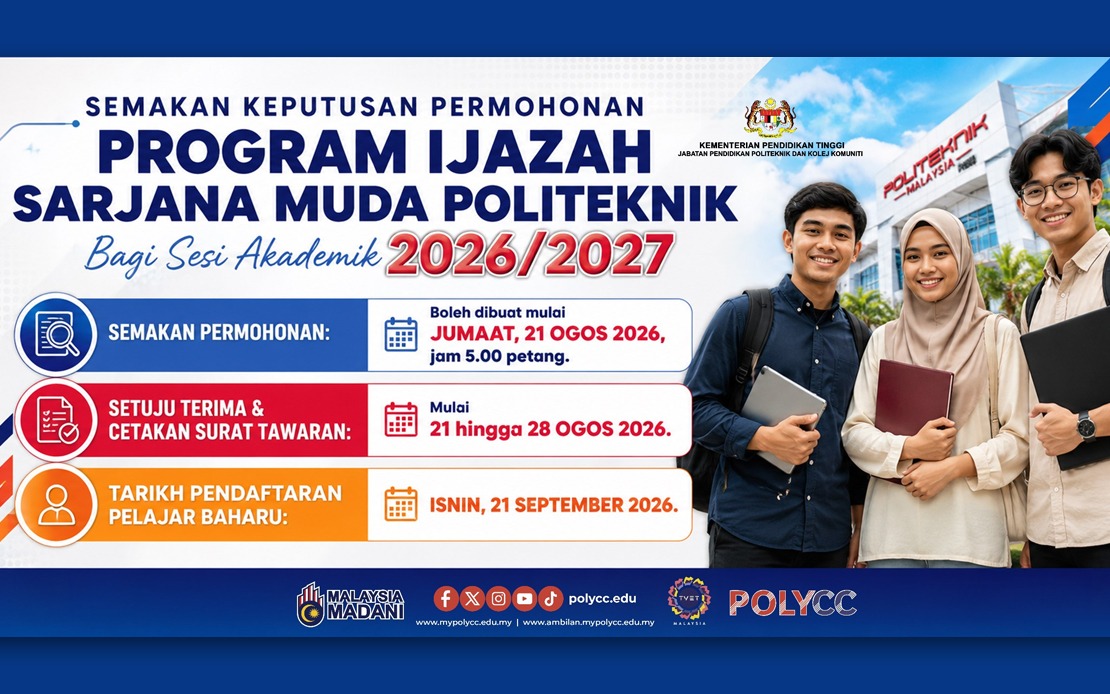
Starting today, prospective students across Malaysia can access their admission outcomes for Bachelor's degree courses at the country's polytechnic institutions. This marks a crucial juncture in the higher education journey for thousands of candidates who applied through the established selection process. Those who have received positive news are now entering the critical window for formal acceptance, as the confirmation period runs through August 28, creating an immediate timeline for decision-making.
The intake encompasses twelve distinct Bachelor's degree programmes distributed across four major polytechnic campuses, each specializing in vocational and technical fields that align with Malaysia's industrial and service sectors. Mechanical Engineering Technology stands alongside Civil Engineering Technology and Built Environment offerings, while Electrical and Electronic Engineering Technology provides pathways into the power and electronics industries. Beyond the engineering disciplines, the programmes expand to include Visual Communication and Design for creative professionals, and Tourism and Hospitality qualifications serving the booming regional travel and hospitality market.
The four participating institutions represent a geographical spread across Peninsular Malaysia designed to provide access to students nationwide. Politeknik Ungku Omar in Ipoh, Perak has long been recognized as a premier technical institution in the northern region, while Politeknik Sultan Salahuddin Abdul Aziz Shah in Shah Alam, Selangor serves the central corridor and greater Klang Valley. Politeknik Ibrahim Sultan in Pasir Gudang, Johor provides crucial technical training capacity for the southern industrial zones, and Politeknik Sultan Azlan Shah in Behrang, Perak rounds out the network by serving both central and northern populations.
The total allocation of 534 places across these programmes reflects deliberate capacity planning by Malaysia's polytechnic education system. This figure represents strategic positioning to meet workforce demands in engineering, infrastructure development, and the growing creative and hospitality sectors. For context, this intake sits within broader efforts to expand technical and vocational education opportunities as alternatives to traditional university pathways, a priority emphasized repeatedly by the Ministry of Education.
Candidates who have successfully gained admission must navigate the acceptance process promptly. The August 28 deadline is firm, meaning students and their families have one week from the results release date to make binding decisions about their tertiary education. This timeline, while standard, underscores the importance of having prepared family discussions and financial arrangements before checking results, as delays in confirmation could theoretically affect placement security.
For those who did not receive offers in this round, the system provides a structured appellate mechanism rather than foreclosing opportunities. Unsuccessful applicants may lodge online appeals beginning today and continuing through September 4, keeping hope alive for late admission through the follow-up allocation process. This two-stage approach has become standard practice in Malaysian higher education admissions, allowing institutions flexibility to fill places while giving borderline candidates a second consideration window.
The first supplementary intake results for appellants will be announced on September 8, giving another week for those candidates to arrange their affairs before the new student registration date of September 21. This staggered timeline, while creating some uncertainty, ensures that polytechnics can finalize their cohorts while managing logistical and administrative challenges across multiple campuses simultaneously.
For Malaysian families, polytechnic Bachelor's degrees represent increasingly credible qualifications in the job market. Unlike technical certificate programmes of earlier eras, these degree-level qualifications from polytechnics now carry currency with employers seeking applied technical knowledge and practical competencies. Graduates emerge ready for immediate deployment in infrastructure projects, manufacturing facilities, design studios, and hospitality operations across Malaysia and the region.
Prospective students requiring guidance throughout this process can contact the Student Intake and Development Division within the Department of Polytechnic Education and Community Colleges, the governmental body overseeing Malaysia's extensive polytechnic network. Given the complexity of managing admissions across multiple institutions and programmes, having a centralized information point reflects acknowledgment that students and parents often need clarification on procedural matters and programme details.
The availability of these Bachelor's degree pathways signals Malaysia's commitment to developing a technically skilled workforce capable of supporting advanced manufacturing, renewable energy installations, smart infrastructure, and sophisticated service industries. As Southeast Asian economies increasingly compete on innovation and technical sophistication, the expansion of polytechnic degree offerings positions Malaysia to nurture talent pools aligned with emerging sectoral needs.

