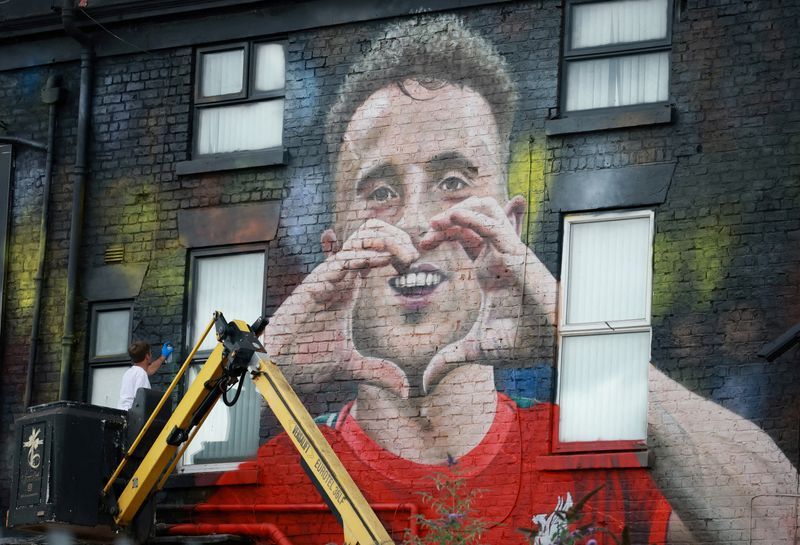
The Portugal national football team enters their World Cup round-of-32 encounter against Croatia in Toronto carrying with them the weight of profound loss. While the match takes place on July 2 in Canada, the calendar at home in Portugal will have already turned to July 3—a date etched into the hearts of an entire nation. Precisely twelve months will have elapsed since Diogo Jota, the 28-year-old Liverpool forward who represented Portugal with distinction and devotion, perished in a catastrophic car accident in northwestern Spain. The tragedy claimed not only Jota but also his brother André Silva when their Lamborghini careened off the roadway and ignited.
The loss of Jota sent tremors through international football and left an indelible mark on the Portuguese squad. His absence extends far beyond the playing field, touching the emotional fabric of teammates, supporters, and the broader football community across Europe. Yet rather than allow grief to overshadow their campaign, Portugal's leadership has deliberately woven Jota's memory throughout their World Cup journey, transforming sorrow into a source of collective purpose and inspiration. Manager Roberto Martinez has spoken of Jota as embodying a special light within the squad, a quality that transcends the technical aspects of the game.
The manner in which Portugal has chosen to honour their fallen teammate demonstrates how football can serve as a vehicle for remembrance and unity. Martinez selected Jota as an honorary member of the World Cup squad, a symbolic gesture that ensures his presence remains tangible within the team's collective consciousness. Midfielder Ruben Neves, whose friendship with Jota ran deep, now wears the number 21 jersey previously associated with his departed friend—a daily affirmation of their bond. Prime Minister Luís Montenegro contributed to these efforts by presenting the players with wristbands bearing Jota's name, embedding the tribute into the fabric of their campaign.
The emotional intensity of these commemorations became vividly apparent when Jota's parents, Isabel and Joaquim Silva, attended Portugal's opening World Cup match against DR Congo in Houston. Witnessing the heartfelt tribute to their son, they struggled visibly to contain their emotions as thousands of supporters and players honoured his memory. These moments transcend sport, revealing how athletic competition can provide a framework for collective grieving and remembrance in the face of tragedy.
Defender Vitinha articulated the psychological complexity surrounding Thursday's fixture, acknowledging the layered motivations propelling the team forward. Beyond the standard imperatives to perform well and advance in tournament competition, the players carry additional weight—the desire to honour Jota's legacy, to play for their families, and to represent an entire nation still processing the shock of his passing. This convergence of personal, familial, and national motivation creates an emotional intensity that extends well beyond conventional match preparations.
The impact of Jota's death extended across international borders, particularly affecting Scotland's squad. Captain Andy Robertson, Jota's teammate at Liverpool and genuine friend, immediately thought of him when Scotland clinched their World Cup qualification in November. The connection between these two professionals illustrated the genuine relationships that develop within club environments, transcending national team rivalries. Jota's widow, Rute Cardoso, reached out to Robertson once the tournament commenced, her message conveying profound gratitude for his refusal to forget her husband. In her words, she expressed how Robertson's decision to carry Jota's memory forward transformed grief into something transcendent—a source of strength rather than despair.
Jota's contributions to Portuguese football extended well beyond his statistical output, though his record alone commanded respect. During his international career, he accumulated 14 goals across 49 appearances for Portugal, establishing himself as a reliable and impactful performer. Notably, injuries prevented him from participating in the 2018 World Cup, making his near-certain inclusion in this year's squad particularly poignant—a World Cup that would have represented a significant milestone in his career arc. His absence from the field, therefore, carries additional weight for those who understood his trajectory and potential.
For his teammates, Jota represented far more than a colleague with whom to train and compete. He embodied a generation of Portuguese players who sustained the nation's status among European football's elite, consistently delivering in moments of importance. His presence in the dressing room extended beyond his playing ability; he was a figure of trust and leadership, a player whose commitment to the national team's cause inspired those around him. The relationships built during major tournaments and qualifying campaigns create bonds that transcend the sport itself.
The precise timing of Thursday's match intensifies the emotional resonance of the occasion. As play commences in Toronto, midnight will approach and then pass in Portugal, marking the exact moment when Jota's absence will be felt most acutely. The simultaneous events—the match in one timezone and the anniversary passing in another—create a poignant reminder of the interconnected nature of modern football, where players and supporters span continents yet remain emotionally united. The game itself becomes a form of tribute, with every goal, every display of skill, and every moment of determination carrying implicit meaning.
Within Toronto's Little Portugal neighbourhood, the significance of Thursday's fixture resonates particularly strongly. Miguel De Silva, a Portuguese-Canadian who operates Amigos da Dundas Sports Bar in that community, recognized how Jota's memory would galvanize the Portuguese contingent. De Silva articulated the perspective held by many: that Jota's legacy provides his teammates with additional motivation, another compelling reason to perform at their highest level. In this view, his memory becomes not merely something to commemorate, but a source of inspiration that could materially affect the team's performance.
While the passage of a year has not diminished the pain of Jota's loss, the machinery of professional football necessarily continues its forward motion. Yet in doing so, Portugal has demonstrated that moving forward need not mean moving past or forgetting. Instead, they have found a way to integrate his memory into their present endeavours, creating a narrative where grief and determination, loss and purpose, become inextricably linked. As the team prepares to face Croatia, they carry with them not only their ambitions for tournament success but also the consciousness that every moment on the pitch represents a continuation of Jota's legacy—a living tribute to a player and person whose impact extended far beyond statistics or achievements.

