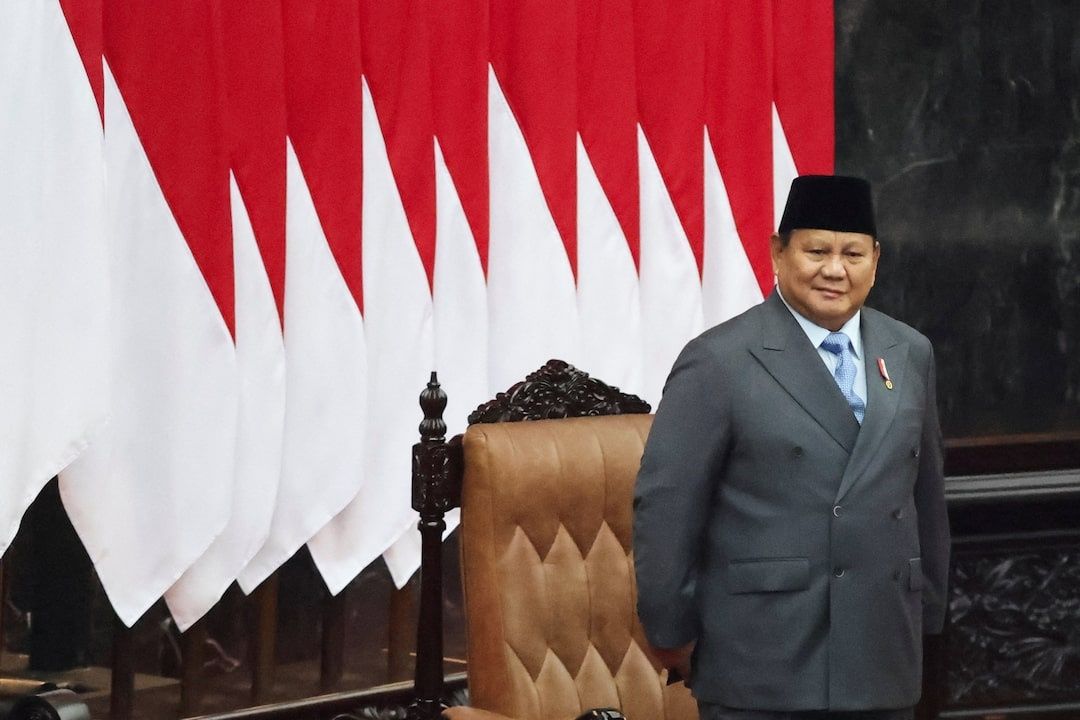
Indonesian President Prabowo Subianto faces a defining moment on Friday when he presents his 2027 budget proposals, arriving at the podium with significantly diminished political capital and mounting scrutiny from global investors questioning his administration's economic direction. The presentation comes as the former special forces commander confronts a dramatic erosion of public backing and market confidence, setting the stage for what analysts describe as a crucial credibility test for both the government and its ability to deliver on sweeping campaign pledges.
Since his October 2024 election victory, which delivered a commanding mandate built on anti-corruption messaging and bold economic targets, Prabowo has struggled to translate political momentum into tangible results. His ambitious agenda promised to accelerate growth from 5% to an aspirational 8%, root out endemic corruption, and fund free meals for millions of schoolchildren. Yet the intervening months have witnessed a succession of economic disappointments and policy complications that have tested investor patience and public goodwill. The rupiah has depreciated significantly, stock market performance has lagged expectations, and concerns about fiscal discipline have mounted alongside whispers of central bank independence being compromised.
The deterioration in Prabowo's standing has been swift and severe. Approval ratings that commanded the confidence of voters less than a year ago have collapsed by roughly 30 percentage points in just eight months, settling at 51% according to recent polling data. Analysts attribute this decline primarily to mounting frustration over economic conditions that have failed to improve, coupled with broader dissatisfaction regarding law enforcement responses and the perceived effectiveness of government initiatives. The combination of macroeconomic headwinds and governance concerns has created a challenging backdrop for budget negotiations and policy announcements.
Perhaps most emblematic of the administration's struggles is the troubled rollout of its flagship free meals programme for schoolchildren, a centrepiece of Prabowo's electoral promises to vulnerable constituencies. The initiative has encountered significant obstacles, including budget reductions that have forced operational scaling-back and allegations of mismanagement that have generated negative headlines and eroded public confidence in programme implementation. These difficulties underscore a broader challenge facing the government: the gap between campaign rhetoric and administrative capacity has proven wider than anticipated.
Central to investor concerns is the government's proposed commodity export control framework, unveiled dramatically during Prabowo's parliamentary address in May. The announcement involved establishing Danantara Sumberdaya Indonesia, a state-owned entity ostensibly designed to centralise exports of critical natural resources. The proposition sent shockwaves through international commodity markets, creating uncertainty about Indonesia's openness to trade and raising questions about potential nationalisation risks. Subsequent clarifications from administration officials suggesting the entity would assume supervisory rather than direct control functions have not entirely dispelled investor anxiety, as fundamental ambiguities regarding its precise operational scope and decision-making authority persist.
The commodity export control proposal carries particular significance for Southeast Asia's largest economy and holds implications extending across the region. Malaysia, as a fellow major palm oil and minerals exporter, will observe closely how Indonesia's policy evolves, particularly regarding whether export centralisation models prove economically effective or generate counterproductive market distortions. Thailand and Vietnam, which compete in various commodity sectors, similarly have strategic interests in understanding how Jakarta's nationalist resource policies might reshape regional trade dynamics and investment patterns.
Analysts from Indonesia's leading financial institutions view Friday's budget presentation as exceptionally consequential. Irman Faiz, an economist at Bank Danamon, characterised the 2027 budget as "one of the most important credibility checkpoints for global investors in recent years," particularly given that international markets have endured multiple policy surprises and reversals across consecutive fiscal years. The erosion of market tolerance for uncertainty means that any additional ambiguity or unexpected announcements could trigger renewed capital outflows and currency pressure.
Fiscal sustainability represents another critical dimension of investor assessment. Indonesia's fiscal deficit stands approximately 2.8% of GDP for 2025, positioning the government dangerously close to the constitutional ceiling of 3%. Should economic conditions deteriorate further or revenue collection disappoint, the deficit could exceed constitutional limits, forcing either painful spending cuts or politically sensitive attempts at constitutional amendment. Prabowo's budget presentation must therefore demonstrate fiscal discipline while simultaneously funding promised social programmes and infrastructure investments, a balancing act that many observers view as increasingly difficult.
The broader context surrounding Friday's address involves not merely budget figures but fundamental questions about the administration's economic philosophy and operational competence. Yose Rizal Damuri, executive director of the Center for Strategic and International Studies, has emphasised that international investors are desperately seeking clarity regarding Danantara Sumberdaya Indonesia's precise mandate and operational framework. Commodity traders similarly remain focused on extracting concrete details about resource export arrangements, as policy uncertainty directly translates into pricing volatility and investment hesitation.
Prabowo's planned programming for Friday attempts to address these mounting pressures through a two-part strategy. His morning Independence Day address will reportedly outline broader policy frameworks and national priorities, while the afternoon budget presentation will provide specific fiscal allocations and revenue projections. This sequencing allows the president to frame his administration's economic agenda within a nationalist and historical context before descending into technical budget minutiae, though observers question whether rhetorical framing can overcome substantive concerns about policy direction and implementation capacity.
Arya Fernandes, head of politics and social change at CSIS, has captured the essential challenge confronting Prabowo: the president must somehow address fundamental economic doubts whilst simultaneously defending ambitious social programmes, all whilst navigating visible market scepticism and public disillusionment. This task represents "certainly no easy undertaking," as Fernandes diplomatically observed, particularly given that the economic conditions providing the rationale for Prabowo's original election victory have not merely persisted but arguably deteriorated.
The implications of Friday's presentation extend beyond Indonesia's borders. Regional policymakers and investors across Southeast Asia view Indonesia's policy trajectory as a barometer for economic nationalism and state intervention approaches more broadly. How Prabowo balances nationalist resource control impulses against investor expectations for openness and rule clarity will influence broader regional investment flows, trade relationships, and perceptions regarding whether major Southeast Asian economies remain committed to market-based economic integration or are drifting toward greater state control models.

