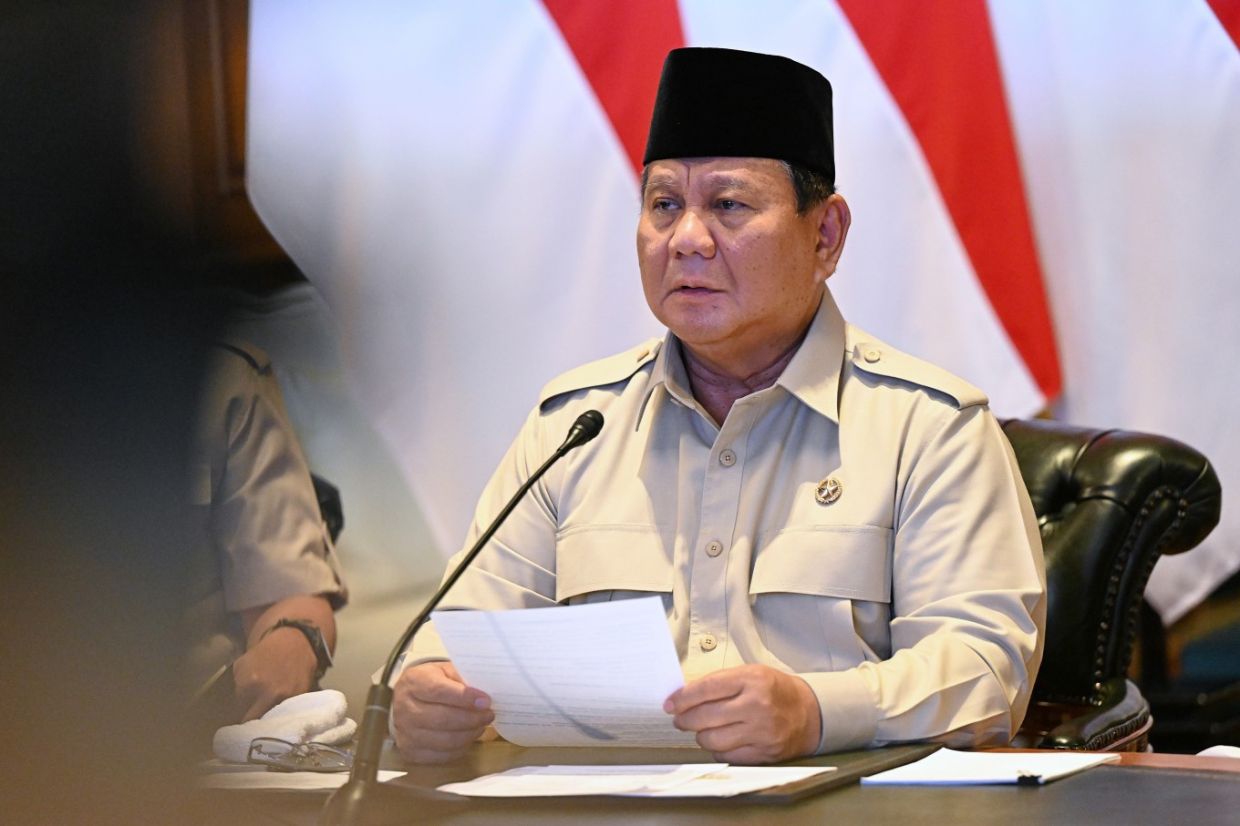
President Prabowo Subianto's political fortunes have shifted dramatically. What once appeared to be an unstoppable tide of public support has reversed course with striking speed, according to fresh polling data from Saiful Mujani Research and Consulting (SMRC). The latest survey, conducted in mid-July 2026, reveals that the Indonesian leader's approval rating has plummeted to 51.1 percent—a precipitous 30-point decline from the 81.2 percent he commanded just eight months earlier in November 2025. The parallel rise in public dissatisfaction, from roughly 16 percent to 46.9 percent over the same period, underscores how dramatically the political landscape has shifted.
When Prabowo took office, few expected his exceptional popularity to evaporate so quickly. For most of his first eighteen months as president, he defied historical patterns that typically see political honeymoons fray within months of inauguration. His sustained approval ratings in the 70 to 80 percent range far exceeded those of his immediate predecessor, Joko Widodo, whose first term began promisingly but collapsed early after a controversial fuel price increase drove his approval down to 41 percent within weeks. The Indonesian public's initial willingness to give Prabowo the benefit of the doubt appeared unusually resilient, suggesting that something more than mere electoral afterglow was sustaining him.
The key to Prabowo's prolonged political advantage lay in strategic social spending initiatives launched early in his tenure. Most significantly, the government's rollout of a free nutritious meal programme beginning in January 2025 provided tangible benefits to millions of Indonesians, particularly lower-income families. This programme, combined with broader social assistance efforts, appeared to translate campaign promises into visible public goods. By extending concrete support to ordinary citizens, Prabowo transformed what might have been a fleeting post-election glow into something more durable. The approach seemed to work brilliantly for nearly a full year, allowing him to maintain popularity levels that eluded even experienced predecessors during their early years.
Yet the July 2026 data reveal that this extended period of goodwill has definitively ended. The decline represents not merely a slight cooling of enthusiasm but a fundamental reassertion of political reality upon public sentiment. According to SMRC executive director Deni Irvani, the deterioration spans three critical areas of public perception. Economic sentiment has soured dramatically, with only 15.7 percent of respondents expressing positive views of the economy in July 2026. Political perceptions have collapsed even more severely, falling from 35.8 percent approval in November 2025 to just 13.5 percent by July. Perceptions of law enforcement performance, though somewhat more resilient, have also weakened at 26.4 percent. Together, these metrics suggest that public frustration is broadly distributed across multiple domains rather than concentrated in any single policy failure.
The underlying economic conditions driving this shift are substantial and increasingly difficult for any government to manage. Indonesia's currency has weakened considerably, the stock market has underperformed, and public anxiety over state spending and central bank independence has grown. These are precisely the kinds of tangible, felt experiences that shape how ordinary citizens evaluate their government. Prabowo entered office with ambitious pledges to curtail corruption and accelerate GDP growth from the recent 5 percent range to an ambitious 8 percent. These campaign commitments are now being weighed against a notably less favourable economic environment than existed when he took office. The gap between what was promised and what appears achievable is widening—the classic dynamic that deflates presidential approval ratings across democracies.
While scepticism about SMRC's political leanings has emerged from Prabowo's coalition, particularly after founder Saiful Mujani became an outspoken government critic, dismissing the survey on that basis alone would be premature. Polling organisations can be both methodologically sound and politically opinionated; the two characteristics are not mutually exclusive. More importantly, SMRC's findings are strikingly consistent with independent data. Indikator Politik Indonesia, a separate polling organisation, surveyed 4,250 respondents in late July and found satisfaction at 49.5 percent—almost identical to SMRC's 51.1 percent figure. Indikator's data also reveals a similar trajectory: 81 percent approval in December 2025 falling to 68 percent by April 2026, then to 49.5 percent by late July. When two independently managed pollsters converge on nearly identical findings, the credibility of the underlying trend becomes difficult to challenge.
Prabowo has not remained a passive observer of his declining fortunes. His administration has maintained an aggressive communications strategy, with the President appearing frequently on television to address the nation, rebut critics, and attempt to shape public narratives. His communications apparatus was deliberately constructed to keep him highly visible and engaged with the public. This assertive approach proved effective when underlying economic conditions provided rhetorical cover—when the fundamentals seemed favourable, presidential statements could fill in gaps created by scattered concerns. However, the July data suggest that this strategy has reached its effective limit. No amount of televised speeches can persuade citizens that the rupiah is stronger than it demonstrably is, that prices have not risen, or that employment prospects have improved. Public judgment ultimately derives from lived experience—prices at the market, the exchange rate when converting currency, job prospects, and whether promised programmes like the free meals initiative actually reach beneficiaries on schedule—rather than from how forcefully a president responds to detractors.
Government insiders acknowledge that the moment demands concrete action rather than rhetorical repositioning. According to officials familiar with recent discussions at the Presidential Palace, Prabowo has convened the National Economic Council (DEN) to chart new approaches to economic policy, recognising that public satisfaction has fallen most sharply in this domain. The administration has signalled an intention to expand social assistance programmes beyond current levels, attempting to recapture some of the goodwill that characterised the free meals programme's early rollout. Additionally, officials are bracing for potential climate disruptions. Forecasts of an El Niño event have raised concerns about agricultural productivity and food price stability, potentially exacerbating household purchasing power pressures precisely when the government least needs additional economic headwinds. The decision to maintain fuel prices unchanged despite global pressures reflects a deliberate calculation that price stability in this critical commodity is essential to preventing further erosion of public confidence.
Beyond these institutional responses, Prabowo's inner circle has also begun consulting the political strategists and pollsters who orchestrated his successful 2024 presidential campaign. These consultations have reportedly generated advice that emphasises two priorities. First, the President should undertake a comprehensive public communication refresh, implicitly acknowledging that current messaging strategies have exhausted their utility. Second, and more substantially, the government should conduct a thorough review of implementation challenges affecting major programmes. The free nutritious meal initiative, for all its conceptual appeal, faces logistical complications in reaching beneficiaries consistently. The Red and White Cooperatives initiative, designed to support small business development, has similarly encountered execution problems that prevent it from delivering on its promise. These implementation gaps matter more than the policies' original design because they translate directly into public experience. A programme that fails to deliver meals on schedule or that creates more bureaucratic hurdles than economic opportunity inherently generates frustration regardless of political messaging.
The scale of Prabowo's approval decline, while dramatic, is not unprecedented in democratic politics. Historical analysis reveals that presidents have recovered from steeper falls than a 30-point drop across nine months. The decline itself is neither inherently catastrophic nor definitional of political crisis. Rather, it represents the normalisation of democratic accountability—the point at which campaign momentum exhausts itself and governing performance becomes the primary determinant of public support. For Prabowo, the critical question is whether his administration can meaningfully address the economic and implementation challenges now constraining public confidence, or whether the current trajectory will continue downward.
The comparison to regional and global precedents offers some perspective. President Widodo faced far steeper early declines and ultimately recovered, sustaining a second term. Contemporary American presidents, by contrast, have struggled to maintain approval ratings anywhere near Prabowo's current 51 percent, with Donald Trump's second term beginning at historically low levels and predecessors Biden and Obama both experiencing sharp early drops from their opening highs. Against this international backdrop, Prabowo retains considerable political space to stabilise or recover his position, provided that economic conditions improve and government programmes demonstrate measurable results in the coming months.
The coming phase of Prabowo's presidency will likely determine whether the current trough represents a temporary recalibration from unsustainably high approval levels or the beginning of a longer, more serious erosion. Public confidence depends far less on communications strategy than on whether ordinary Indonesians experience tangible improvements in economic conditions, employment security, and reliable delivery of promised programmes. The government's recent focus on economic policy review, selective social assistance expansion, and programme implementation reform suggests an administration attempting to respond to public signals. Whether these efforts prove sufficient to halt further decline, and whether economic conditions cooperate with political intentions, remain open questions that will determine Prabowo's political trajectory through the remainder of his term.

