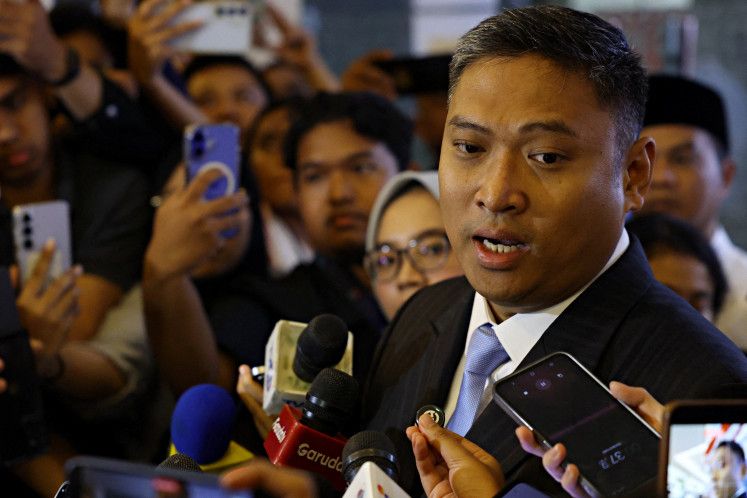
President Prabowo Subianto's signature free nutritious meals initiative has encountered another leadership upheaval, with the recently appointed head of the National Nutrition Agency stepping down and being replaced by a senior minister from the president's own political party. The rapid turnover underscores mounting institutional instability at an agency meant to deliver one of the government's most ambitious social welfare pledges, but which has instead become synonymous with governance lapses and operational chaos.
Nanik Sudaryati Deyang, who had taken charge of the National Nutrition Agency only seven weeks earlier, announced her resignation through a Facebook post on Wednesday, citing a serious heart condition requiring overseas medical treatment. In a particularly candid disclosure, she described the psychological toll of overseeing the programme's massive budget as producing "acute trauma," comparing the weight of fiscal responsibility to "standing on the edge of a steep cliff" where any misstep threatened dire consequences. Nanik's medical revelations suggested that the administrative pressures associated with safeguarding public funds in such a high-profile programme had directly contributed to her physical deterioration, painting a stark picture of institutional dysfunction beyond mere operational setbacks.
Nanik's appointment as BGN chief had itself been an emergency measure. She had assumed the role specifically to restore institutional credibility following the dramatic arrest of her predecessor, Dadan Hindayana, and two of his deputies in a corruption investigation directly connected to the free meals scheme. Dadan's removal came just days after being dismissed by Prabowo in early June, following months of complaints about procurement irregularities and financial mismanagement within the multitrillion-rupiah programme. The expectation had been that Nanik, as a trusted insider who had previously served as Dadan's deputy, could stabilise the troubled agency. Instead, her swift departure highlighted deeper systemic problems that personnel changes alone could not resolve.
Within hours of accepting Nanik's resignation, Prabowo moved to install Sudaryono, the Deputy Agriculture Minister, as the new BGN chief. This appointment represented a particularly revealing strategic choice. Sudaryono brings credentials as a member of Prabowo's own Gerindra Party and previously served as an aide to the president during the 2010s, making him essentially a trusted political lieutenant rather than a technocratic expert in nutrition policy or public health administration. During his inaugural ceremony at the State Palace, Sudaryono pledged to overhaul the agency's governance framework, committing to enhanced transparency through digitalisation of previously manual processes and elimination of opaque decision-making. The timing of such promises, arriving amid an active corruption investigation, suggested the administration was attempting to reassert control over a narrative that had spiralled beyond its management.
State Secretary Prasetyo Hadi acknowledged that recent events fell far short of governmental aspirations, noting that Prabowo had personally directed comprehensive reforms across the entire agency. Prasetyo justified Sudaryono's appointment by emphasising his involvement in designing the free meals programme during its developmental phase, attempting to frame the move as continuity with strategic vision rather than political patronage. Nevertheless, the succession of three BGN heads within roughly eighteen months conveyed institutional volatility and suggested that the programme's problems transcended individual leadership capacity.
The free meals initiative has struggled from its inception in early 2025, facing persistent challenges encompassing food quality disputes, multiple mass poisoning incidents scattered across provinces, inadequate kitchen standards, and widespread allegations of financial irregularities. In attempting to contain the damage, Nanik had implemented a freeze on establishing new meal preparation facilities while subjecting nearly twenty-eight thousand existing kitchens nationwide to comprehensive reviews. This moratorium, though administratively necessary, prompted fierce backlash from thousands of prospective kitchen operators who had made substantial financial investments anticipating programme expansion, transforming food safety measures into a source of political friction.
The budget situation further illustrates the programme's trajectory of contraction and recalibration. The BGN announced a significant reduction in its provisional 2026 budget allocation to 229 trillion rupiah, approximately 12.8 billion US dollars, down sharply from the previously planned 268 trillion rupiah. More dramatically, the beneficiary target for 2026 was reduced to 62.7 million people, representing a substantial retreat from the initial ambition to serve 82.9 million individuals across schoolchildren, toddlers, and pregnant women. The government had originally budgeted 335 trillion rupiah to reach that expanded beneficiary base, meaning the current configuration represents both fiscal and programmatic contraction. BGN deputy chief Agustina Arumsari rationalised the retrenchment by emphasising quality over quantity, indicating that service improvement had become the stated priority rather than pursuing expansion targets, effectively acknowledging that the original programme design had proven unmanageable.
Political analyst Wasisto Raharjo Jati offered incisive commentary on the underlying contradictions plaguing the initiative. According to Wasisto, the free meals programme exemplified a fundamental disconnect between political ambition and administrative preparation, suggesting that while Prabowo had championed the scheme as a defining campaign commitment, the actual institutional machinery required for successful implementation had been inadequately developed. The recurrent governance failures, Wasisto argued, reflected deficient planning architecture from inception rather than representing temporary operational glitches that leadership changes might remedy. This assessment implies that the programme's troubles run deeper than individual competence or corruption, pointing instead toward flawed foundational design and insufficient pre-launch preparation.
For Malaysian observers, Indonesia's experience with the free meals programme offers cautionary lessons regarding the implementation complexities inherent in large-scale social welfare initiatives. The programme's difficulties encompass procurement accountability, quality assurance across dispersed supply chains, corruption prevention mechanisms, beneficiary identification systems, and management structures capable of overseeing operations across an archipelago spanning thousands of islands with vastly different infrastructure capacities. These implementation challenges align closely with issues that any regional government seeking to expand welfare provision must confront, making Indonesia's struggles instructive for understanding the organisational demands of national food security programmes.
The successive leadership crises and budget reductions suggest that the Prabowo administration is entering a phase of damage management and incremental repair rather than programme expansion. The appointment of a political associate rather than an independent technocrat as the third BGN chief within months raises questions about whether reform measures will prove substantive or primarily cosmetic, designed principally to weather immediate political pressure whilst preserving the programme's basic existence. The coming months will reveal whether Sudaryono's digitalisation pledges and transparency commitments translate into genuine institutional transformation, or whether the free meals scheme becomes an example of ambitious political rhetoric constrained by the realities of executing complex public administration across a diverse and dispersed national territory.

