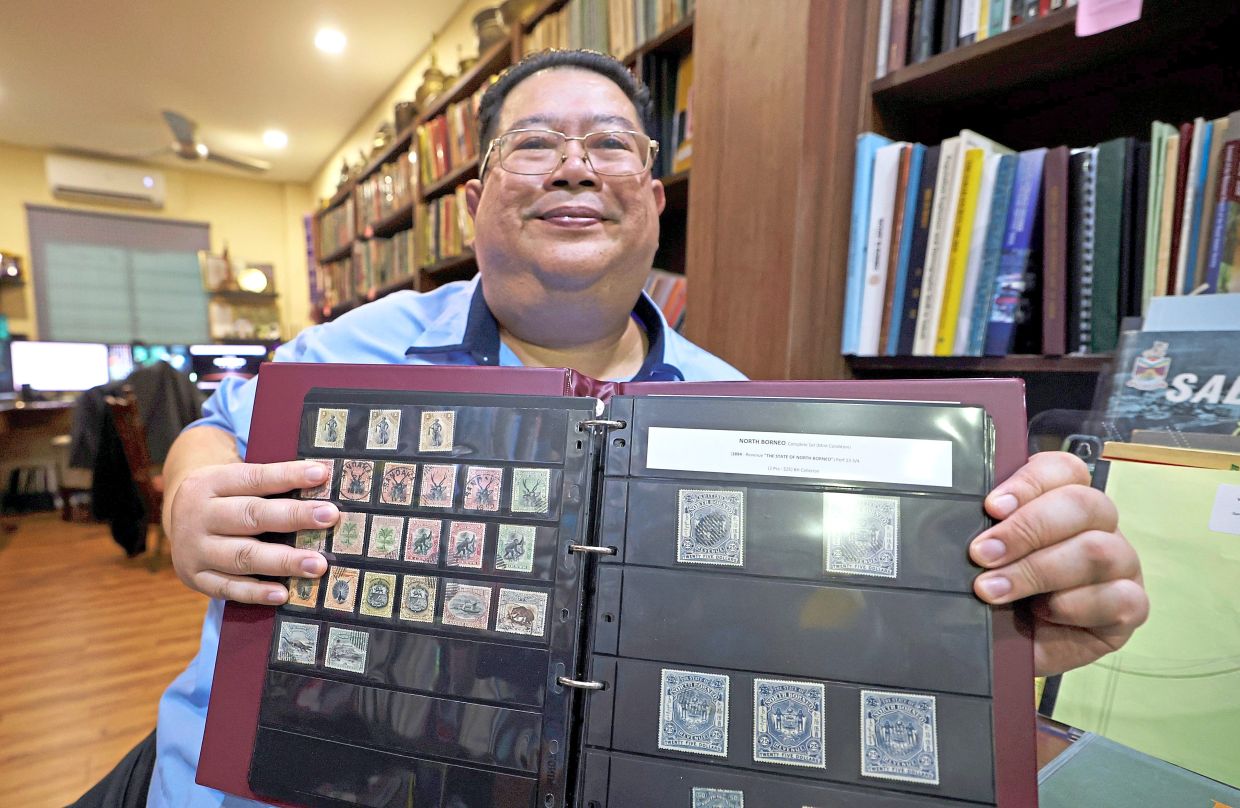
The fragile legacy of North Borneo's postal stamps—issued between 1883 and 1963—hangs in precarious balance as the passion for philately dims among modern collectors. These rare and increasingly scarce artefacts represent far more than decorative curiosities; they constitute what experts describe as a crucial historical record embedded in miniature form, documenting the economic, cultural and political trajectory of Sabah across nearly a century. The challenge facing heritage advocates today is not merely one of acquisition or display, but rather the fundamental question of whether future Malaysians will have the opportunity to engage with this tangible connection to their region's colonial and early post-colonial past.
Dr Shari Jeffri, 56, who heads the Borneo History Association, articulates this concern with particular urgency. Having devoted nearly four decades to philatelic scholarship, he characterises the stamp collection as a "living archive" demanding active stewardship rather than passive storage. His perspective carries weight not merely from academic credentials but from a lifetime spent handling, studying and contextualising these objects. Yet his observations reveal a troubling demographic reality: contemporary enthusiasm for stamp collecting has contracted dramatically compared to previous generations. The pool of genuinely committed enthusiasts continues to shrink, and younger Malaysians typically lack even basic exposure to philately as a hobby or intellectual pursuit. This generational disconnect threatens to sever the knowledge transmission that has historically sustained such specialised collecting communities.
A systematic survey of antique dealers operating in Kota Kinabalu reveals the material consequences of this waning interest. North Borneo stamps have become progressively harder to locate in the market, with valuations fluctuating significantly based on age, physical condition and scarcity. Recent discoveries include notable specimens such as a six-cent denomination issued between 1954 and 1961, featuring Queen Elizabeth II alongside imagery of a Dusun woman—a striking visual testimony to the cosmopolitan character of mid-century Sabah. Equally compelling is a ten-cent stamp from the same period depicting logging operations, which speaks directly to the extractive industries that shaped the region's economic history. Such designs were not arbitrary aesthetic choices but deliberate representations intended to project an image of North Borneo to a distant imperial audience.
Dr Shari's engagement with this field carries a deeply personal dimension rooted in family inheritance. His late grandfather, employed at the Recreation Club Jesselton during the 1920s, acquired his own stamp collection after observing British administrators pursuing the hobby—a reminder that philately functioned as a vehicle for cross-cultural engagement during the colonial era. The grandfather's hope to kindle similar enthusiasm in subsequent generations found expression through young Shari, though the boy did not become an active collector until adolescence. What might have remained merely sentimental memorabilia evolved into serious scholarship when Shari began researching the historical narratives embedded within stamp designs and postal practices. His family collection now includes two remarkable two-cent stamps from the inaugural 1883 issue, adorned with brown sailing boat imagery and bearing complete postmark evidence of authentic historical circulation.
The significance that philatelists attach to the 1883 inaugural series cannot be overstated. For collectors operating within established conventions, possessing an example from this foundational issue represents a non-negotiable marker of collection completeness. Yet the deeper value transcends collecting protocol. Each stamp functions simultaneously as proof of postage and as documentary evidence of a specific historical moment—the infrastructure decisions, the governance structures and the economic relationships that defined North Borneo during the earliest years of organised European colonial rule. The four-decade career that Dr Shari has devoted to studying this material reflects recognition that these small objects compress vast historical information into portable, preservable form.
The North Borneo stamps were first issued in 1883 by the British North Borneo Chartered Company, a private enterprise exercising delegated imperial authority across the territory. This commercial entity maintained postal systems for approximately 52 years before absorption into broader colonial administrative structures. During this comparatively long circulation period, design evolution occurred in deliberate stages reflecting changing imperial priorities and local development. The earliest issues deployed potent symbolic language through imagery of lions, boats and tigers, paired with the Latin motto Pergo et Perago—"I undertake and I achieve." These selections functioned as a comprehensive prospectus directed toward international investors and observers, signalling the territory's stability, resources and potential for profitable development.
By 1894, the design vocabulary shifted markedly toward indigenous content, featuring Borneo's distinctive flora, fauna and wildlife. This transition reflected several simultaneous dynamics: growing confidence in administrative control, increased attention to environmental resources, and recognition that local distinctiveness constituted a marketable brand identity. The 1935 series represents the culmination of this trajectory, projecting a fully articulated regional identity through denominations ranging from two cents to one dollar. Each denomination carried distinctive imagery that cumulatively conveyed a comprehensive portrait of Sabah's natural wealth and human diversity. The designs functioned not as casual decoration but as deliberate assertions of territorial distinction within the broader imperial postal system.
Conservation presents persistent technical challenges that demand specialised knowledge and appropriate materials. Acid-free storage represents the foundational requirement for preventing deterioration, yet many private collectors and even some institutions lack access to such supplies or proper guidance regarding preservation protocols. The adhesive composition and paper quality employed in stamp manufacture provide crucial authentication markers, yet examination requires magnification and comparative reference materials beyond the reach of casual collectors. Stamps bearing complete postal cancellations—including legible dates, office designations, times and locations—command premium valuations among specialists because they provide rich postal and logistical documentation that transcends the nominal face value of postage.
Dr Shari's methodical development as a scholar involved apprenticeship under recognised authorities such as Singaporean experts Voon Kyam Foh and Tan Chun Lim, alongside consultation of specialised reference works including the Commonwealth & British Empire Stamps catalogue. This trajectory reflects the reality that serious philatelic knowledge requires systematic training and access to authoritative comparative materials. Such expertise cannot emerge spontaneously from casual interest but demands deliberate investment in study and mentorship. The scarcity of such trained practitioners raises urgent questions about knowledge succession and the institutional capacity to maintain scholarly standards within Malaysian philatelic communities.
The paradox confronting contemporary heritage stewardship is particularly acute in Malaysia's context. Digital communication has rendered postal stamps functionally obsolete within their original intended purpose, yet this technological displacement has not transferred public attention to their historical significance. Rather, the infrastructure supporting philatelic engagement—the clubs, the publications, the expertise networks—has contracted alongside the practical demand for stamps. North Borneo's collection thus faces a future where preservation depends increasingly upon institutional commitment rather than organic community enthusiasm. Without deliberate intervention establishing appropriate repositories, training new custodians and creating accessible engagement pathways, these artefacts risk fragmentation across dispersed private collections and eventual loss to deterioration or indifference.
The materials spanning from 1883 to 1963 constitute an unparalleled documentary record of Sabah's transformation across three quarters of a century. No alternative source provides equivalent granular detail regarding contemporaneous perceptions of territorial identity, economic orientation and aesthetic priorities. Yet this irreplaceable archive remains vulnerable to forces of market dispersion, environmental degradation and knowledge loss. The imperative for systematic preservation transcends antiquarian concern; it reflects recognition that understanding Malaysia's regional history and the diverse narratives of its constituent territories depends partly upon maintaining access to material evidence that current and future generations can directly observe and analyse.

