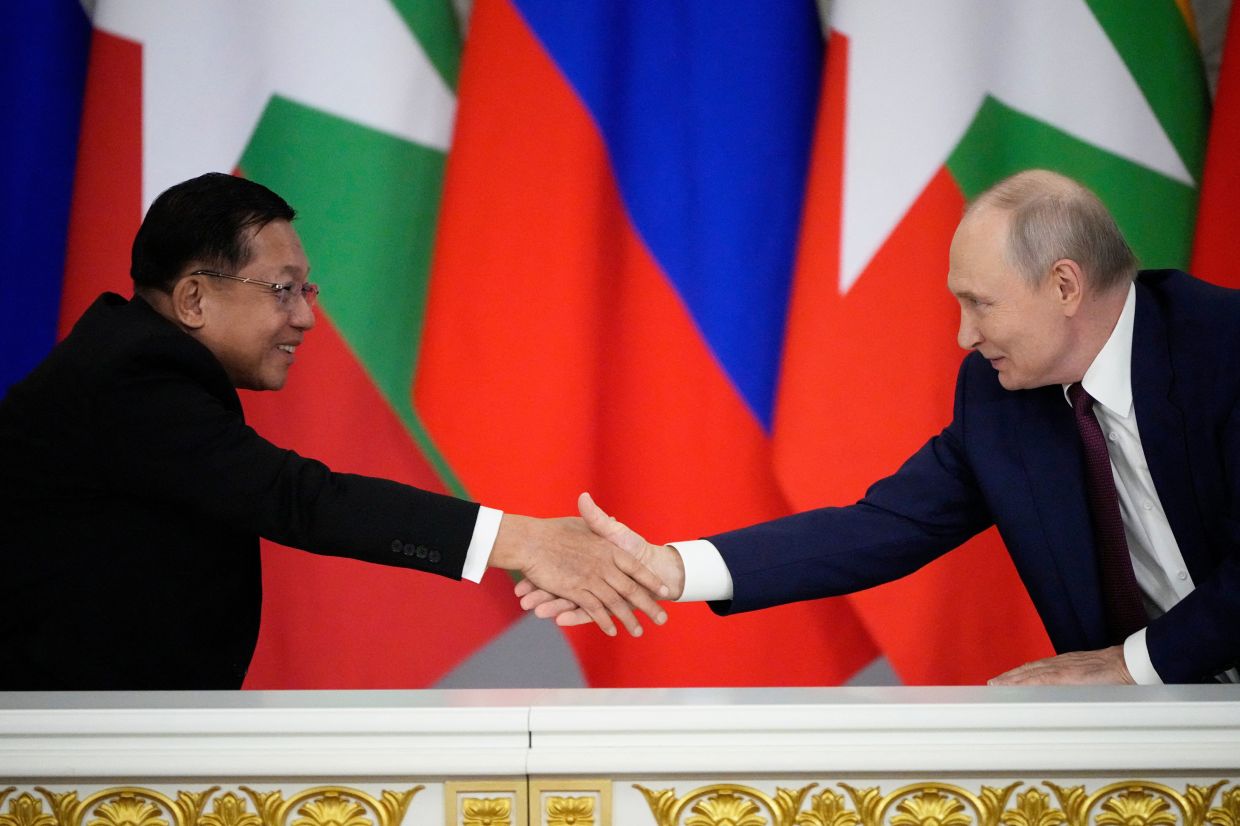
Russian President Vladimir Putin used a high-profile Kremlin meeting on Tuesday with Myanmar's military leader Min Aung Hlaing to underscore the deepening alignment between Moscow and Naypyidaw, characterizing their relationship as increasingly "especially trusting." The encounter marked the first visit by Min Aung Hlaing to Russia since his formal ascension to the presidency in April, though the two leaders have met at least four times since Russia's 2022 invasion of Ukraine set in motion sweeping Western sanctions that fundamentally altered Moscow's global positioning and strategic priorities.
The scale and composition of Russia's diplomatic presence at Tuesday's talks reflected the breadth of bilateral engagement Moscow is pursuing across Myanmar. Putin convened a notably large contingent of high-ranking officials spanning foreign policy, defence, energy, and financial sectors, a deliberate signal that cooperation extends far beyond symbolic gestures. This comprehensive institutional involvement underscores how Myanmar has become a significant piece in Russia's post-sanctions strategic architecture, offering diversification opportunities at a moment when the Kremlin faces severe restrictions on accessing Western markets and technology.
Energy infrastructure ranks prominently among Moscow's ambitions in Myanmar. Putin outlined plans for Russian involvement in constructing a power generation facility and crude oil refinery in Myanmar's southern regions, ventures that would represent substantial capital commitments and long-term operational footprints. Beyond these headline projects, Russia seeks deeper integration into Myanmar's energy sector through geological exploration partnerships and hydrocarbon production ventures. Such economic penetration provides Moscow with strategic leverage while offering Myanmar access to Russian technical expertise and capital—a particularly valuable dynamic given widespread Western reluctance to invest in or support the junta following its 2021 coup.
Nuclear technology cooperation represents perhaps the most symbolically significant dimension of the partnership. Myanmar is collaborating with Russia's Rosatom State Corporation to develop a small nuclear power plant, a foundational project that carries implications extending across healthcare, agriculture, and industrial applications. This nuclear dimension differentiates the Russia-Myanmar relationship from purely transactional defence arrangements, suggesting long-term institutionalisation of Russian involvement in Myanmar's strategic infrastructure. The project also positions Russia as a technological partner capable of delivering sophisticated capabilities that Western countries have effectively denied to Myanmar's military government.
Military and defence cooperation constitutes the relationship's traditional pillar. Russia has functioned as Myanmar's primary weapons supplier since the 2021 coup, with defence transfers exceeding US$400 million according to United Nations assessments from May 2023. Beyond equipment provision, Moscow has cultivated what Putin characterised as "close military and military-technical cooperation," language suggesting training partnerships, joint planning mechanisms, and intelligence sharing that bind the two militaries together institutionally. This deepening military relationship reflects Russia's strategic interest in maintaining presence and influence in Southeast Asia while Myanmar depends upon Russian weapons systems and defence support that alternative suppliers refuse to provide.
Min Aung Hlaing's Moscow visit forms part of a broader diplomatic offensive aimed at rehabilitating Myanmar's international standing following the disputed August 2023 elections that returned military leadership to formal state power. The Myanmar leader has undertaken a systematic regional tour encompassing China, India, Laos, and Thailand, choreographed to demonstrate international engagement and counter narratives portraying his government as a pariah state. Moscow functions as a particularly valuable destination on this itinerary given Russia's willingness to extend legitimacy to Myanmar's military rulers at precisely the moment when Western governments have isolated them.
The timing of this engagement carries significance within broader Southeast Asian geopolitical currents. While Myanmar's military has pursued selective engagement with Western powers and attempted limited reconciliation with the Association of Southeast Asian Nations, its core strategic partnerships increasingly anchor to Russia and China. The Russian connection particularly matters because it provides alternatives to the regional consensus that has grown uncomfortable with Myanmar's internal repression and the junta's refusal to release detained civilian leader Aung San Suu Kyi. By hosting Min Aung Hlaing with considerable ceremony, Putin essentially provided an alternative legitimating venue for a leader facing widespread democratic world scepticism.
Min Aung Hlaing's delegation, which arrived in Moscow on Monday with several cabinet ministers and Myanmar's space agency director, engaged with multiple levels of Russian officialdom beyond Putin himself. Meetings with Prime Minister Mikhail Mishustin and Vyacheslav Volodin, speaker of Russia's lower house, broadened the engagement across the Russian state apparatus. The inclusion of a business forum in the itinerary signalled attempts to catalyse commercial connections between Russian and Myanmar enterprises, though Western sanctions and financial restrictions limit the scope of such cooperation substantially.
Russia's approach toward Myanmar reflects pragmatic post-Western sanctions strategy. Unlike traditional Western strategic partnerships built upon shared democratic values and institutional compatibility, the Russia-Myanmar relationship emphasises complementary interests: Myanmar requires military and energy support and international legitimacy, while Russia seeks strategic footholds, energy partnerships, and alternatives to Western-dominated regional architectures. Putin's explicit praise of "especially trusting" ties represents an inversion of Western diplomatic language, positioning Russia as a reliable partner precisely when others withdraw.
For Southeast Asia more broadly, the deepening Russia-Myanmar partnership illustrates the region's evolution into a multipolar competition arena. Myanmar's systematic cultivation of Russian and Chinese relationships alongside selective Western engagement reflects rational diversification of external partnerships. However, the asymmetries embedded within these relationships merit scrutiny—Myanmar's dependence upon Russian weapons, energy technology, and diplomatic legitimacy creates structural vulnerabilities should Russian priorities shift. The investment in Myanmar's energy infrastructure and nuclear capabilities suggests Moscow intends sustained, institutionalised engagement rather than episodic support.
The broader context involves Russia's reorientation toward Asia following its isolation from Atlantic communities. Myanmar represents one node within Moscow's expanding Southeast Asian network, complementing partnerships with Laos, Vietnam, and Cambodia. However, Myanmar's strategic location along China's southwestern border, combined with its weak state institutions and military governance, makes it particularly valuable for Russia's purposes. The junta's international isolation simultaneously reduces Moscow's costs for deepening support, as Russia faces few countervailing Western pressure mechanisms that might discourage such engagement.
Looking forward, the trajectory of Russian-Myanmar relations will likely deepen across military, energy, and technological dimensions. Putin's emphasis upon economic cooperation and liquefied natural gas partnership suggests Moscow anticipates sustained engagement irrespective of international criticism. For Myanmar, the relationship offers critical support for military consolidation and regime sustainability, though it simultaneously constrains options for eventual reconciliation with Western powers. The Russia-Myanmar partnership thus represents both a stabilising force for the junta's continued rule and a potential complication for eventual regional reintegration.

