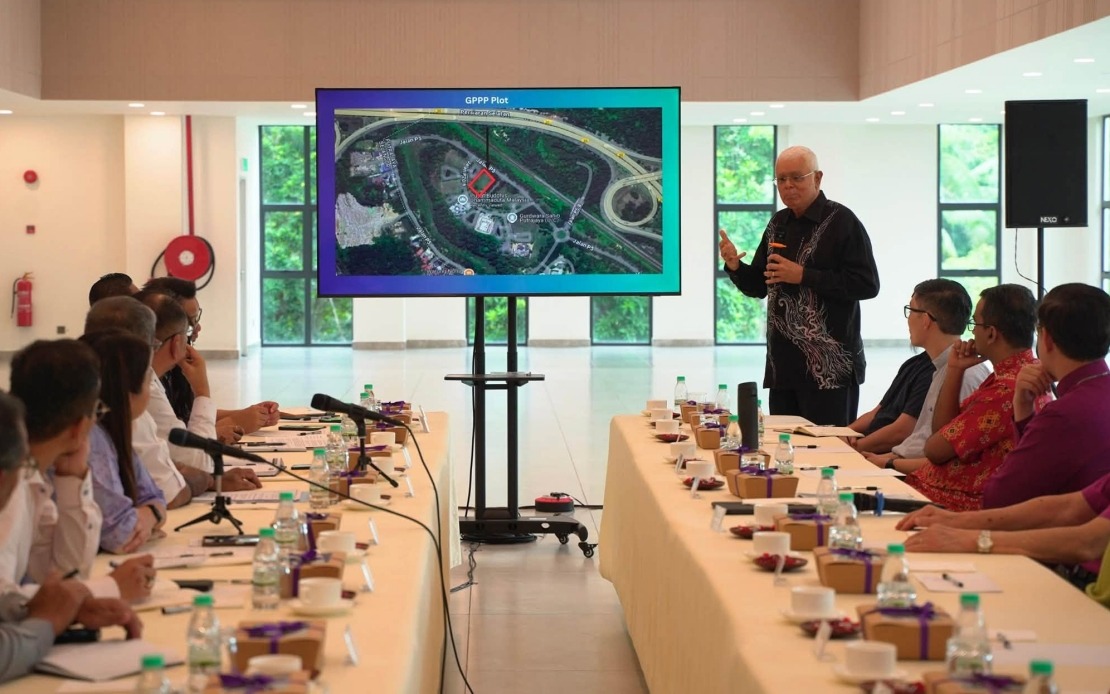
The federal government has formally confirmed a long-standing commitment to religious pluralism through its development of Precinct 20 in Putrajaya as a dedicated interfaith worship district. National Unity Minister Datuk Aaron Ago Dagang disclosed that site allocations for non-Muslim places of worship have been part of the federal territory's planning framework since 2013, reflecting a deliberate policy spanning more than a decade. This announcement carries particular significance as Malaysia navigates complex questions about religious coexistence in federal territories where the government wields direct planning authority.
The designation of Precinct 20 represents far more than bureaucratic land allocation; it embodies a systematic approach to urban design that prioritises religious inclusion alongside practical infrastructure development. Aaron emphasised that the initiative reflects aspirations outlined in Policy 17 of the Putrajaya Structure Plan 2050, which seeks to build an inclusive and compassionate community. By embedding religious diversity into the master planning process rather than treating it as an afterthought, the federal government signals that accommodation of different faiths forms a foundational principle of federal territory development.
The Harmoni MADANI initiative, launched by the National Unity Ministry in 2024, provides the contemporary policy framework undergirding Precinct 20's interfaith vision. This programme explicitly promotes the principle of "Understand, Respect, Accept and Celebrate" across Malaysia's multireligious society, moving beyond mere tolerance toward active celebration of religious diversity. For Malaysian policymakers and urban planners observing Putrajaya's model, the integration of Harmoni MADANI principles into physical urban design offers a template for translating national harmony rhetoric into tangible community infrastructure.
Minister in the Prime Minister's Department (Federal Territories) Hannah Yeoh accompanied Aaron during a visit to the Prince of Peace Church, a recently established congregation within Precinct 20. This ministerial engagement signals high-level political investment in the interfaith project and demonstrates commitment beyond ceremonial acknowledgement. The church's establishment in the precinct validates the government's planning framework and provides concrete evidence that allocated sites are transitioning from theoretical provision to operational worship spaces serving genuine congregational needs.
Precinct 20 has already begun functioning as a functional interfaith district. The Dhammaduta Malaysia Buddhist Centre has operated continuously since 2023, establishing a functional foothold for Buddhist communities within federal territory planning. Simultaneously, multiple additional facilities remain in development stages, creating momentum toward a diverse religious landscape within the precinct. The planned facilities—including Gurdwara Sahib Putrajaya, Dewi Sri Lalithaambigai Alayam, San Qing Taoist Temple, and a Roman Catholic church—represent Christianity, Buddhism, Sikhism, Hinduism, Taoism, and Catholicism, encompassing major faith communities within Malaysia's plural society.
The concentration of multiple places of worship within a single precinct creates infrastructure advantages beyond individual religious practice. Aaron articulated the potential for Precinct 20 to function as an interfaith hub facilitating interaction and dialogue among different communities. Physical proximity combined with shared civic space encourages spontaneous encounters, collaborative initiatives, and organic relationship-building that formal interfaith councils sometimes struggle to achieve. For Malaysian urban planners and community leaders, this model suggests that deliberate spatial design can foster religious understanding more effectively than top-down coordination mechanisms alone.
The development trajectory spanning from 2013 planning through 2024 operational phases demonstrates that establishing inclusive religious infrastructure requires sustained commitment across political cycles and administrative periods. The initial 2013 designation predates the current government, indicating that interfaith urban planning has transcended partisan politics in Putrajaya's federal territory governance. This continuity provides reassurance to religious communities that site allocations represent enduring government commitments rather than temporary political gestures vulnerable to reversal.
Precinct 20's evolution as an interfaith district carries implications for federal territory governance and Southeast Asian urban religious pluralism more broadly. As Malaysia's capital and administrative centre, Putrajaya's approach to religious diversity shapes national policy discourse and provides a model other federal entities may emulate. The physical manifestation of religious inclusion in federal territory infrastructure demonstrates government capacity to translate constitutional commitments to religious freedom into practical urban development outcomes accessible to all communities.
The integration of interfaith considerations into master urban planning, rather than accommodating religious facilities through ad-hoc allocation processes, establishes professional standards for inclusive development in Malaysia. By embedding religious diversity into Policy 17 of long-term structure plans, the federal government normalises religious accommodation as a routine planning category alongside transportation, utilities, and commercial zoning. This institutionalisation creates consistency, predictability, and professional frameworks that protect religious facilities from discretionary administrative interference.
For religious minorities within Malaysia's federal territories, Precinct 20's development represents tangible evidence of government commitment to material support for worship infrastructure. While religious freedom constitutes a constitutional right, access to designated, well-serviced land within planned urban precincts transforms abstract freedom into practical religious observance. The allocation of Putrajaya's planned, resource-rich precinct demonstrates that federal territory governance actively facilitates minority religious practice rather than merely tolerating it.
The broader strategic value of Precinct 20 extends to Malaysia's international reputation and soft power positioning. As a Muslim-majority nation demonstrating institutional commitment to religious pluralism through urban design and infrastructure investment, Malaysia projects an image of inclusive governance that distinguishes it within regional and global contexts marked by religious tensions. The visible presence of Christian churches, Buddhist centres, Hindu temples, Sikh gurdwaras, and Taoist temples within the federal capital provides tangible counternarrative to religious polarisation narratives.

