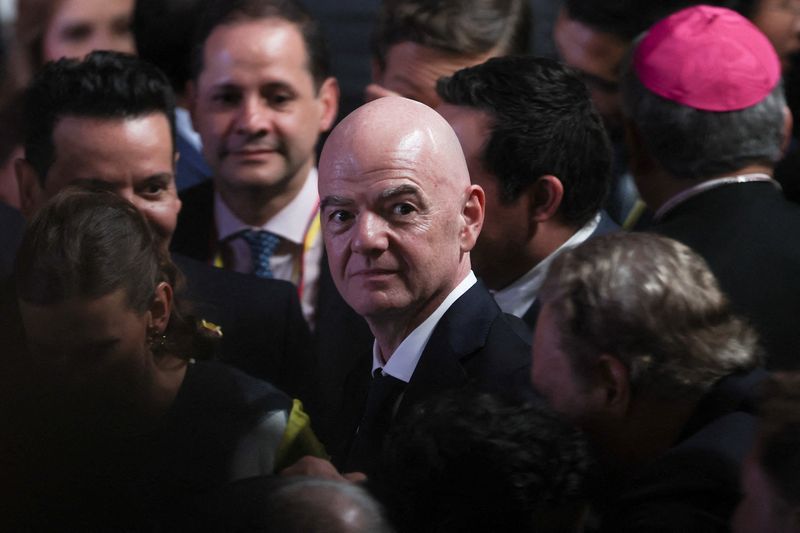
A significant fault line has emerged within Asian soccer governance, threatening to undermine a coordinated regional response to FIFA's leadership crisis. Qatar Football Association President Hamad bin Khalifa Al-Thani has formally objected to the Asian Football Confederation's decision to align with UEFA and CONCACAF in issuing a scathing open letter against embattled FIFA President Gianni Infantino, arguing that the AFC lacked proper authority to speak on behalf of all its member associations without seeking their input.
In correspondence directed to AFC President Sheikh Salman bin Ibrahim Al Khalifa, Al-Thani asserted that neither he personally nor the Qatar Football Association had been afforded advance notice, consultation, or the opportunity to comment on the joint statement before it was released publicly under the AFC's banner on Monday. The Qatari official, who holds dual positions as an AFC Executive Committee member and FIFA Council member, questioned the fundamental legitimacy of the confederation's unilateral action and demanded clarification on what consultation mechanisms, if any, the AFC had employed.
The substance of Al-Thani's complaint goes beyond procedural grievance. He contended that any collective position must be genuinely established through consultation among member associations rather than simply declared into existence by an administrative body. His pointed question to the AFC leadership demanded an explanation of the specific basis upon which it considered itself authorised to represent the interests and positions of all 47 member associations in condemning Infantino's leadership.
This rupture within Asian soccer's ranks comes at a particularly sensitive juncture for FIFA's governance. Infantino, who is preparing his bid for reelection next year, has found himself facing unprecedented institutional pressure from continental confederations. The coordinated statement from UEFA, the AFC, and CONCACAF attacked his conduct directly and explicitly called for his resignation, primarily targeting his ill-fated proposal to commercialise World Cup rights by selling a 20 percent stake to private investors. The scheme, which would have raised approximately $4.2 billion, was abandoned following intense backlash but has severely damaged his standing with key stakeholders.
Qatar's intervention is particularly noteworthy given that the nation has simultaneously positioned itself as a supporter of the FIFA chief. Just days before the AFC's public letter, six heads of Arab national football associations, including Qatar's Al-Thani and Morocco's Fouzi Lekjaa, released their own statement expressing appreciation for Infantino's efforts to advance football globally and strengthen the sport's community-building role. This apparent contradiction reveals the complex and sometimes contradictory interests at play within world soccer's power structures.
The timing of Qatar's challenge also reflects broader geopolitical alignments within Asian and African soccer. Four of the six Arab football chiefs who backed Infantino hold seats on the FIFA Council, granting them significant influence over the organization's direction. Al-Thani, Hany Abo Rida of Egypt, Lekjaa of Morocco, and Ahmed Yahya of Mauritania collectively wield considerable power within FIFA's decision-making apparatus, and their public support for Infantino represents a meaningful counterweight to the Western confederations' attacks.
For Malaysian and Southeast Asian observers, this fractious debate reveals the reality that FIFA governance is far from monolithic. The emergence of an Africa-Arab coalition willing to defend Infantino against Western confederations suggests that the FIFA president retains significant support in the Global South, particularly among nations seeking to expand their influence within world soccer's power structures. This dynamic has profound implications for how continental confederations, including the AFC, will navigate internal disagreements and external pressures.
The AFC's silence in response to Qatar's challenge is itself significant. When contacted for comment, the confederation declined to address the substance of Al-Thani's objections or explain its consultation procedures. This reticence may indicate either confidence that the statement was legitimately issued or discomfort with the spotlight now trained on its internal decision-making processes. Either way, the episode exposes the federation's governance vulnerabilities and raises questions about how member associations exercise voice within its structures.
Moreover, this dispute underscores a fundamental tension within international sports governance. Confederations typically claim to represent their member associations, yet the mechanisms through which they establish genuine consensus remain opaque and often inadequate. The AFC's decision to issue a sweeping statement against a sitting FIFA president without securing explicit approval from all members, particularly those holding FIFA Council seats, represents a significant governance oversight that threatens the confederation's internal cohesion.
For Southeast Asian nations with votes in AFC affairs, Qatar's challenge serves as a reminder that continental bodies do not always operate according to transparent democratic principles. The unilateral issuance of the AFC's statement raises uncomfortable questions about how smaller member associations can meaningfully shape their confederation's positions on major issues affecting world football. If the AFC can act without consulting its Executive Committee members, what guarantees exist that other member nations' interests will be properly considered?
The broader implications for FIFA's institutional stability are equally consequential. A fractured AFC, divided between those supporting Infantino and those opposing him, weakens the confederation's ability to exercise coherent influence over FIFA's direction. This internal discord plays directly into Infantino's hands, as it demonstrates that the global consensus against him is far less solid than the Western confederations' public statements might suggest. The FIFA president can point to Arab and African support as evidence that his tenure retains legitimacy despite UEFA and CONCACAF's calls for his removal.
As the countdown to FIFA's next presidential election begins, the battle for Infantino's future will increasingly turn on such internal alliance-building and procedural legitimacy questions. Qatar's intervention has exposed the AFC's governance challenges while simultaneously demonstrating that the football world remains deeply divided over who should lead FIFA and according to what principles. For Southeast Asia and the broader AFC membership, these manoeuvres among the confederation's power brokers will ultimately shape the region's voice in determining football's future direction at the highest levels.

