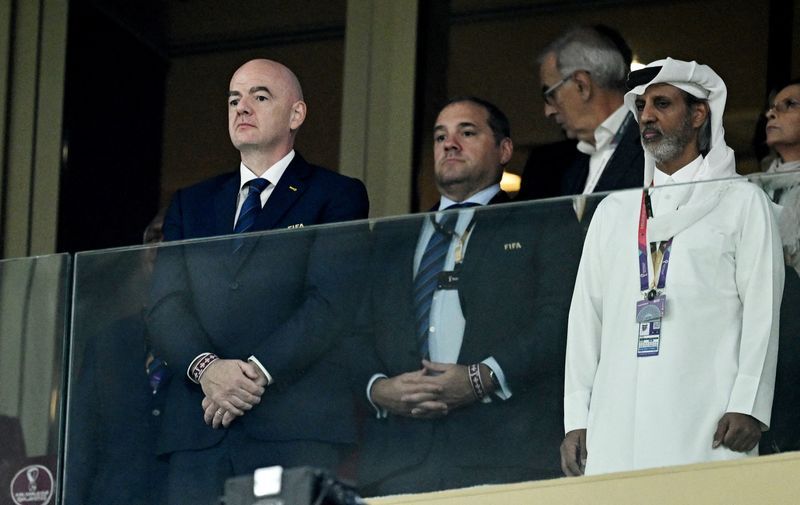
The Qatar Football Association has intensified pressure on the Asian Football Confederation's leadership over what it characterises as a flagrant breach of procedural protocol, issuing a third letter in an increasingly contentious public dispute centred on governance and institutional authority within Asian football's governing structure. The escalation marks an unusually transparent confrontation within the AFC, an organisation traditionally protective of its deliberative processes and reluctant to air internal disagreements through open correspondence.
At the heart of the disagreement lies the AFC's decision to join UEFA and CONCACAF in issuing a statement that criticised FIFA President Gianni Infantino and his conduct surrounding a controversial scheme to attract private investment into World Cup operations. The initiative, which ultimately collapsed amid widespread opposition from continental confederations and member associations, has become a flashpoint in Infantino's bid to secure reelection to his FIFA post in the coming year, with his leadership now facing unprecedented scrutiny from traditionally reliable power bases.
Qatari Football Association President Hamad bin Khalifa Al-Thani, who maintains close ties to Infantino, has repeatedly challenged AFC President Sheikh Salman bin Ebrahim Al-Khalifa's authority to commit the confederation to such a statement without securing prior approval from the AFC's executive committee or seeking input from individual member associations across the Asian region. In his latest correspondence, Al-Thani contended that the AFC's defence of its actions actually constituted an implicit acknowledgment that no meaningful consultation process had occurred before the statement was released under the confederation's name.
This procedural objection strikes at fundamental questions about how football's continental bodies exercise power and make decisions affecting dozens of member nations. The complaint reflects broader anxieties within Asian football about the centralisation of authority among senior officials and the erosion of meaningful consultation mechanisms that ostensibly exist to ensure member associations have voice in decisions taken in their collective interest. For a body representing 47 distinct national football associations with varying interests and priorities, the absence of consultation before issuing a high-profile political statement represents a significant governance failure, regardless of the merits of the underlying criticism of Infantino.
Sheikh Salman's defence, articulated in his Tuesday response, rested on claims that he possessed both the constitutional authority and the institutional responsibility to act decisively in protecting Asian football's interests without requiring explicit prior approval from every constituent member. The Bahraini administrator characterised the Qatari focus on procedural technicalities as a distraction from substantive issues affecting the integrity of the game, suggesting that Al-Thani was prioritising form over substance in a manner that obscured legitimate governance concerns.
Yet this dismissal of procedural objections as mere technicality glosses over a central tension in confederation governance. The precedent being established—that a confederation president can unilaterally commit his body to major political statements without member consultation—carries significant implications for how Asian football conducts its affairs. Qatar's insistence that Sheikh Salman lacked authority to act without executive committee approval and explicit member authorisation reflects a constitutionalist interpretation of AFC governance structures that, if accepted, would fundamentally constrain presidential prerogatives.
The Qatari response also recontextualises earlier AFC statements issued in support of Qatar's hosting of the 2022 World Cup, which Sheikh Salman had invoked as precedent for presidential activism on significant football matters. Al-Thani's distinction—that earlier statements reflected the AFC's own institutional interests in hosting a World Cup on the Asian continent rather than constituting arbitrary presidential action—suggests a more nuanced argument about when and under what circumstances confederation leaders may legitimately act without explicit member authorisation.
Qatar's position within this dispute carries additional weight given Al-Thani's seat on the FIFA Council and the AFC executive committee, granting him direct access to both institutional hierarchies and a privileged vantage point from which to assess compliance with governance protocols. His repeated assertions that Sheikh Salman exceeded his authority thus represents not merely complaint from a peripheral actor but challenge from a senior figure embedded within Asian football's power structure, lending credibility to his interpretation of the confederation's constitutional framework.
The very fact that this exchange has become public and contentious represents an extraordinary rupture in AFC norms and practices. The confederation has historically managed internal disputes through confidential discussions and closed-door negotiations, avoiding the public airing of disagreements that might undermine institutional authority or project disunity to external observers. This escalation to successive open letters, with content selectively disclosed to media outlets, signals the depth of frustration on both sides and the breakdown of channels through which these disputes might normally be resolved.
The silence from the AFC following Al-Thani's latest letter appears telling, suggesting either that Sheikh Salman and his team have exhausted substantive responses or that continuing the public exchange serves no strategic purpose. The AFC may calculate that further justifications will only generate additional rebuttal, extending an increasingly damaging public controversy and potentially encouraging other member associations to voice similar governance concerns that have perhaps remained dormant but unresolved.
For Malaysian football officials and other Southeast Asian confederation members observing this dispute, the implications extend beyond personalities or internal AFC politics. The confrontation raises fundamental questions about how continental bodies should balance presidential authority with member consultation, how decisions affecting multiple nations should be made, and whether AFC structures adequately protect smaller member interests against centralised decision-making. Malaysia and other nations in the region may find themselves forced to consider their own positions on these governance principles, particularly if the dispute eventually requires explicit member votes or formal positions from the executive committee.
The broader context remains Infantino's reelection campaign and the mobilisation of support among traditional voting blocs. Qatar's early alignment with Infantino, combined with its willingness to challenge the AFC's anti-Infantino posture through governance arguments, suggests a calculation that the confederation's letter represents both a substantive threat to the FIFA president's political position and a procedurally illegitimate act that can be contested on technical grounds. Whether this strategy succeeds in undermining the AFC statement's authority or further isolates Qatar within the confederation remains uncertain, but the public nature of the dispute has already inflicted reputational damage on the institution itself.

