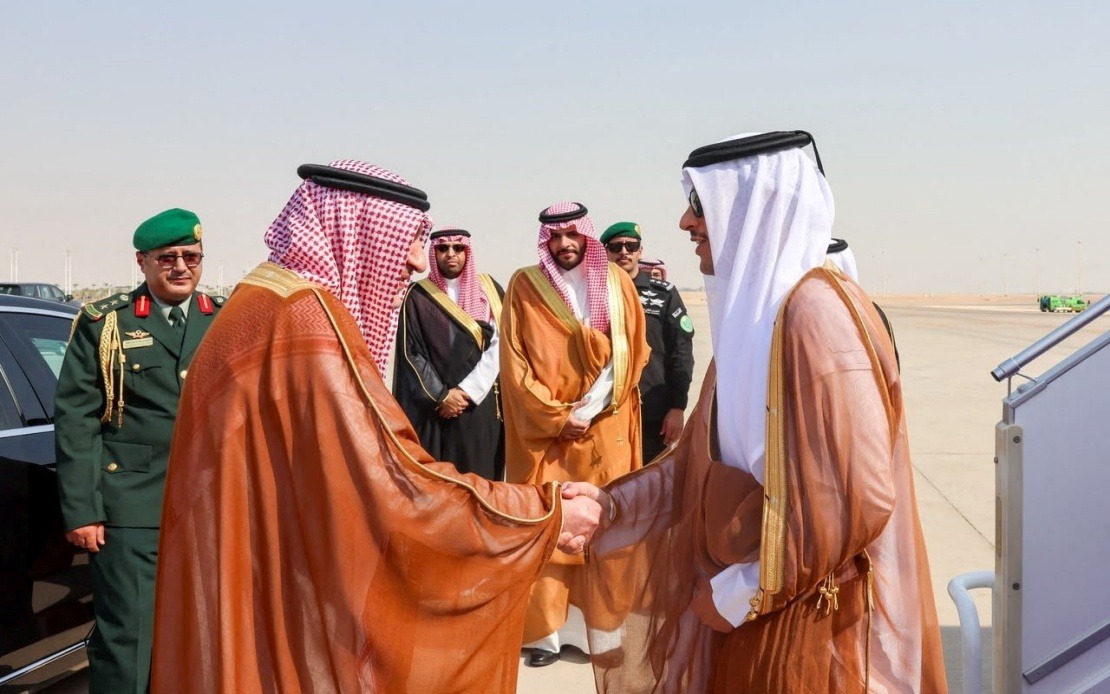
Qatar's Prime Minister and Foreign Minister Sheikh Mohammed bin Abdulrahman bin Jassim Al Thani arrived in Riyadh on Wednesday for a state visit centred on advancing diplomatic solutions to mounting regional tensions. The visit underscores the renewed commitment by two of the Gulf Cooperation Council's most influential members to pursue dialogue-based approaches to the escalating challenges confronting the Middle East.
The Qatari leader's engagement with Saudi Foreign Minister Faisal bin Farhan addressed the full spectrum of bilateral relations and the broader regional landscape, with particular emphasis on coordinated diplomatic initiatives designed to lower tensions and strengthen collective security arrangements. Both officials reaffirmed their commitment to resolving disputes exclusively through diplomatic channels rather than confrontational posturing, signalling a shared conviction that sustained dialogue remains the foundation for regional prosperity.
These discussions reflect a deliberate strategy by Gulf powers to assume greater responsibility for managing regional crises independently of external powers. The emphasis on bilateral coordination and multilateral cooperation suggests that Saudi Arabia and Qatar increasingly view their partnership as essential to moderating tensions that have periodically threatened to destabilise one of the world's most strategically significant energy corridors.
A central theme throughout the Riyadh discussions involved safeguarding freedom of navigation through the Arabian Gulf and Red Sea, waters through which enormous quantities of global energy supplies and commercial cargo transit daily. Both nations recognised that maritime security remains inseparable from broader regional stability, particularly given repeated incidents that have disrupted shipping and escalated tensions between major powers operating in these waters.
The emphasis on protecting trade flows reflects the economic interdependencies binding Gulf states together and the shared vulnerability these nations face from any prolonged disruption to international commerce. For Malaysia and other Southeast Asian trading partners heavily dependent on stable passage through these strategic waterways, the diplomatic progress between Doha and Riyadh carries direct implications for regional supply chains and energy security.
Saudi Deputy Foreign Minister Waleed bin Abdulkarim Al-Khereiji extended formal greetings to Sheikh Mohammed upon his arrival, a ceremonial gesture underscoring the official nature of the visit and the importance both governments attach to the discussions. The diplomatic protocols observed during the reception indicated this represented substantive engagement rather than a routine bilateral exchange.
The timing of this visit carries particular significance given the volatile geopolitical environment characterising the Middle East. Tensions between Iran and the United States have created cascading instabilities throughout the region, directly affecting the strategic calculus of Gulf states. Saudi Arabia's historical alliance with Washington stands in contrast to Qatar's more diversified international relationships, yet both nations recognise that uncontrolled escalation serves neither their interests nor those of the broader international community.
The absence of specific details regarding the visit's duration suggests the discussions may extend beyond preliminary exchanges, potentially involving substantive negotiations on mechanisms for sustained coordination. Longer engagements typically indicate negotiations addressing complex issues requiring detailed discussion and consensus-building among multiple parties.
For Southeast Asian observers, including Malaysia, these diplomatic developments carry important ramifications. The region's prosperity depends significantly on maintaining stability in the Middle East and ensuring unimpeded access to Gulf energy resources and sea lanes. When major Gulf powers like Saudi Arabia and Qatar demonstrate commitment to dialogue and cooperation, this creates a more predictable environment for international commerce and reduces the likelihood of crises that might draw in external powers or trigger broader conflicts.
The Qatari Premier's visit also illustrates how smaller Gulf states can leverage diplomatic engagement to influence regional dynamics. Despite Saudi Arabia's larger military capabilities and regional influence, Qatar's role as a neutral intermediary with extensive international relationships positions Doha as a valuable partner in de-escalation efforts. This balance of influence suggests that solutions to regional problems increasingly require inclusive approaches involving multiple Gulf actors rather than unilateral action by any single power.
Looking forward, the consolidation of Saudi-Qatari cooperation on regional security matters may establish the foundation for more ambitious multilateral initiatives. If sustained, such coordination could eventually extend to encompass other Gulf states and potentially create frameworks for managing specific flashpoints or establishing confidence-building measures that reduce the likelihood of miscalculation.
The emphasis throughout the discussions on coordination of regional and international efforts reflects recognition that contemporary security challenges transcend individual state capacity. Climate change, transnational extremism, cyber threats, and energy transitions require pooled resources and shared intelligence. By strengthening bilateral cooperation, Saudi Arabia and Qatar model the kind of integration that increasingly characterises successful state responses to transnational challenges.
As regional tensions persist and international actors maintain significant presence in Gulf waters, the willingness of major Gulf powers to prioritise diplomatic solutions and mutual coordination provides some reassurance that responsible voices remain engaged in preventing escalation. For Malaysia and other nations with substantial interests in Middle Eastern stability, such diplomatic initiatives merit close attention as indicators of the direction regional geopolitics may take in coming months.

