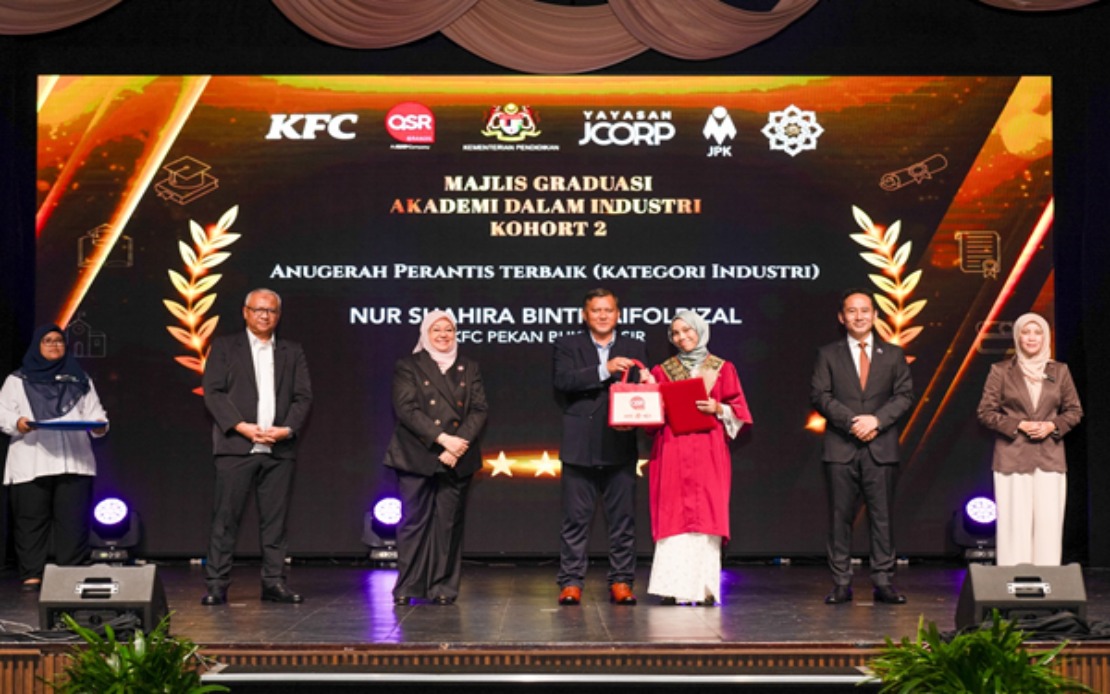
The collaborative effort between QSR Brands and Yayasan JCorp has yielded another cohort of 37 vocational graduates through the Apprenticeship Development Initiative (ADI), marking a significant expansion of workforce development in Malaysia's quick-service restaurant sector. With the completion of this second intake, the cumulative number of workers trained through the partnership has reached 60, demonstrating the growing scalability of a model that bridges formal education with practical industry experience.
The ADI programme represents a distinctive approach to vocational training in Malaysia, having emerged as the first initiative of its kind within the quick-service restaurant industry when it launched in June 2023. The partnership draws together KFC Malaysia as the primary employer-partner, Yayasan JCorp as the facilitating foundation, and backing from the Department of Skills Development under the Ministry of Human Resources alongside the Ministry of Education. This tripartite structure reflects the government's push to integrate private sector expertise with public educational frameworks, creating pathways that conventional schooling alone cannot provide.
For the second cohort, all participants completed their vocational training at KFC outlets in Johor Bahru, where they engaged directly with the demands of fast-food operations. The curriculum focused on the vocational syllabus for Fast Food Preparation and Service, ensuring that each graduate possessed competencies directly aligned with industry needs. Beyond technical skills in food preparation, trainees gained exposure to restaurant management, customer relations, and strict adherence to workplace safety protocols—competencies that employers consistently identify as critical gaps in school-leavers entering the workforce.
The quantifiable outcomes of this cohort underscore the programme's effectiveness. Students achieved a 100 per cent pass rate in Vocational Stream Subjects (MPAK) assessments as well as in the Malaysian Skills Certificate (SKM) certifications at both Level 2 and Level 3. Notably, 95 per cent of participants also successfully sat the Sijil Pelajaran Malaysia (SPM) examination, indicating that the dual-track approach—combining vocational training with academic qualification pursuit—remains achievable. Each graduate received five credentials upon completion: the Vocational Sijil Pelajaran Malaysia (SPMV), dual SKM certifications, a programme completion certificate, and institutional recognition from QSR Brands itself.
Zulkernai Fauzi, director of the Ministry of Education's Technical and Vocational Education and Training (TVET) unit, has identified the ADI model as a benchmark for industry-education collaboration in Malaysia. His endorsement carries particular weight given the government's stated direction toward expanding technical and vocational pathways as counterbalance to Malaysia's historically academic-skewed secondary education system. Fauzi emphasised that the value proposition extends beyond mere certification; graduates emerge with tangible, employer-recognised qualifications paired with practical experience that significantly shortens their adaptation period upon employment.
The inaugural intake, completed in March 2025, involved 23 participants and established the foundational proof of concept. The successful doubling of cohort size in the second round suggests that both institutional capacity and market demand exist to scale the initiative further. This progression matters considerably for Malaysia's broader skills development agenda, particularly as the nation seeks to reduce youth unemployment and equip school-leavers with immediately deployable competencies in an increasingly competitive regional labour market.
Yayasan JCorp chairman Rozaini Mohd Sani positioned the ADI programme as a vehicle for social mobility, stressing that participation opportunities remain accessible to young people irrespective of socioeconomic background or prior academic performance. This inclusivity dimension addresses a critical policy concern in Malaysia: ensuring that vocational pathways do not become repositories for academically underperforming students, but rather genuine alternatives that confer equal dignity and economic prospects. By combining skills training with mentorship and institutional support, the programme seeks to build self-confidence alongside technical competence.
Dr Sharifah Musainah Syed Alwi, chief human resources officer at QSR Brands (M) Holdings Bhd, emphasised that the second cohort's success validates the fundamental premise of the ADI approach: that workplace-based learning, when properly structured and supervised, produces graduates who have already internalised industry standards and expectations. This matters operationally because employers in the quick-service restaurant sector face notorious retention challenges and high training costs. Hiring graduates who have already completed apprenticeships reduces onboarding time and turnover costs, creating a virtuous cycle that incentivises continued participation.
The graduation ceremony also featured recognition of standout performers through the Best Apprentice Award in both the Industry and SPM categories, as well as a dedicated award for exceptional apprenticeship documentation. These distinctions signal that the programme values not merely technical competence but also professionalism, thoroughness, and commitment—attributes that extend employability beyond the initial hiring decision and support career progression within the hospitality and food-service sectors.
For Malaysia's broader developmental context, the ADI initiative illuminates pathways that other sectors might emulate. The food-service industry's participation is particularly strategic given its labour intensity, its role as a traditional entry point for school-leavers, and the relative ease of standardising training delivery across multiple outlets. Sectors such as hospitality, retail, logistics, and light manufacturing face analogous workforce challenges and could theoretically adopt similar collaborative models. The Ministry of Education's explicit endorsement of the ADI framework as a template suggests that expansion into additional sectors and companies may become policy priority.
Looking forward, the cumulative 60 graduates represent a modest but meaningful contribution to Malaysia's skilled workforce in a sector that directly employs hundreds of thousands of Malaysians. The programme's sustainability will depend on whether QSR Brands continues its commitment and whether other major quick-service restaurant operators launch comparable initiatives. Additionally, the expansion of ADI-style programmes into other industries will determine whether this model transitions from isolated corporate social responsibility exercise to systemic component of Malaysia's vocational education infrastructure, ultimately shaping how the nation prepares youth for employment in the post-secondary stage.

