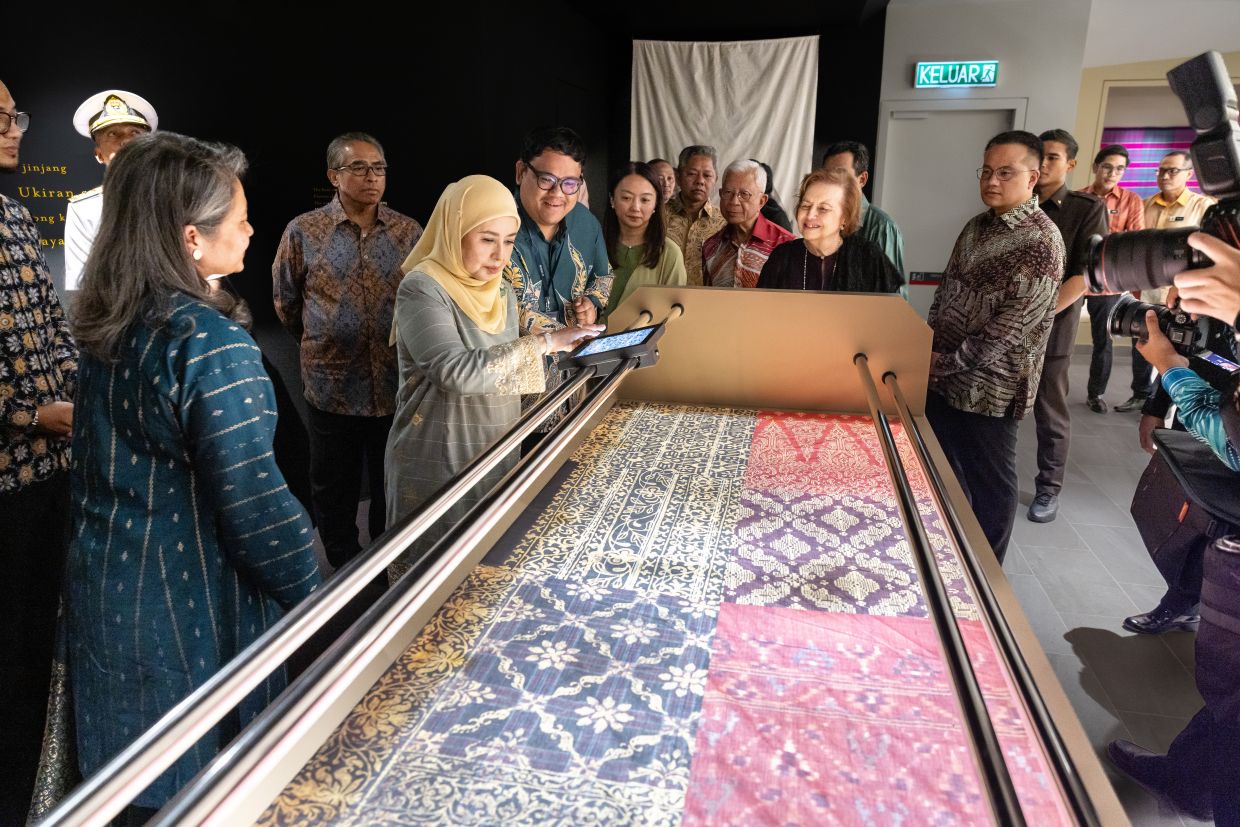
Queen Raja Zarith Sofiah opened the Merdeka Textile Museum yesterday at the Menara Merdeka Maybank compound in Kuala Lumpur, marking a significant step in preserving Malaysia's rich textile heritage. The ceremonial launch, attended by prominent government officials including Hannah Yeoh and Chief Secretary to the Government Tan Sri Shamsul Azri Abu Bakar, underscores the national importance placed on safeguarding traditional craftsmanship and cultural knowledge that defines the Malay world.
Established by PNB Merdeka Ventures Sdn Bhd, a subsidiary of the state-linked investment vehicle Permodalan Nasional Berhad (PNB), the museum represents a deliberate institutional commitment to transforming textile traditions into accessible learning experiences. Rather than presenting artefacts behind glass in conventional museum fashion, the venue employs contemporary storytelling methods and interactive installations to engage diverse audiences, recognising that cultural preservation must resonate with modern sensibilities to remain relevant.
Her Majesty articulated a vision of cultural stewardship that extends beyond passive conservation. In remarks shared through Sultan Ibrahim Sultan Iskandar's official social media channels, the Queen emphasised that every nation bears responsibility for appreciating, safeguarding and transmitting its heritage to succeeding generations. This framing positions textile preservation not as antiquarian nostalgia but as essential work in maintaining Malaysian identity and social cohesion in an era of rapid globalisation.
The museum's foundation rests upon an extraordinary personal collection assembled by the late Sharifah Azah Syed Mohammed Alsagoff, known professionally as Azah Aziz. Her background as the spouse of the late Prof Diraja Ungku Abdul Aziz Abdul Hamid and mother of former Bank Negara Malaysia governor Tan Sri Dr Ungku Zeti Akhtar Aziz afforded her unique access to Malaysia's cultural and intellectual circles. More significantly, her scholarly engagement with textile arts and Malay traditions established credibility that transcends familial connection, positioning the collection as substantive historical documentation rather than mere heirlooms.
The physical holdings demonstrate considerable breadth and cultural specificity. Two hundred and forty garments form the textile core, encompassing ceremonial and everyday wear that traces evolving aesthetics across generations. Sixty-nine traditional jewellery items supplement these textiles, including pieces crafted through goldwork techniques such as Tekat Emas. The inclusion of songket sarongs and Limar Baju Kurung—garments requiring extensive hand labour and representing regional stylistic variations—ensures the collection captures both common and exceptional examples of Malay material culture.
Theologically and intellectually, the museum draws sustenance from Azah Aziz's own research endeavours into textile traditions. Rather than treating her collection as a static bequest, the institution activates her scholarly legacy, positioning textiles as documents worthy of intellectual investigation. This approach acknowledges that understanding why particular design choices emerged, which communities favoured specific techniques, and how garments functioned within social hierarchies demands rigorous study, not merely aesthetic appreciation.
The eight-gallery layout provides spatial organisation necessary for thematic exploration while preventing exhibition fatigue. More consequentially, the integrated study centre addresses the technical demands of textile scholarship. A conservation laboratory ensures pieces receive professional preservation treatment combating humidity, insect damage and photodegradation. The fabric library permits hands-on examination of weaving structures and dye composition, transforming abstract textile knowledge into tactile understanding. The textile knowledge centre provides reference materials and research infrastructure, positioning the museum as an active site of intellectual production rather than passive display.
For Malaysian women particularly, Her Majesty identified the museum as an inspirational resource. This gendered framing reflects recognition that textile production, wearing, and transmission of textile knowledge have historically fallen disproportionately upon women, from weavers and seamstresses to mothers teaching daughters ceremonial dress codes. By elevating these traditions through institutional validation, the museum acknowledges women's cultural labour and positions contemporary Malaysian women as inheritors of sophisticated technical and aesthetic traditions.
The Queen's emphasis on preventing cultural loss carries particular urgency within Southeast Asia's contemporary context. Younger generations, increasingly mobile and digitally connected, may not absorb traditional knowledge through family channels. Urbanisation and economic restructuring have displaced communities whose livelihoods centred on textile production. Without institutional intervention, techniques perfected across centuries risk extinction within single decades. The museum thus functions as cultural rescue operation, stabilising endangered knowledge before transmission networks collapse entirely.
PNB's stewardship signals investment community recognition that cultural infrastructure constitutes legitimate public asset. Unlike purely commercial retail or entertainment venues, museums generate value through education, research capability and soft power contributions—benefits difficult to quantify on conventional balance sheets yet significant for national standing. The location within Menara Merdeka Maybank, a financial services landmark, symbolically integrates cultural preservation into mainstream economic institutions rather than marginalising heritage as niche concern.
Regionally, Malaysia's museum initiative contextualises within broader Southeast Asian efforts to validate indigenous knowledge systems against homogenising global consumer culture. Indonesian batik, Thai silk weaving, and Philippine textile traditions face similar pressures. The Merdeka Textile Museum establishes precedent for institutional approaches that other nations might adapt, potentially fostering regional scholarly networks and cooperative conservation efforts that strengthen collective Southeast Asian cultural positioning.
The Her Majesty's call for youth engagement acknowledges that heritage preservation ultimately depends upon generational willingness to invest intellectual energy in traditions. Museums function most powerfully when they inspire rather than instruct, providing spaces where young Malaysians encounter textile arts as living rather than dead knowledge. This experiential approach—interactive rather than didactic—recognises that durability of cultural traditions correlates with perceived contemporary relevance.

