Malaysia's cardiac emergency landscape demands urgent intervention. Sudden cardiac arrest remains among the nation's leading killers, striking without warning and leaving mere minutes for life-saving action. Current survival rates between 0.5 and 8.5 per cent reflect a harsh reality: too many deaths that medical experts believe could be prevented. The fundamental challenge is not lack of willingness to help, but rather the critical time gap between collapse and treatment. Every minute without cardiopulmonary resuscitation significantly erodes a patient's chances, with survival plummeting after eight to ten minutes pass. This grim arithmetic has spurred Sunway Medical Centre Velocity to launch an ambitious initiative designed to shrink that fatal window through wider access to automated external defibrillators and enhanced public training.
The hospital's expanded programme represents a strategic departure from treating emergency response as a hospital responsibility alone. By positioning life-saving equipment at multiple public nodes across Kuala Lumpur, Sunway Medical Centre is essentially arming bystanders and staff at high-traffic locations with tools previously confined to ambulances and clinical settings. The installations span transportation arteries including Tun Razak Exchange, Bukit Bintang, Ampang Park and Muzium Negara MRT stations, and extend into commercial spaces such as Aquaria KLCC and the Public Bank tower offices. Stadium Merdeka's National Heritage Building within the Merdeka 118 Precinct has also been identified as a priority site, recognising that cardiac emergencies spare no setting, whether leisure venues, transit hubs or workplaces.
Dr Wee Tong Ming, the hospital's Medical Director and Emergency Physician consultant, articulated the core insight driving this expansion: survival often hinges not on the absence of help, but on response delays and equipment shortages. His observation cuts to the heart of Malaysia's emergency preparedness gap. In urban settings like Kuala Lumpur, formal emergency services exist, yet the biological clock of cardiac arrest runs faster than any ambulance dispatch system. By embedding defibrillators within the community fabric, the hospital aims to collapse response times from minutes to seconds. Each installed unit comes paired with a clearly visible standee and QR code linking to guidance materials, removing ambiguity that might paralyse untrained bystanders during crisis moments.
Corporate social responsibility framing for this initiative reflects broader shifts in how Malaysian healthcare institutions conceptualise their duty to the public. Rather than confining intervention to clinical walls, Sunway Medical Centre positions emergency preparedness as a shared civic responsibility. The "Save A Number, Save A Life" campaign branding emphasises that survival correlates directly with collective action. This reframing matters particularly in Malaysia's context, where public health infrastructure remains unevenly distributed and where private healthcare institutions' willingness to extend resources into public spaces can meaningfully reshape outcomes for entire urban populations. The QR codes linking residents to campaign materials on GP clinic walls further suggest efforts to reach beyond clinic visitors to broader community networks.
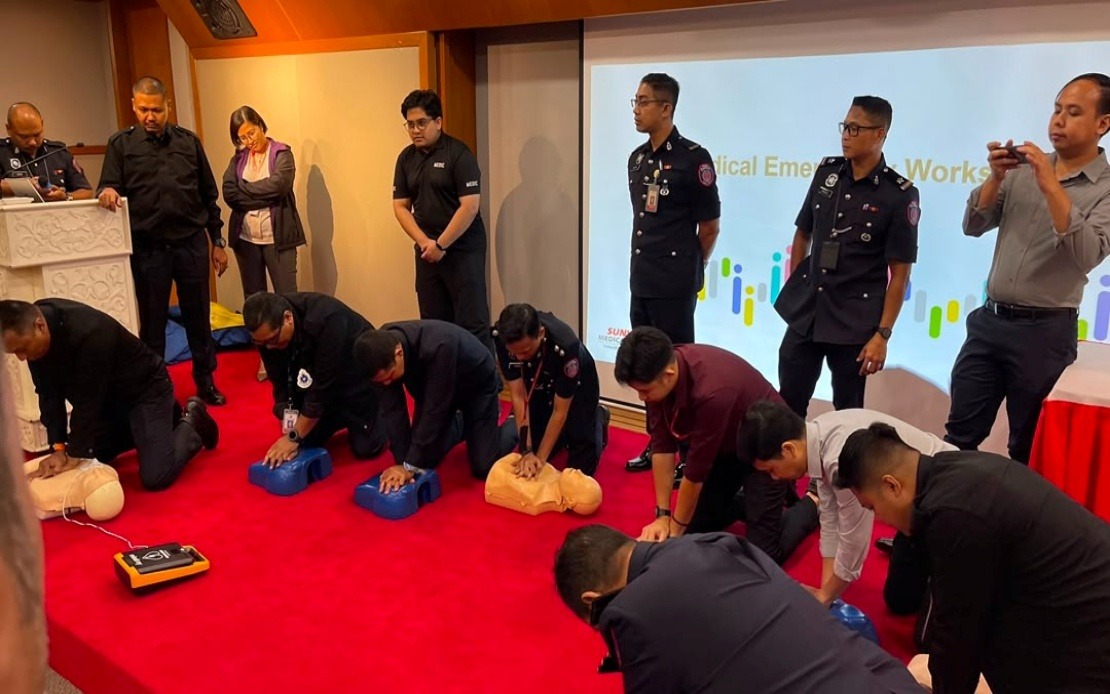
The public awareness dimension deserves particular scrutiny, as equipment without knowledge yields limited benefit. Sunway Medical Centre has coupled defibrillator deployment with on-site training sessions and A&E awareness talks targeting both public members and staff at installation sites. These sessions emphasise symptom recognition, CPR technique and proper defibrillator operation. Such training addresses a pervasive knowledge gap where many Malaysians understand intuitively that cardiac emergencies are serious but lack confidence in their own response capacity. By normalising CPR and defibrillator training through workplace and public venue sessions, the hospital attempts to shift cultural norms around medical emergency response from passivity and panic to informed action.
CEO Susan Cheow's framing that "no one should feel helpless" during medical emergencies reflects an important philosophical shift. Traditionally, Malaysian public discourse around healthcare has emphasised deferring to medical professionals, with laypeople positioned as passive recipients rather than active participants in survival chains. This campaign consciously repositions bystanders as essential links in the life-saving chain. Such psychological reframing carries implications beyond cardiac arrest alone; it potentially cultivates a broader culture where Malaysians feel empowered to intervene competently in health crises rather than waiting for official responders. This empowerment dimension may prove as valuable as the physical defibrillators themselves.
The strategic location selection reveals sophisticated epidemiological thinking about where cardiac emergencies cluster. High-traffic transit nodes, commercial hubs and leisure venues represent collision points where population density, visitor unpredictability and average age profiles create conditions for sudden cardiac events. MRT stations particularly serve diverse commuter populations including elderly residents whose cardiac risk profiles are elevated. Aquaria KLCC draws family visitors whose medical histories may be unknown to accompanying parties, creating situations where trained bystanders become essential. This targeted deployment approach maximises potential lives reached relative to defibrillator units deployed, a critical consideration given equipment costs and maintenance requirements.
Malaysia's position within the Southeast Asian context adds relevant dimension to this initiative. Regional cardiac mortality and morbidity data suggests wide variation in emergency response infrastructure, with gaps most pronounced in semi-urban and rural settings. Kuala Lumpur's experience with this Sunway Medical Centre initiative may offer instructive models for other Malaysian cities and regional peers. If the programme demonstrates measurable improvements in survival rates among cardiac arrest cases occurring near defibrillator locations, the evidence base for broader rollouts strengthens considerably. Documentation of training effectiveness and community adoption rates could inform ministry-level policy considerations around emergency preparedness standards for public venues across Malaysia.
The initiative also illuminates insurance and liability frameworks surrounding emergency response. Public placement of defibrillators creates both opportunities and risks; untrained or poorly trained users might operate equipment incorrectly, raising questions about liability and accountability. The prominence of QR codes, standee design and training emphasis suggests Sunway Medical Centre has given considerable thought to risk mitigation. However, Malaysian regulatory frameworks around public emergency equipment remain relatively underdeveloped compared to some developed nations with mandatory AED registries and training requirements. This programme, if successful, may build case for strengthened regulatory standards that could specify minimum AED density in public venues or training requirements for staff in high-traffic commercial spaces.
The temporal urgency framing in the campaign title—"Every Second Counts"—reflects medical reality but also challenges Malaysian public culture around emergency response. Traditional cultural values around deference to authority and professional expertise can create hesitation among laypeople contemplating emergency intervention. Yet cardiac arrest waits for no one. This campaign implicitly argues that respect for medical expertise and willingness to intervene as trained bystanders are complementary rather than contradictory. Someone performing CPR on a stranger represents neither overstepping nor disrespect but rather necessary collective action within the eight-to-ten-minute window that determines life outcomes.
Sunway Medical Centre's framing of this initiative as part of proactive healthcare advocacy signals recognition that hospital responsibility extends beyond admitting and treating patients. By intervening upstream in the survival chain before patients reach clinical settings, the institution addresses a systemic failure point. This philosophy aligns with global trends toward pre-hospital emergency care, community training and public-private partnerships in healthcare delivery. For Malaysian readers, the initiative suggests that improving health outcomes increasingly requires navigating partnerships between government health systems, private healthcare providers and community participants, rather than expecting any single sector to bear responsibility alone.
The practical mechanics of implementation deserve close monitoring. Installation of defibrillators requires not only initial placement but ongoing maintenance, battery replacement, pad expiration date management and regular functionality testing. The visibility and accessibility of equipment matters critically; a defibrillator hidden behind locked doors or difficult to locate in crisis moments becomes functionally useless. Sunway Medical Centre's emphasis on clear standees and QR code navigation addresses this challenge partially, yet sustained performance depends on maintenance discipline over years, not months. Whether the hospital's CSR framework can sustain this commitment long-term, and whether additional institutions adopt similar standards, will ultimately determine whether this initiative becomes a turning point in Malaysia's cardiac emergency response capacity or a well-intentioned but limited pilot programme.
Looking forward, the success metrics for this initiative extend beyond equipment deployment numbers to clinical outcomes. Do patients experiencing cardiac arrest near defibrillator installations demonstrate improved survival rates? Do training sessions measurably increase public confidence and CPR skill retention? Do community members actually utilise equipment when cardiac emergencies occur, or does equipment remain untouched despite availability? These outcome questions matter because they determine whether Malaysia's cardiac mortality statistics improve or whether defibrillator access simply creates a reassuring illusion of preparedness without substantive impact. The initiative represents genuine effort to narrow survival gaps, yet translating that effort into improved lives requires sustained attention, community engagement, and honest assessment of what works. For Malaysian health policy, this Sunway Medical Centre programme offers both an example of proactive institutional response and a framework through which to evaluate emergency preparedness more comprehensively across the nation.

