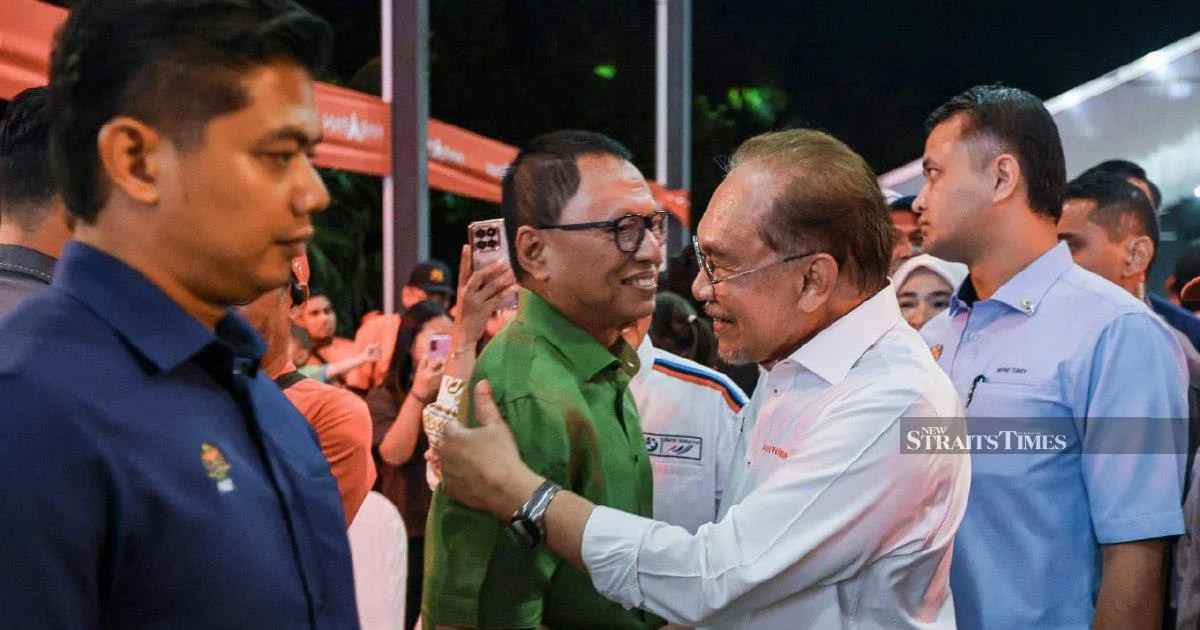
Bersama leader Datuk Seri Rafizi Ramli has taken a satirical jab at Datuk Dr Mohd Puad Zarkashi, the former Islamic affairs minister, suggesting that his political loyalties have undergone a dramatic transformation. The barbed comment came in the aftermath of a notably warm public greeting between Puad and Prime Minister Anwar Ibrahim at an event in Johor Baru on Saturday, a moment that did not escape Rafizi's sharp sense of political theatre.
The interchange between the two figures reflects the fluid and often unpredictable landscape of Malaysian coalition politics, where symbolic gestures—a handshake, an embrace, or a shared moment in public—can be read as signals of shifting allegiances and changing fortunes within government structures. For seasoned observers of the political scene, such physical demonstrations of camaraderie carry weight beyond their surface appearance, often suggesting deeper negotiations or consolidations of power that may be unfolding behind closed doors.
Puad, a long-standing figure in Umno circles and former minister under previous administrations, has occupied various positions within the political establishment. His apparent proximity to the Prime Minister in recent exchanges has sparked speculation about his role and standing within the current administration. Rafizi's quip playfully suggests that Puad has effectively reoriented his political base, implying that positions held under one party banner may now be claimed under another through proximity to executive power.
The comment arrives amid a period of reconfiguration within Malaysia's political landscape, where factional realignments and coalition shuffles continue to reshape ministerial portfolios and influence hierarchies. In such an environment, public figures who maintain strong working relationships with the Prime Minister occupy particularly strategic positions, regardless of their nominal party affiliations. Rafizi's observation highlights the tension between formal party structures and the practical exercise of power, which often depends more on personal relationships and access to decision-making processes.
Rafizi, as a prominent voice within Bersama—a component party within the Pakatan Harapan coalition—occupies a position that allows him to comment on intra-coalition dynamics with a degree of authority. His remarks serve multiple purposes: they acknowledge shifting political realities while simultaneously reinforcing factional boundaries within the broader government coalition. The humour embedded in his observation functions as both social commentary and political positioning.
The broader context of Malaysian politics reveals recurring patterns whereby prominent figures navigate between parties, institutional roles, and access to power. Puad's education background and administrative experience have positioned him as a technocratic figure capable of functioning effectively across different political arrangements. His apparent ease with the current Prime Minister reflects the pragmatic nature of contemporary Malaysian governance, where competence and relationships often supersede strict ideological adherence.
For observers tracking ministerial movements and power consolidations within government, such public moments provide valuable data points about who holds genuine influence and who maintains working relationships with central decision-making authority. The fact that Puad and Anwar shared what multiple sources describe as a notably warm embrace suggests either a pre-existing working relationship or the beginning of a new collaborative arrangement that may have implications for policy implementation and resource allocation across various government departments.
The timing of Rafizi's comment reflects broader tensions within the ruling coalition regarding power distribution and portfolio allocation. Bersama, as a newer entrant to coalition governance, naturally maintains awareness of how power and positions distribute among coalition members. Rafizi's observation, while couched in humour, underscores legitimate questions about how roles and responsibilities are allocated when coalition partners include both longstanding establishment figures and relative newcomers to the governing arrangement.
In Malaysian political discourse, such exchanges between high-profile politicians often carry implications extending beyond the immediate parties involved. Coalition partners and opposition figures alike monitor public interactions among government members for signals about internal stability, factional alignments, and the distribution of executive favour. A well-timed embrace between a prime minister and a former minister, followed by critical commentary from coalition colleagues, creates the kind of political theatre that structures media coverage and public understanding of governance dynamics.
Moving forward, observers will likely watch how Puad's positioning within government evolves and whether his apparent proximity to Prime Minister Anwar translates into expanded responsibilities or greater influence over policy matters. Rafizi's comment, whether intended primarily as satire or as substantive political critique, has succeeded in drawing public attention to these questions about power, portfolio, and political identity in contemporary Malaysia.

