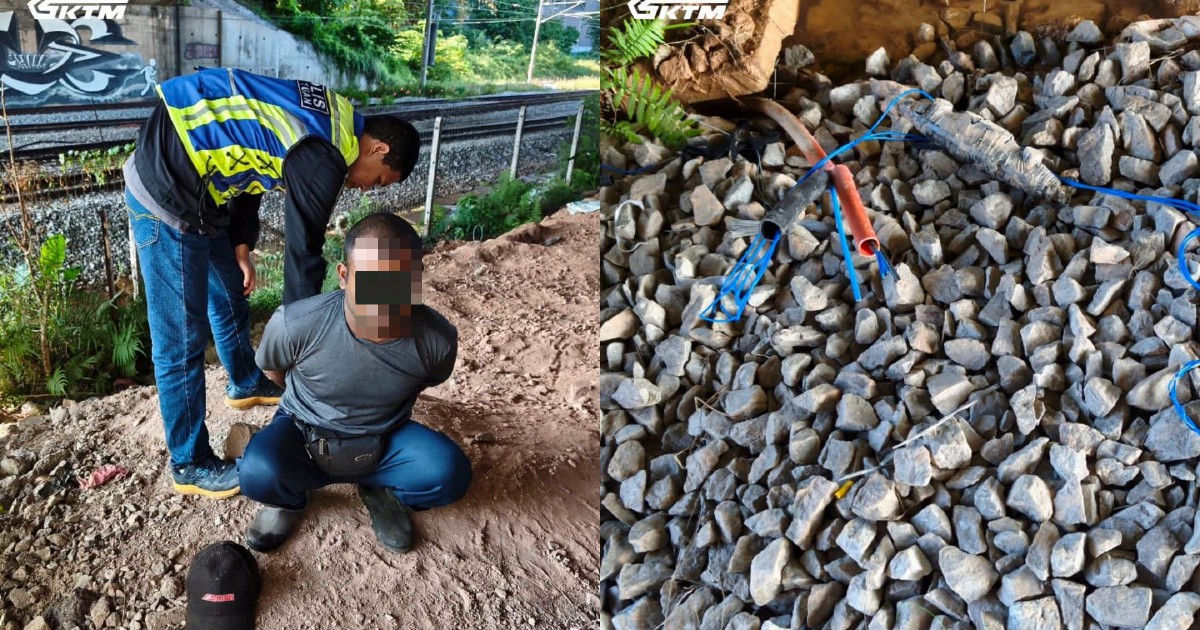
Railway infrastructure faces mounting challenges from organised theft rings targeting valuable copper and aluminium cabling, a problem that has grown increasingly acute across Malaysia's rail network. In the latest incident, Keretapi Tanah Melayu Bhd's auxiliary police force successfully intercepted two suspects in Shah Alam during an active cable theft operation, preventing further losses to the national rail operator and disruption to commuter services.
The arrest underscores the vulnerability of Malaysia's railway assets to criminal activity, despite enhanced security measures implemented by KTMB across major routes and depot facilities. Cable theft has emerged as a significant operational headache for the state-owned rail company, creating safety hazards for maintenance personnel and disrupting train schedules when critical sections of the network require emergency repairs. The valuable metals contained in railway cabling make them attractive targets for scrap metal dealers, who offer quick cash to thieves willing to brave electrocution risks and trespassing charges.
The Shah Alam incident demonstrates that railway theft remains a persistent challenge even in urban areas with higher police presence and surveillance capacity. KTMB's reliance on auxiliary police units reflects broader resource constraints faced by national law enforcement agencies, which must balance railway security against competing demands across other critical infrastructure. These auxiliary officers, while valuable force multipliers, often work with limited equipment and backup compared to the Royal Malaysia Police's regular divisions.
Theft of railway infrastructure carries serious implications for commuter safety and service reliability. Beyond the immediate financial cost of replacing stolen materials, disrupted rail services force commuters onto already congested road networks, exacerbating Klang Valley traffic congestion and impacting businesses dependent on reliable transport links. Each theft incident requires investigation, evidence processing, and repair work that diverts maintenance resources from preventive upkeep, accelerating wear on aging rail infrastructure.
Criminal networks operating in this space often work with stolen goods receivers in the scrap metal recycling industry, creating a market chain that incentivises theft despite criminal penalties. Authorities have previously identified syndicates targeting railway copper and aluminium cabling specifically because these materials command high scrap values in both domestic and cross-border markets. The speed at which thieves can strip and transport cabling means that recovery rates remain low even after arrests.
For Malaysian readers concerned about public transport reliability, railway cable theft represents a hidden tax on commuting efficiency and service quality. The costs of replacing stolen infrastructure ultimately flow through to maintenance budgets, potentially delaying network expansions and upgrades. In the Klang Valley context, where rail networks form critical arteries connecting residential zones to employment centres, each disruption cascades through the broader metropolitan transport ecosystem.
The auxiliary police success in Shah Alam reflects improved coordination between KTMB security personnel and ground-level enforcement, though capturing thieves represents only part of the solution. Prosecuting cases effectively requires sustained commitment from the judicial system, with sentences that deter future offenders rather than treating cable theft as a minor infraction. Previous cases have seen surprisingly lenient sentences for organised theft rings, sending mixed signals about the seriousness with which authorities treat attacks on national infrastructure.
Addressing this challenge comprehensively will likely require multi-pronged approaches beyond police enforcement alone. Technological solutions such as GPS tracking systems on valuable materials, improved fencing and surveillance around vulnerable cable runs, and partnerships with scrap metal dealers to verify material provenance could make theft riskier and less profitable. Some rail networks internationally have deployed anti-theft chemicals that render stolen cabling worthless, effectively eliminating the economic motivation for theft.
The broader context of infrastructure theft in Malaysia extends beyond railways to telecommunications networks, electricity grids, and water infrastructure, suggesting organised criminal activity rather than opportunistic opportunism. The persistence of these networks despite periodic enforcement actions indicates that disrupting supply chains and prosecution capacity remain underdeveloped compared to the sophistication of criminal operations. Railway theft therefore merits categorisation alongside other high-impact crimes rather than minor property offences.
As Malaysia pushes forward with mass rapid transit expansion and modernisation of existing networks, protecting physical assets from theft becomes increasingly urgent. The capital-intensive nature of rail infrastructure means that theft rates directly impact cost-effectiveness and return on public investment. Future rail projects, including potential extensions of the Klang Valley network, will face similar vulnerabilities unless systematic solutions addressing both supply-side (police enforcement) and demand-side (scrap metal market regulation) factors are implemented effectively.
The Shah Alam arrests, while welcome, highlight that reactive police responses alone cannot sustainably address infrastructure theft. KTMB and federal authorities must escalate efforts to make theft riskier and less profitable, transforming the calculus that currently encourages criminal networks to target railway assets. Without such comprehensive approaches, commuters can expect continued disruptions, and the country's transport infrastructure investment returns will remain eroded by preventable theft.

