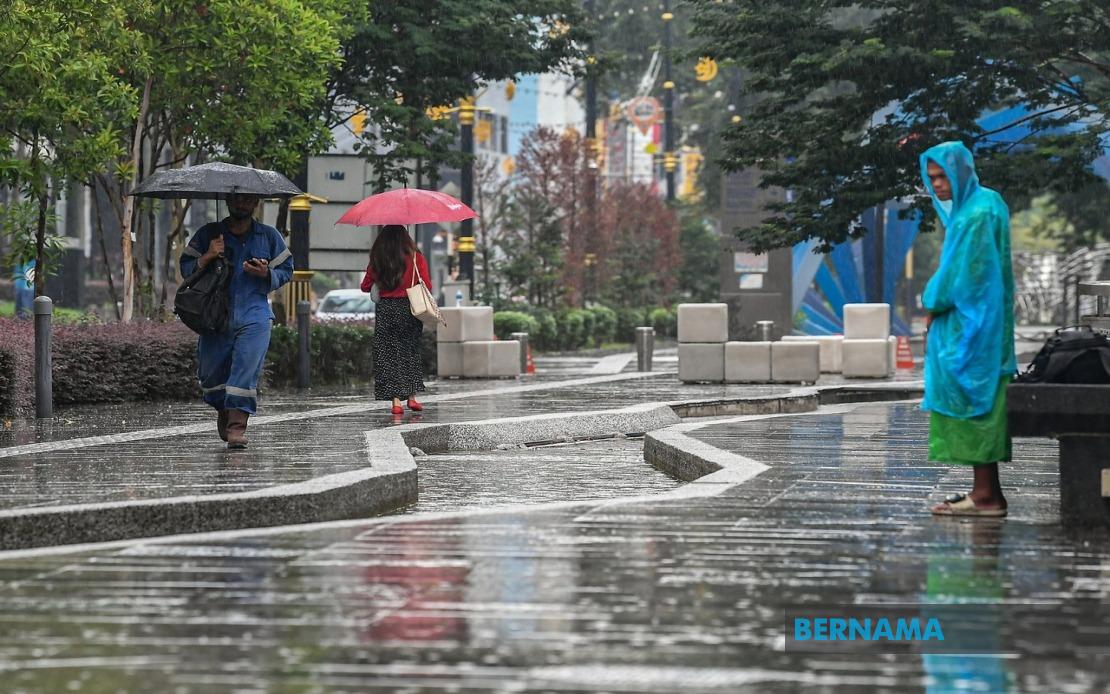
The Malaysian Meteorological Department has cautioned that incoming rain will affect seven of Johor's ten districts on June 27, the scheduled nomination day for the state election, potentially creating logistical difficulties for candidates and their supporters during the crucial filing process. Azlai Ta'at, the Johor director of MetMalaysia, said precipitation is expected throughout the morning hours in Johor Bahru, Muar, Batu Pahat, Kota Tinggi, Pontian, Tangkak and Kulai, while the three remaining districts of Segamat, Kluang and Mersing are anticipated to remain clear during the early part of the day.
Temperatures across the state will span a relatively moderate range, with lows between 24 and 25 degrees Celsius and highs between 31 and 34 degrees Celsius, with Segamat expected to experience the warmest conditions at up to 34 degrees Celsius. The meteorological authority has urged members of the public and electoral supporters to remain vigilant regarding sudden shifts in atmospheric conditions, a standard precaution given the equatorial climate's unpredictability. The weather advisory takes on added significance given that the nomination centres will operate during a narrow two-hour window from 9 am to 10 am across 56 locations statewide, leaving limited flexibility for rescheduling should conditions deteriorate sharply.
Thunderstorms are anticipated to intensify during the afternoon hours once the nomination process concludes and the official campaign period officially commences. MetMalaysia's extended forecast indicates that afternoon thunderstorms will sweep through Johor Bahru, Segamat, Kluang, Kota Tinggi, Pontian, Mersing and Kulai, whilst Batu Pahat and Tangkak face conventional rainfall, and Muar is expected to remain hot and humid without significant precipitation. This pattern suggests a volatile meteorological environment throughout the nomination and early campaigning phases, potentially complicating candidate movements and supporter mobilization during the critical opening days of the contest.
The electoral contest itself represents a significant political moment for Malaysia's southern gateway state, with the Election Commission confirming that 2,727,926 registered voters will participate in the sixteenth Johor state election. The voter rolls comprise 2,703,175 ordinary citizens, alongside 12,041 military personnel and their spouses, and 12,710 police officers and their spouses, reflecting the traditional inclusion of uniformed services in state-level democratic exercises. Early voting has been scheduled for July 7, with the main polling day set for July 11, providing voters across the geographically dispersed state with adequate time to participate in the process.
Pakatan Harapan has committed to fielding candidates across all 56 state seats, with the coalition distributing nominations strategically among its three component parties: PKR will contest 20 seats, Amanah 19 seats, and DAP 17 seats. This allocation reflects internal coalition agreements and respective party strengths within particular constituencies, demonstrating how Malaysia's multi-ethnic political landscape requires sophisticated power-sharing arrangements even within putatively unified opposition coalitions. The distribution indicates PKR's continued pre-eminence within the alliance structure, whilst acknowledging DAP's necessary presence in constituencies with significant non-Malay populations and Amanah's role in capturing the Islamic-oriented vote sensitive to governance and religious affairs messaging.
Barisan Nasional, the incumbent coalition governing Johor, similarly commits to contesting all 56 seats with a traditional communal allocation: UMNO will field 36 candidates, MCA 16 candidates, and MIC four candidates, maintaining the federation's historical three-community representation model. This configuration underscores how Malaysia's longstanding political architecture continues to shape contemporary electoral competition, with each coalition partner retaining designated constituencies where they hold comparative electoral advantages and community connections. The composition also reflects the Malay and bumiputera dominance within peninsular state governments, with UMNO's substantial candidate allocation reflecting its traditional base in rural and semi-urban Johor constituencies.
Perikatan Nasional, the newer political alignment that has reshaped Malaysian politics since 2020, presents a more fragmented candidate distribution across the 56 seats. PAS will contest 11 seats, Bersatu 16 seats, the Malaysian Indian People's Party five seats, and Pejuang one seat, indicating that this coalition remains organizationally less cohesive than its Barisan or Pakatan counterparts. The Perikatan framework essentially represents a vehicle for PAS to expand its electoral footprint without the explicit UMNO partnership that characterized earlier decades, whilst Bersatu leverages its position as the formally-registered vehicle for former Prime Minister Muhyiddin Yassin's political interests and Pejuang offers a platform for former Prime Minister Mahathir Mohamad's residual political following.
Additional smaller parties are also contesting, indicating that Johor's political marketplace remains competitive at the margins despite dominance by three main coalitions. The Malaysian United Democratic Alliance will contest four seats, Parti Sosialis Malaysia one seat, whilst Parti Bersama Malaysia makes its electoral debut with 15 contested seats, potentially appealing to voters dissatisfied with established coalition offerings. This proliferation of electoral options, whilst not threatening the fundamental three-way contest between Pakatan, Barisan and Perikatan, provides alternative outlets for protest votes and issue-specific constituencies that feel inadequately represented by mainstream formations.
For Malaysian observers and the broader Southeast Asian region watching these state-level contests, Johor's election carries significance beyond its 56 seats and single state government. As Malaysia's largest state by population and economic output, Johor's political trajectory influences perceptions of stability and governance quality throughout the peninsula, affecting investor confidence, skilled labor migration patterns, and regional economic cooperation frameworks. The state's geopolitical position as a gateway to Singapore and its role as a manufacturing and logistics hub for broader Southeast Asian supply chains means that political uncertainty or governance deterioration in Johor generates ripple effects throughout regional commerce and strategic relationships.
The nomination day weather challenges, whilst operationally manageable for experienced election administrators, serve as a symbolic reminder that Johor's governance will occur within Malaysia's monsoon environment and tropical climate pressures that increasingly reflect broader climate disruption patterns. Beyond immediate logistical concerns, the climate patterns affecting Johor's agricultural hinterland, water resources, and coastal infrastructure increasingly feature in state-level political discourse, with different coalitions proposing varying approaches to environmental management, water security, and agricultural modernization. The incoming rain on nomination day thus carries both immediate practical significance for the nomination process itself and deeper symbolism regarding the environmental governance questions that will define Malaysian state politics throughout the coming decade.

