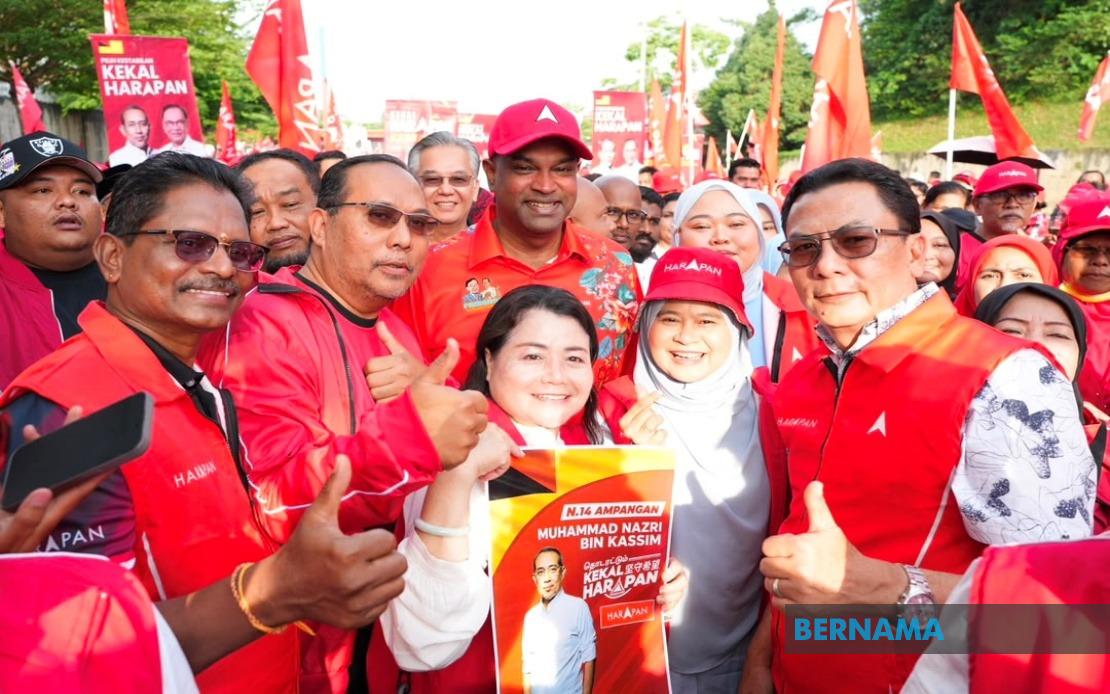
High-ranking Pakatan Harapan figures descended on Seremban's nomination centre on July 18 to demonstrate the coalition's organisational muscle ahead of the Negeri Sembilan state election. PKR vice-president and Sungai Buloh Member of Parliament Datuk Seri R. Ramanan led the charge at the Seremban City Council Building, accompanied by DAP deputy secretary-general Steven Sim and other senior coalition operatives. Their presence underscored the stakes involved in recovering support across the state, where the coalition is seeking to consolidate its position after a period of political turbulence in Malaysia's heartland.
The six candidates receiving the coalition's backing span a geographically diverse set of constituencies, suggesting a deliberate strategy to present a united front across Negeri Sembilan's electoral landscape. Nor Azman Mohamad in Sikamat, Datuk Muhammad Nazri Kassim in Ampangan, Zarinna Abu Zarin in Lenggeng, Chew Seh Yong in Lobak, J. Arul Kumar in Nilai, and Ho Weng Wah in Temiang represent the coalition's attempt to compete effectively across urban and semi-rural seats. This distribution indicates that Pakatan Harapan's campaign machinery is attempting to broaden its appeal beyond traditional strongholds and into areas where the coalition has faced electoral headwinds in recent years.
Ramanan's characterisation of the turnout at the nomination centre as evidence of grassroots enthusiasm carries significance for understanding how the coalition measures internal momentum. The presence of party workers and supporters at such administrative events often signals campaign readiness and member engagement, metrics that matter considerably in tightly contested state elections. In Negeri Sembilan, where political fortunes have swung between federal coalitions, the ability to mobilise ground support remains a critical variable in determining outcomes. The coordination of senior leadership appearances at nomination events serves dual purposes: it boosts candidate morale while simultaneously sending signals to party rank-and-file about the importance the central leadership attaches to individual races.
The timing of this leadership engagement merits examination within the broader context of Malaysian coalition politics. Negeri Sembilan, located strategically between Kuala Lumpur and southern Peninsular Malaysia, has historically served as a barometer for political sentiment in the region. The state's 36-seat assembly carries symbolic weight beyond its numerical size, partly because results there often reflect sentiments that ripple across neighbouring constituencies and influence perceptions of government competence. By fielding visible senior leadership so early in the campaign period, Pakatan Harapan signals that it views Negeri Sembilan as territory worth defending intensively.
Ramanan's statement emphasising continuity and development echoes messaging that coalitions typically deploy when seeking to retain voter support. References to stability and sustained development projects appeal to constituents concerned with tangible governance outcomes rather than political drama. This framing suggests that Pakatan Harapan's campaign in Negeri Sembilan intends to centre on performance narratives and administrative achievements rather than personality-driven politics. For Malaysian voters increasingly weary of coalition infighting, such messaging may prove more persuasive than the partisan combat that has dominated recent political discourse.
The compressed campaign calendar operates as a significant constraint on all participants. With nomination completed on July 18 and polling day set for August 1, candidates and their supporting machinery face a tight window spanning just over two weeks. Early voting on July 28 introduces an additional complication, as campaigns must peak early to capture this tranche of voters. In such condensed timeframes, the visibility and credibility conferred by senior leader endorsements take on amplified importance. Voter contact becomes logistically challenging, making media impressions and word-of-mouth recommendations from established figures disproportionately influential.
Negeri Sembilan's dissolution on June 5 followed the extended political instability that has characterised Malaysian state politics since 2018. The 16th state election represents an opportunity for the coalition holding power to seek fresh electoral validation and strengthen its mandate for governing the state. Simultaneously, opposition forces view the election as a potential inflection point for repositioning their influence in the region. The stakes inherent in such contests explain why parties deploy their most recognisable personalities and politically astute operatives to key nomination events, where cameras congregate and party discipline is visible to the public.
The geographic distribution of Pakatan Harapan's supported candidates reflects tactical calculations about where the coalition possesses competitive advantage. Sikamat, Ampangan, Lenggeng, Lobak, Nilai, and Temiang encompass constituencies ranging from essentially rural communities to suburban and semi-urban areas adjacent to greater Kuala Lumpur. This variety suggests that the coalition has assessed its chances across different demographic and socioeconomic contexts and identified these six contests as winnable propositions. Conversely, the coalition's implicit decision to concentrate senior leadership attention on these six rather than spreading effort across all contested seats indicates pragmatic resource allocation in a contest where every ground operation matters intensely.
The involvement of both PKR and DAP figures symbolises the coalition's effort to maintain unity publicly despite occasional tensions that surface between member parties. Leadership turnout at major campaign events serves as reassurance to voters that the coalition remains coherent and committed to joint governance. In Malaysian elections, voter calculations frequently incorporate assessments of coalition stability, with constituents worried that supporting fractious coalitions risks political chaos if partners prove unable to cooperate after voting concludes. High-profile joint appearances by representatives of different coalition components help counteract such concerns by demonstrating visible solidarity among party elites.
The campaign period extending until July 31 provides limited time for ground-level engagement, requiring campaigns to maximise efficiency in voter contact and messaging delivery. Television advertising, social media campaigns, and street-level visibility become compressed into a tight timeframe where peak impact demands saturation coverage during the final week before early voting commences. For six candidates receiving explicit senior-level backing, this endorsement carries capital that extends beyond the nomination centre event itself, generating news coverage and social media amplification that extends campaign reach beyond what door-to-door canvassing alone could accomplish.
For Malaysian observers monitoring coalition dynamics nationally, the Negeri Sembilan election offers preliminary indicators of Pakatan Harapan's organisational health and electoral appetite. State elections that precede federal contests often function as rehearsals for campaign strategies and messaging frameworks. Success or setback in Negeri Sembilan will likely inform coalition strategists' calculations about approaches to deploy in future electoral contests, whether at state or federal level. The visible commitment of senior national figures to these six candidates communicates that the coalition's centre regards Negeri Sembilan not as peripheral but as integral to its broader political project and image-building.

