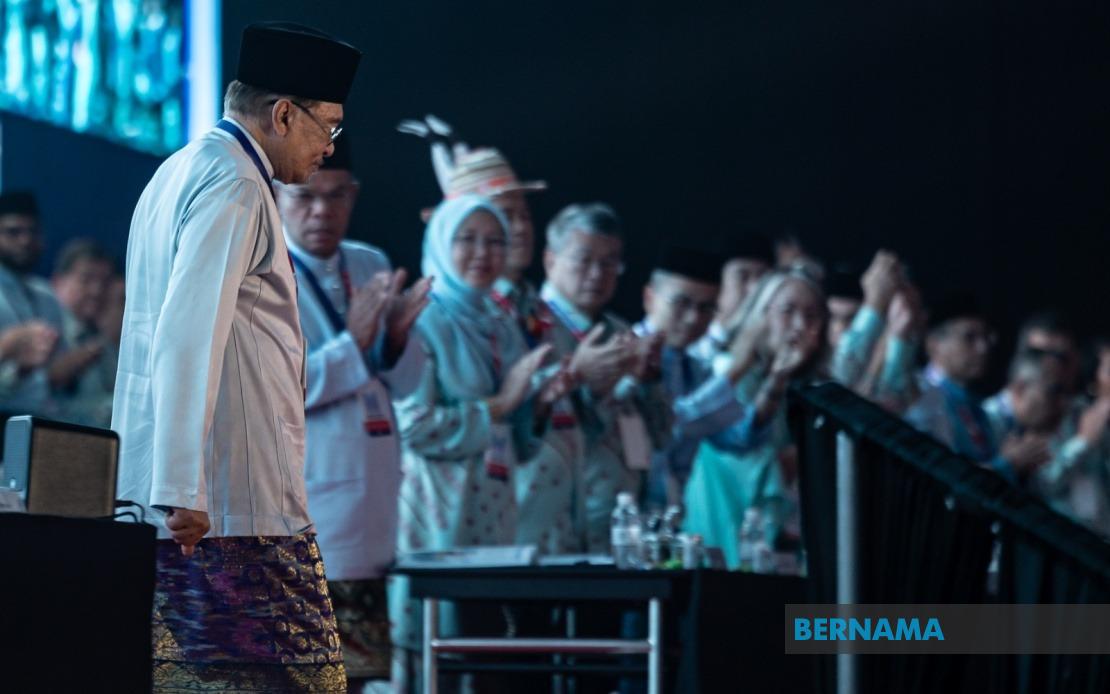
Prime Minister Datuk Seri Anwar Ibrahim has pushed back against critics who dismiss the government's institutional reform efforts, arguing that substantial progress has been made under his administration even as fresh demands for change continue to emerge. Speaking at the 2026 PKR National Congress in Melaka, Anwar acknowledged the tension between celebrating completed work and responding to calls for accelerated transformation, contending that both realities deserve recognition.
Anwar, who leads the People's Justice Party (PKR) alongside his roles as Prime Minister and Finance Minister, framed the reform agenda as a foundational shift following what he characterised as six decades of institutional stagnation. He emphasised that regardless of ongoing criticism, a catalogue of tangible achievements should not be overlooked simply because more work remains. His comments reflect an attempt to balance governing pragmatism with the progressive aspirations that brought his Pakatan Harapan coalition to prominence.
The concrete reforms implemented to date span considerable institutional ground. Parliamentary and audit frameworks have been modernised through amendments to the Audit Act 1957 and the Parliamentary Service Act. A significant public finance governance structure emerged through the Public Finance and Fiscal Responsibility Act 2023. Consumer protection was strengthened via the Consumer Credit Act, while new legislation addressed the protections and rights of gig economy workers, a rapidly growing segment of the Malaysian workforce increasingly exposed to regulatory gaps.
Beyond legislative measures, the government established a Special Task Force on Agency Reform aimed at systemic efficiency improvements across the bureaucracy. These institutional modifications, Anwar suggested, represent the kind of foundational changes that typically take years to conceptualise, legislate, and implement. In the Malaysian context, where institutional reform has often stalled between electoral cycles, the pace of change within three years of his administration represents a notable departure from historical patterns.
However, Anwar remained candid about the constraints shaping the reform timeline. The formation of the Unity Government following the 2022 general election required coalition negotiations with parties holding competing priorities. As the principal component of the governing arrangement, PKR and Pakatan Harapan had to accommodate coalition partners' positions and interests, necessarily slowing the pace of institutional overhaul. This political reality, Anwar explained, prevented the wholesale transformation that some stakeholders expected upon his election.
The Prime Minister defended the phased approach as both strategically sound and practically necessary. Change, he argued, cannot be imposed uniformly across complex bureaucratic systems without careful foundation-building and staged implementation. He cautioned against assumptions that institutional transformation could occur instantaneously, drawing on his experience in governance to emphasise that reforms require deep roots to function effectively and sustainably. This methodology, while sometimes frustrating to advocates of rapid change, recognises the entrenched nature of institutional cultures across Malaysian government agencies.
Anwar's remarks carry particular weight for Malaysian politics and regional governance discussions. The reform agenda represents a central commitment of the current administration to address longstanding criticisms about corruption, institutional capture, and governance standards that weakened public confidence during previous eras. For Southeast Asian observers, Malaysia's institutional evolution matters as a test case: whether a large developing economy with entrenched governance challenges can meaningfully modernise while managing coalition politics and competing stakeholder demands.
The acknowledgment that not all government actions have been perfect represents a subtle but significant concession. Rather than claiming flawless execution, Anwar positioned the administration as engaged in continuous learning. This framing invites ongoing scrutiny while requesting patience with the complexity of institutional change in a federal system with devolved powers, constitutional constraints, and multiple layers of bureaucratic resistance to reform.
For Malaysian civil society and reform advocates, Anwar's address raises important questions about momentum and measurement. How should progress be assessed when some reforms proceed while others stall? What constitutes adequate pace when competing against decades of accumulated institutional dysfunction? These questions shape the political environment heading toward future electoral cycles, as various stakeholders evaluate whether the current government merits continued support for its reform trajectory or whether faster-moving alternatives offer better prospects.
The speech also reflects internal PKR dynamics and the party's positioning within Pakatan Harapan. By defending reform progress while acknowledging limitations, Anwar attempted to satisfy party members and broader progressive constituencies seeking continued institutional change while explaining realistic governing constraints. Coalition partners attending the event, including Amanah president Datuk Seri Mohamad Sabu and Gabungan Rakyat Sabah chairman Datuk Seri Hajiji Noor, represented the multiple political interests requiring accommodation in the Unity Government structure.
Looking forward, Anwar signalled the government's continued commitment to strengthening the reform agenda while operating within current political and administrative circumstances. This suggests neither acceleration of the timeline nor abandonment of institutional change, but rather continuation of the measured pace established since 2022. For stakeholders seeking dramatic transformation, this represents both reassurance that reform remains a priority and realistic acknowledgment that Malaysia's political coalition structure permits incremental rather than revolutionary change.
The international dimension deserves consideration as well. Malaysia's reform efforts are watched by regional investors, international governance bodies, and neighbouring countries assessing institutional quality and rule-of-law standards. Demonstrating tangible progress while maintaining political stability appeals to external audiences concerned about governance standards in Southeast Asia. Anwar's defence of the reform record therefore serves multiple constituencies simultaneously: domestic stakeholders demanding change, coalition partners requiring reassurance about political stability, and international observers evaluating Malaysia's governance trajectory and institutional reliability.

