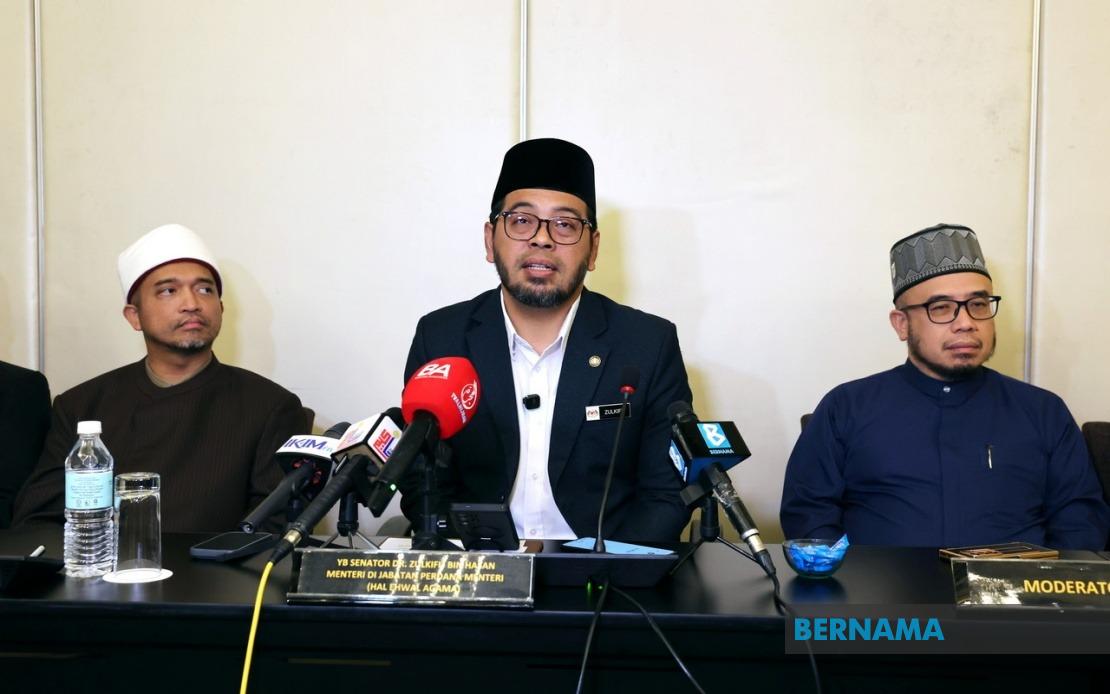
Religious Affairs Minister Dr Zulkifli Hasan has declared that applying the term "kafir harbi" to Malaysian citizens is fundamentally at odds with the nation's constitutional framework and multiethnic social contract. Speaking in Putrajaya on August 10, Zulkifli drew this conclusion following a formal roundtable discussion convened specifically to examine the theological and practical implications of using such language within Malaysia's plural society. The pronouncement marks a significant intervention by government leadership on a contentious issue that has periodically surfaced in public discourse and touched on questions of religious identity, citizenship, and national cohesion.
The minister's statement rests on a straightforward constitutional argument: every Malaysian citizen, regardless of religious affiliation, stands equally under the Federal Constitution and bears identical legal rights and obligations as members of a single national community. This foundational principle means that the concept of "kafir harbi"—a term with roots in Islamic jurisprudence referring to non-Muslims in a state of conflict with Muslim authority—lacks applicability in Malaysia's context. The distinction matters because it shifts the conversation away from theological abstractions toward concrete legal and civic realities. Zulkifli emphasised that Malaysian citizens inhabit a shared homeland and contribute collectively to national defence and development, making divisive religious classifications both inappropriate and counterproductive to the nation's integrity.
The roundtable discussion that preceded this declaration brought together stakeholders to examine the issue comprehensively. Through presentations, formal deliberation, and structured dialogue, participants concluded that adopting such terminology would contradict Malaysia's foundational commitment to constitutional governance and equal citizenship. The collaborative process itself underscores the government's preference for consultative approaches to sensitive religious matters rather than unilateral pronouncements. This methodology reflects recognition that Malaysia's plural composition requires buy-in from multiple constituencies when addressing topics at the intersection of religion, law, and national identity.
Zulkifli's assertion that the term no longer suits modern Malaysia contains an implicit historical acknowledgment: the concept may have had relevance in different contexts or periods, but contemporary Malaysian reality has rendered it obsolete. This framing allows for respectful engagement with Islamic intellectual traditions while clearly demarcating boundaries for their application within the nation-state. The minister's language—emphasising unity, shared responsibility, and common destiny—positions the rejection not as a critique of Islamic scholarship but as a practical recognition of how Malaysia functions as a political community bound by constitutional law rather than religious law alone.
The Department of Islamic Development Malaysia (JAKIM) has been tasked with leading a coordinated effort to communicate this position across government, civil society, and the broader public. Rather than treating this as an isolated pronouncement, the government intends to embed the message within a systematic campaign for public awareness and education. This collaborative apparatus includes multiple ministries and agencies, reflecting the view that strengthening national integration requires coordinated action across institutional boundaries. The inclusive scope of the proposed outreach signals that religious clarification alone cannot resolve what are fundamentally questions about citizenship and national belonging.
The timing and framing of this intervention carry significance for Malaysia's ongoing conversation about religious boundaries in a constitutionally secular but Muslim-majority state. By having a cabinet minister responsible for religious affairs explicitly reject the term's applicability, the government sends a clear signal about official policy while respecting Islam's intellectual traditions. This balance allows religious communities to maintain theological positions without translating them into civic divisions or legal frameworks that fragment national life. The statement also indirectly addresses a broader pattern wherein terms and concepts drawn from Islamic jurisprudence have occasionally been invoked in ways that create social friction or challenge the constitutional order.
From a practical standpoint, Zulkifli's declaration establishes a baseline for government institutions, religious educators, and public figures. When religious discourse touches on questions of citizenship, rights, or national belonging, the constitutional equality of all Malaysians provides the operative framework. This does not prohibit religious discussion or theological inquiry but establishes that Malaysia's legal and political order supersedes sectarian distinctions when state power and citizen rights are at stake. For Malaysian Muslims, the statement affirms that robust religious identity can coexist with full participation in a constitutional, multi-confessional nation-state.
The minister's call for Malaysians to "work together to strengthen unity, foster closer bonds of brotherhood, respect one another, and understand each other's cultures and religions" articulates a vision of national cohesion grounded in mutual recognition rather than theological uniformity. This appeal to solidarity appeals across religious lines while simultaneously reinforcing that diversity itself strengthens rather than weakens the nation. For Malaysia's religious minorities, the statement provides reassurance that government religious authorities reject frameworks that would subordinate non-Muslim citizens within a conflictual theological paradigm. For the Muslim majority, it affirms that Islamic identity need not depend on adversarial categorisation of fellow citizens.
Looking forward, the effectiveness of this intervention depends partly on how consistently it is reinforced across government, educational institutions, and public discourse. A single ministerial statement, however authoritative, lacks the power to reshape deeply held convictions or eliminate all use of contested terminology. The collaborative approach that JAKIM and other agencies will undertake must therefore focus on constructive education rather than prohibition. This requires engaging religious scholars, community leaders, and educators in developing alternative frameworks and language that allow for robust religious expression without importing conflict-laden conceptual distinctions into Malaysian citizenship.
The declaration also illustrates how Malaysia navigates the tension between respecting Islamic intellectual traditions and protecting a secular constitutional order. Rather than rejecting Islamic jurisprudence wholesale, the government makes a jurisdictional argument: particular concepts may be valid within theological discourse but inappropriate for state application or citizen classification in a constitutional democracy. This approach preserves space for diverse religious thought while maintaining the boundaries necessary for inclusive governance. For regional observers, the statement demonstrates how a Muslim-majority nation with constitutional secularism can assertively defend pluralism without dismissing religion from public conversation.
For Malaysia's plural society, the broader implication extends beyond terminology to fundamental questions about citizenship and belonging. By explicitly rejecting a framework that categorises fellow citizens as adversaries on religious grounds, the government reaffirms that Malaysian nationality transcends religious identity as the primary legal and civic bond. This position becomes increasingly important as Malaysia develops economically and demographically, requiring ever-greater coordination and interdependence across community lines. The rejection of "kafir harbi" in the Malaysian context therefore signals commitment to citizenship models that emphasise shared civic responsibility over theological distinction, a principle that sustains constitutional democracies with religiously diverse populations.

