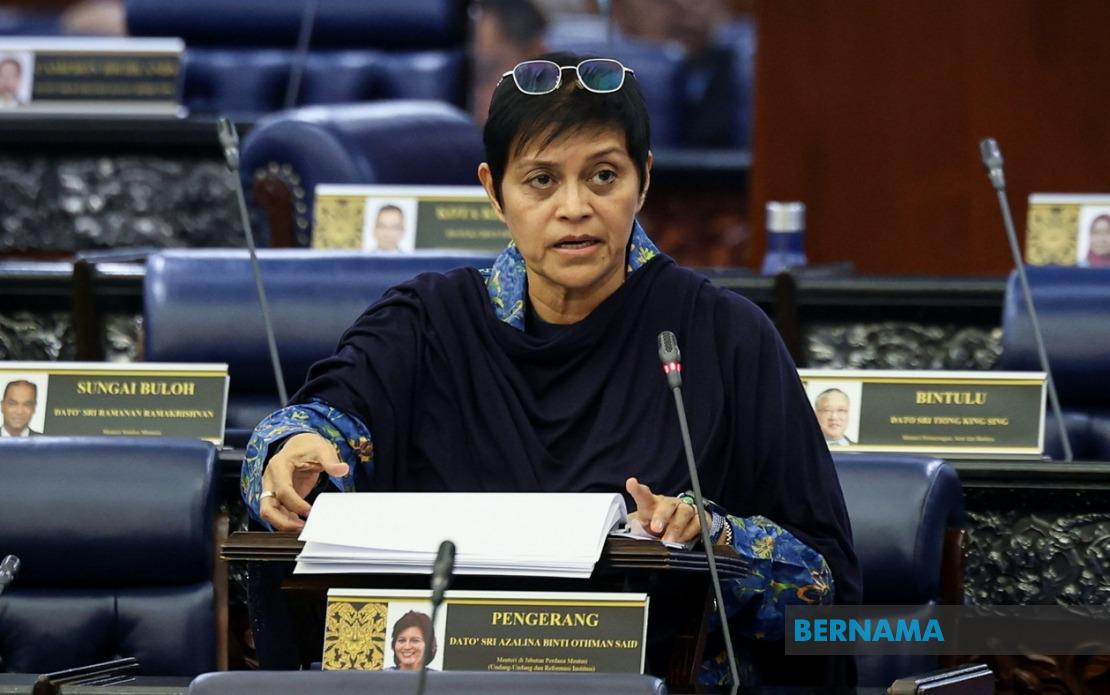
Parliament will consider a landmark report tomorrow on the institutional separation of the Attorney General and Public Prosecutor, representing a critical juncture in Malaysia's ongoing judicial reform efforts. Datuk Seri Azalina Othman Said, who oversees legal and institutional reform as Minister in the Prime Minister's Department, framed the presentation as evidence of the MADANI Government's dedication to reinforcing the rule of law and restoring public trust in the country's justice system.
The Special Select Committee, which convened on seven separate occasions, has developed a comprehensive set of seven structural improvements designed to insulate the Public Prosecutor's office from undue political influence while enhancing its operational accountability. These recommendations represent the culmination of extensive deliberation on how Malaysia's prosecutorial function should be organised to better serve justice without compromising constitutional arrangements or democratic oversight.
Central to the committee's proposals is a fundamental restructuring of how Malaysia's top prosecutor is appointed. Rather than the Public Prosecutor continuing under joint administration with the Attorney General, the role would be filled through a process initiated by the Judicial and Legal Service Commission (SPKP), which would present candidates to the Speaker of the Dewan Rakyat for evaluation by a parliamentary select committee before the recommendation returns to the commission for transmission to the Yang di-Pertuan Agong. This multi-layered approach aims to inject parliamentary scrutiny and institutional checks into a decision previously concentrated in executive hands.
The committee has also advocated for establishing a fixed, non-renewable seven-year tenure for the Public Prosecutor position. This reform directly addresses longstanding concerns that indefinite tenure structures can create vulnerability to political pressure or create expectations of preferential treatment in exchange for continuation in office. A defined term paradoxically strengthens independence by removing the anxiety of reappointment decisions while providing institutional clarity about succession planning.
Creation of a formal Code of Ethics specifically governing Public Prosecutors represents another significant innovation. Such a code would establish transparent professional standards and provide a documented framework against which the prosecutor's conduct can be measured. This institutional innovation signals movement toward a prosecution service modelled on professional norms rather than ad hoc administrative discretion, potentially elevating the status and integrity of the office.
The proposals also contemplate constitutional amendments to Article 145A, specifically to Clause 18, that would enshrine Parliament's enhanced role in the appointment mechanism. Constitutional entrenchment makes such reforms difficult to reverse unilaterally, thereby providing durable protection against future backsliding. The government's willingness to pursue constitutional amendment rather than merely administrative adjustment demonstrates seriousness about permanence and irreversibility of these changes.
Azalina emphasised that Parliament would have greater authority to enact additional legislation strengthening the Public Prosecutor institution in the future. This residual legislative capacity recognises that institutional design is not static; future parliaments may identify additional safeguards or procedural improvements as experience accumulates. However, such future reforms would require parliamentary deliberation rather than executive decree, thereby maintaining democratic participation in prosecutorial governance.
The separation initiative must be understood within Southeast Asia's broader judicial reform context. Neighbouring jurisdictions have undertaken their own restructuring of prosecutorial independence in response to domestic political pressures and international advocacy regarding the rule of law. Malaysia's approach reflects both regional and global currents emphasising that prosecutorial independence—while remaining answerable to law, not to political masters—is foundational to legitimate criminal justice systems.
For Malaysian observers, this reform addresses persistent anxieties about weaponisation of prosecutorial power. High-profile cases and shifting political circumstances have occasionally generated perceptions that prosecution decisions track partisan interests rather than legal merit. Whether the proposed structural separation will practically eliminate such perceptions depends on implementation rigour and sustained political commitment beyond tomorrow's parliamentary presentation.
The timing of this reform coincides with broader Malaysian institutional introspection. Recent elections, constitutional amendments, and investigations into previous administrations have created both momentum for systemic change and scepticism about whether structural reforms produce substantive behavioural shifts. This report represents an attempt to embed rule-of-law principles in institutional architecture rather than depending on individuals' voluntary compliance with norms.
Implementation will require coordination across multiple institutions: Parliament must enact enabling legislation, the SPKP must adapt its administrative procedures, and the office of the Public Prosecutor must operationalise the Code of Ethics and adapt to new reporting relationships. The complexity of such coordination explains why Azalina characterised this as a multi-year agenda rather than an immediate transformation.
The separation proposal also carries implications for prosecutorial effectiveness. Independence and accountability sometimes create tension in practice. A prosecutor insulated from political pressure might pursue cases unpopular with the electorate or powerful interests, but might also lack political support for resource allocation or legislative authority. Malaysia's design attempts to balance prosecutorial independence with parliamentary oversight, though real-world operation will reveal whether the balance proves workable.

