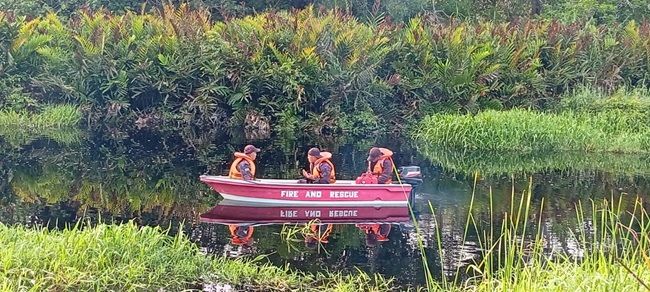
The search for a missing fisherman feared to have fallen victim to a crocodile attack in Brunei's Sungai Bera has now extended into its third day, with rescue authorities deploying multiple assets across the waterway yet to locate any sign of the man. Kampong Baru Sungai Bera, a rural settlement along the river system, became the focus of an intensive inter-agency operation after the distress call was received on Wednesday, June 24, prompting firefighters to mobilise immediately to the area.
The Fire and Rescue Department (FRD) has anchored the search operation with a comprehensive strategy encompassing river patrols conducted aboard dedicated rescue vessels, methodical sweeps of the riverbanks on foot, and overhead surveillance carried out using the department's drone fleet. This multi-layered approach reflects the challenging terrain and conditions typical of Brunei's river systems, where dense vegetation and murky waters complicate visibility and access. The deployment of aerial reconnaissance technology represents a significant modernisation in rescue capabilities, allowing operators to scan larger stretches of river in shorter timeframes than traditional ground-based methods alone would permit.
Beyond the firefighting contingent, the operation has mobilised personnel from the Royal Brunei Police Force (RBPF), with officers from the Seria Police Station and the specialised Royal Brunei Police Force Marine Police (POLMAR) unit actively participating in the fieldwork. The inclusion of POLMAR is particularly significant, as the marine division brings specialised training and equipment for water-based operations and potential recovery scenarios. Supporting these efforts is Brunei's Wildlife Division, whose expertise in crocodile behaviour and habitat patterns provides crucial intelligence for predicting where a crocodile might have taken its prey or where the victim's remains might be located.
Operational direction rests with Senior Superintendent Amirul Hadi Junaidi, the Commanding Officer of the Operations Branch, who is orchestrating the coordination between these distinct agencies. This command structure underscores the gravity authorities are attaching to the incident and reflects standard protocol for missing-person cases involving potential fatalities. The establishment of a Tactical Command Post at the scene enabled real-time decision-making and resource allocation as the operation progressed through its early critical hours.
Initial response to the distress call came swiftly, with two fire engines and nine personnel led by Acting Station Officer Mohd Zulkifli Md Tahir reaching the location. Preliminary interviews with the victim's family at the scene established the working hypothesis that the man had been fishing when the encounter with the crocodile occurred—a scenario not uncommon in rural Brunei, where river fishing remains a traditional livelihood practice in communities adjacent to waterways. The transition from emergency response to sustained search operation happened within hours of their arrival, signalling the severity of the situation as assessed by the responding teams.
Crocodile attacks in Southeast Asian waters remain rare but documented occurrences, and Brunei's river systems do support saltwater and estuarine crocodile populations in certain regions. The timing of the incident during daylight hours at a fishing location suggests the victim may have been taken by surprise, as such predators typically remain submerged and relatively inconspicuous until an opportune moment presents itself. The prolonged absence of any recovery or sighting after multiple days of systematic searching raises concerning implications about the likely outcome, though rescue teams typically maintain search efforts for extended periods in such cases.
For residents in communities like Kampong Baru Sungai Bera and other riverside settlements throughout Brunei, incidents of this nature underline the inherent environmental hazards associated with proximity to untamed waterways. While such attacks are statistically uncommon, their dramatic nature and severe consequences when they do occur make them significant events in local consciousness and inform community risk awareness. The incident also demonstrates the interagency coordination capacity of Brunei's emergency services, with the FRD, police, and wildlife authorities working in tandem despite their distinct jurisdictional domains.
The deployment of drone technology in this particular search highlights the evolving capabilities of regional emergency services in Southeast Asia, where technological adoption has accelerated considerably in recent years. Drones provide advantages in speed, coverage area, and operator safety when surveying potentially dangerous environments, and their use in this operation reflects international best practices in modern search and rescue operations. The persistence of the search into its third day, despite the absence of positive developments, demonstrates the commitment of authorities to pursuing all possibilities for recovery or resolution.
As the search continues, the incident serves as a sobering reminder of the natural hazards present in Brunei's environment. For Malaysian readers, the operational response and inter-agency coordination demonstrated here parallels approaches employed by Peninsular and East Malaysian rescue services when confronting wildlife-related emergencies in their own river systems. The case exemplifies how geography, livelihoods, and wildlife coexist in complex ways throughout the region, requiring careful management and swift emergency response when incidents occur.

