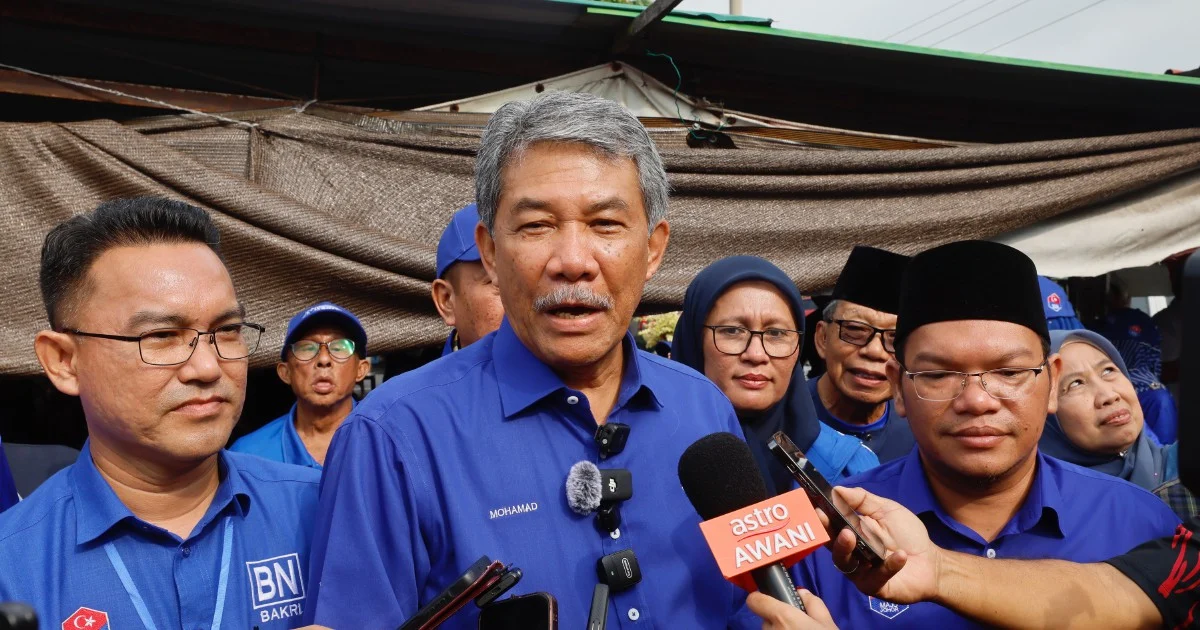
Barisan Nasional's second-ranked leadership has launched a sharp rebuke at the Democratic Action Party's highest-ranking member, demanding he step down from his governmental position over statements made regarding Johor's electoral politics. The confrontation, aired publicly in Muar, represents an escalation in tensions within Malaysia's ruling coalition at a time when party unity has already been tested by competing state-level ambitions and ideological differences.
Datuk Seri Mohamad Hasan, who holds the influential deputy chairmanship of Barisan Nasional, directed his challenge at Nga Kor Ming following the latter's commentary on Johor election dynamics. The demand to resign immediately signals that BN leadership views the remarks as sufficiently serious to warrant removal from office rather than internal reconciliation or correction. This aggressive stance suggests the coalition's patience with DAP's positioning has worn thin, particularly in a state where Barisan Nasional maintains traditional strength.
Johor, Malaysia's southernmost mainland state and historically a Barisan Nasional stronghold, remains politically significant for both coalition cohesion and federal stability. The state's electoral health directly impacts the federal government's legislative majority and regional influence. Any perceived undermining of BN's authority or electoral prospects in Johor therefore carries outsized consequences for the broader political landscape, making Tok Mat's response less about personal grievance and more about protecting coalition interests.
Nga Kor Ming's position as the most senior DAP figure within government structures makes his public statements particularly sensitive. As a minister and coalition member, his comments carry weight both domestically and internationally, potentially influencing investor confidence and diplomatic relationships. When such statements appear to contradict or critique coalition electoral strategy, they create friction with larger alliance partners who bear greater demographic and infrastructural responsibility for governance across the federation.
The timing of this conflict reflects broader questions about DAP's role within the Barisan Nasional-led coalition. The party's rapid rise to ministerial prominence has occasionally created friction with traditional BN components, particularly when policy positions or electoral narratives diverge. Johor, as a state with substantial Malay-Muslim populations and longstanding BN organizational structures, represents territory where DAP's influence remains limited and where coalition hierarchy is most keenly felt.
Tok Mat's ultimatum carries implicit institutional weight. As deputy chairman of the oldest and largest political coalition in Malaysia, his words reflect a collective position rather than individual opinion. The public nature of his challenge in Muar—a town deeply embedded in Johor's political consciousness—underscores that this is not a private disagreement but a formal coalition statement with audience-facing implications.
The escalating rhetoric between coalition partners raises questions about the stability of Malaysia's current governing arrangement. While similar tensions have surfaced previously without causing coalition collapse, each public confrontation incrementally tests the bonds holding together parties with fundamentally different electoral bases and policy objectives. Coalition stability depends partly on older members tolerating DAP's presence and partly on DAP exercising restraint in how it wields its expanded influence.
For Malaysian observers and regional analysts, this spat illuminates the continuing fragility of multi-party coalitions governing through consensus rather than command. BN itself comprises parties with historical tensions and competing interests; the addition of DAP, which entered federal coalition politics relatively recently through the Pakatan Harapan arrangement, has further complicated the balancing act. Leaders like Tok Mat must navigate between satisfying their traditional support base—which often harbors skepticism toward DAP—while maintaining the coalition unity necessary for government stability.
Nga Kor Ming's specific remarks about Johor elections have not been detailed in official statements, but the intensity of Tok Mat's response suggests the comments ventured beyond typical political disagreement into territory perceived as threatening to coalition narrative or electoral strategy. In Malaysian politics, where euphemism and indirect language often mask deeper grievances, such public ultimatums typically follow private discussions that failed to resolve underlying concerns.
The controversy also reflects the precarious mathematics of Malaysia's current Parliament, where the federal government's majority depends on maintaining coalition discipline across ideologically diverse partners. Loss of even a handful of DAP legislators through internal party crisis or cross-defection would materially weaken federal stability, making high-stakes public disputes like this one more consequential than they might appear in other political systems.
Looking ahead, observers will monitor whether Tok Mat's challenge escalates further or whether behind-the-scenes negotiations produce a resolution that allows both sides to claim victory. The coalition's ability to navigate such conflicts without breaking apart will significantly influence Malaysia's political trajectory over the coming years, particularly as next general elections approach and electoral calculations intensify.

