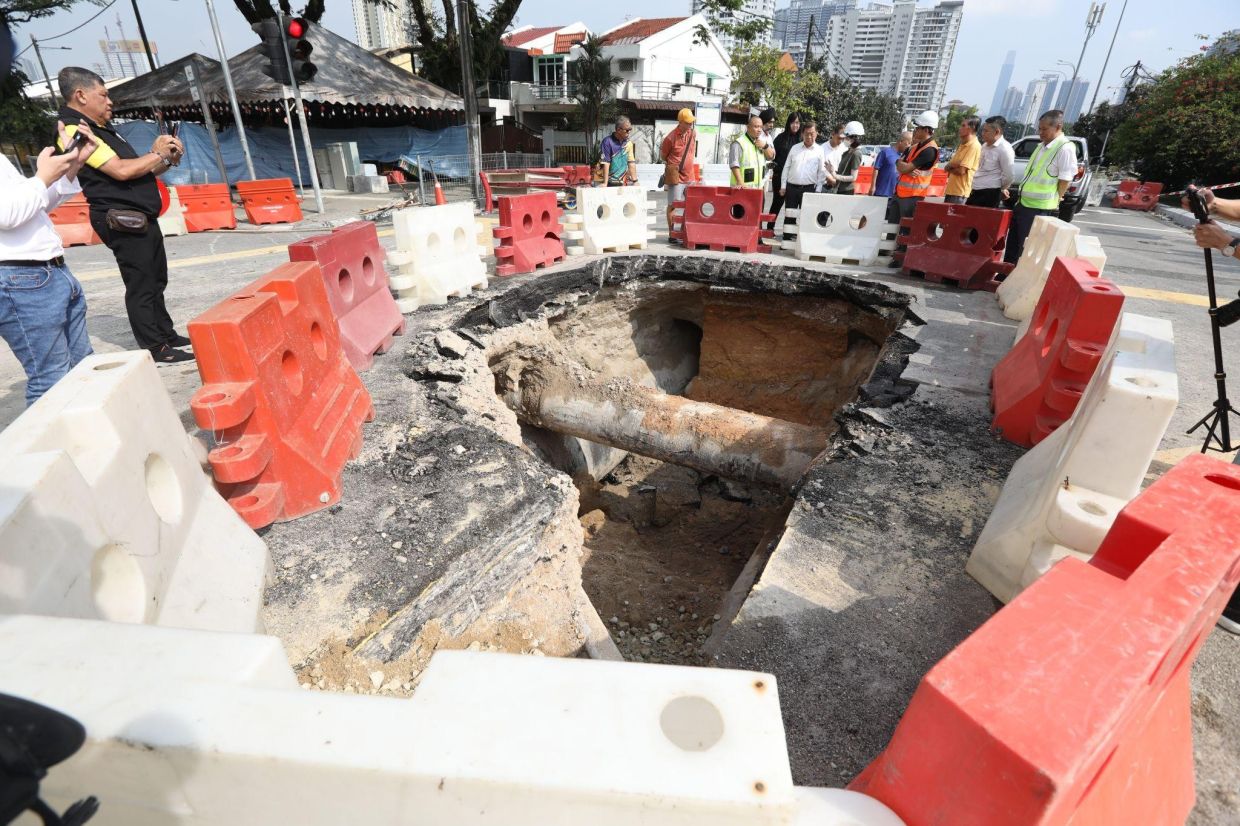
Malaysia's growing vulnerability to severe weather events has sharpened focus on an underground threat often overlooked until it catastrophically surfaces: sinkholes in the nation's ageing sewerage networks. The phenomenon, which occurs when subterranean voids collapse and swallow the ground above, is becoming an increasingly urgent concern for infrastructure managers as rainfall patterns grow more erratic and intense. Understanding both the mechanisms behind sinkhole formation and the strategies being deployed to prevent them offers insight into the broader challenge facing Malaysia's utilities sector in an era of climate volatility.
Sinkholes emerge from a complex interplay of geological, hydrological and infrastructural factors that vary significantly from incident to incident. Natural subsurface conditions interact with groundwater flows, construction activities and, critically, the deteriorating state of buried pipelines and other underground assets. The precise cause of any given collapse requires exhaustive technical investigation, as superficial analysis often misses the root drivers of failure. This complexity underscores why a standardised response is insufficient; each region and each pipe network demands tailored assessment and remediation.
Indah Water Konsortium, the statutory authority responsible for managing Malaysia's public sewerage systems, oversees approximately 22,500 kilometres of sewer pipelines spanning the nation. Within this vast network, particular concern centres on the large trunk sewers—those measuring 600 millimetres in diameter and above—which carry the bulk of sewage volumes and operate under constant stress. These reinforced concrete conduits are frequently running at or near maximum capacity, a condition that exposes them to high-velocity flows and the accumulation of hydrogen sulphide gas, a corrosive substance that degrades concrete structural integrity and accelerates deterioration. Over decades, this chemical assault combines with structural loading to weaken pipes, creating the preconditions for eventual failure.
To counter these vulnerabilities, IWK has adopted a proactive, risk-based approach to asset management centred on condition monitoring. The utility employs an arsenal of advanced inspection technologies adapted to different site circumstances: Ground Penetrating Radar permits subsurface imaging without excavation, while Closed-Circuit Television crawler systems provide detailed visual records of pipe interiors; push rod and pole cameras extend the inspection toolkit for areas where crawler access proves impractical. Periodic condition assessments using these tools generate data that guides targeted rehabilitation efforts, ensuring resources are directed toward the pipes and stretches posing the greatest risk.
Infrastructure rehabilitation follows a tiered approach aligned with inspection findings. Where deterioration is detected, IWK pursues trenchless sewer lining—a technique that restores structural integrity without extensive excavation—or, where damage is beyond recovery, complete pipeline replacement. Both strategies aim to restore the watertightness and load-bearing capacity that prevents the catastrophic failures leading to sinkholes. By addressing defects before they propagate into larger failures, this preventive model seeks to interrupt the chain of causation that transforms minor pipe damage into public emergencies.
The connection between extreme precipitation and sinkhole formation operates through several reinforcing mechanisms, according to Indah Water Konsortium chief executive officer Narendran Maniam. Heavy rainfall destabilises ground conditions by increasing moisture content, which reduces soil strength and can cause differential settling or lateral displacement. When saturated ground shifts, it can misalign or rupture nearby sewer pipes, creating immediate blockages and, in severe cases, complete breaks. The hydrostatic pressures generated by heavy flows exceed pipe design specifications, causing cracks that permit sewage and groundwater to escape into surrounding soil, a process that gradually excavates underground voids.
These developing cavities present a particularly insidious hazard: as the voids enlarge, the overburden above becomes increasingly unstable until sudden catastrophic collapse occurs. The resulting sinkhole can swallow vehicles, damage buildings and adjoining infrastructure, and create public safety emergencies with little advance warning. The social costs extend beyond property damage; sinkholes disrupt transport routes, compromise utility services and generate economic losses across affected areas. For ageing tropical cities like Kuala Lumpur, where older sewer networks with poorer construction standards underlie dense urban development, the exposure is considerable.
Rainwater infiltration presents a second pathway through which extreme weather stresses sewerage systems. When heavy precipitation falls on permeable surfaces or percolates through cracks and unsealed joints in the network, it enters the sewer lines designed primarily to carry domestic and industrial waste. This influx of stormwater dramatically increases volumes flowing through pipes, overwhelming treatment capacity and generating pressures for which older infrastructure was not engineered. Pipes already compromised by age or corrosion prove especially vulnerable; the additional hydraulic stress can trigger failures that might have remained latent for years or decades under normal flow conditions. The compounding effect—where extreme weather simultaneously destabilises ground and overloads pipes—creates windows of peak vulnerability when system failures cluster.
Recognising these escalating risks, IWK recently conducted a large-scale crisis simulation exercise at its Asian Sewerage Training, Research & Innovation Centre of Excellence facility. The tabletop exercise, which modelled a catastrophic sinkhole involving casualties and suspected damage to a major trunk sewer, allowed IWK to test operational protocols, emergency mobilisation procedures and coordination with external agencies including the Fire and Rescue Department and Royal Malaysia Police. Such simulations, while resource-intensive, reveal gaps in communication chains, identify resource bottlenecks and familiarise personnel with crisis procedures before actual emergencies demand split-second decisions. The exercise functioned as a diagnostic tool, exposing weaknesses in the standard operating procedures that will guide responses to real incidents.
The simulation findings will inform revision and enhancement of IWK's crisis management frameworks, ensuring that documented procedures reflect current operational capacity and inter-agency capabilities. Critically, the exercise ensured that frontline staff and management understood their specific roles during an emergency, reducing the confusion and coordination failures that often exacerbate crisis outcomes. By conducting the exercise in a controlled environment, IWK avoided the real-world costs of learning-by-doing while still capturing lessons applicable to actual scenarios. This investment in preparedness reflects an understanding that emergency response efficacy depends heavily on prior planning and rehearsal.
The escalation of extreme weather events across Southeast Asia presents Malaysia's infrastructure managers with an evolving challenge requiring sustained adaptation. Sinkholes, though geologically natural phenomena, are now increasingly triggered by human-created stressors: undersized or ageing sewerage networks, inadequate stormwater separation, sprawling urbanisation over fragile geology, and the intensifying precipitation regimes accompanying climate change. IWK's multi-layered response—combining advanced condition monitoring, targeted rehabilitation, emergency preparedness and inter-agency coordination—represents a comprehensive approach to reducing risk. Yet the scale of the challenge—22,500 kilometres of pipe, much of it decades old—means that resource constraints will perpetually limit the pace of remediation. For Malaysian communities, the emerging imperative is clear: protecting public safety from underground hazards demands continuous investment in infrastructure resilience, coupled with the planning and preparedness that transforms inevitable climate stresses into manageable challenges rather than catastrophic surprises.

