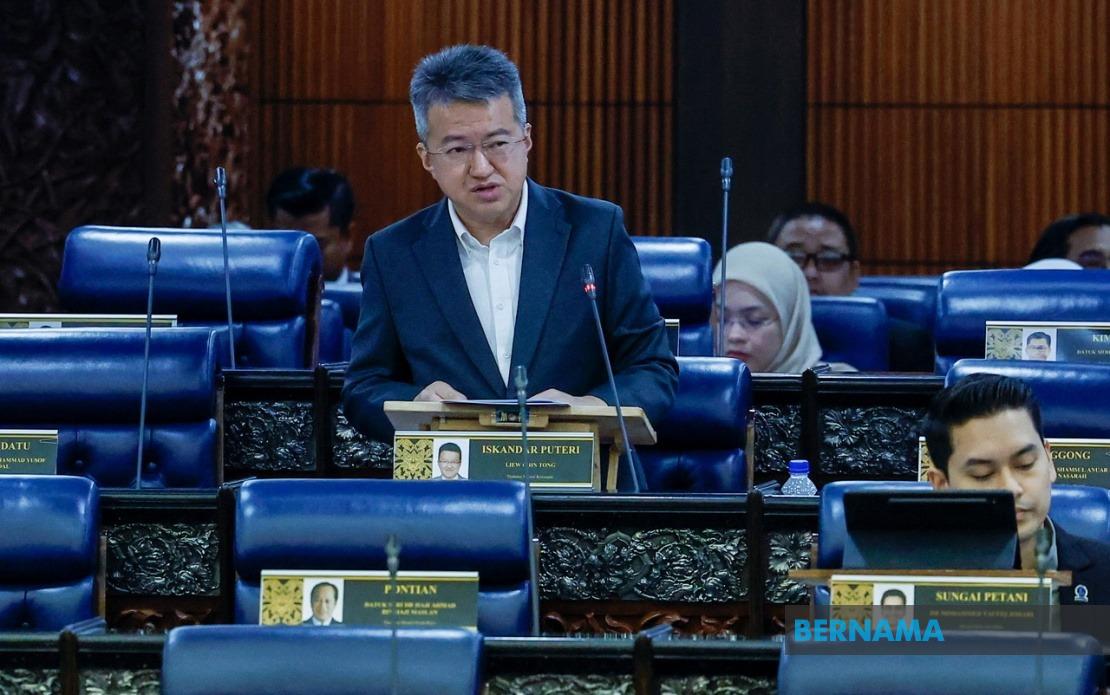
The federal government has moved to dispel concerns that a substantial injection of additional funding to Sabah could come at the expense of the state's infrastructure and development programmes. Deputy Finance Minister Liew Chin Tong made clear in Parliament that the RM1.5 billion interim special grant increase, announced by Prime Minister Datuk Seri Anwar Ibrahim in May, represents genuine additional federal support rather than a reallocation of existing development resources.
Liew's statement, delivered during the Special Chamber session at the Dewan Rakyat, directly addressed parliamentary questions raised by WARISAN member Isnaraissah Munirah Majilis regarding the mechanics and constitutional implications of the enlarged grant payment. The reassurance carries particular weight given long-standing sensitivities around federal resource distribution in Sabah, where perceptions of unequal development spending relative to Peninsular Malaysia have historically fuelled political grievance and shaped inter-governmental relations since the formation of Malaysia.
The federal government's commitment to maintaining development spending reflects a deliberate strategy to balance competing demands within the 2024 budget framework. Sabah's development allocation has expanded from RM6.7 billion to RM6.9 billion for the current year, channelling resources into flagship infrastructure projects including the ongoing Pan Borneo Highway, a critically important arterial route that promises to unlock economic potential across the island state's interior regions. Beyond this headline project, federal money continues flowing toward rural road networks, electrification programmes in remote areas, and water supply infrastructure serving communities beyond the reach of commercial utility providers.
Healthcare and education infrastructure have also received continued attention, with funds allocated for hospital construction and renovation, clinic expansion, and rehabilitation of deteriorating school facilities. The investment extends to police infrastructure improvements, reflecting federal recognition that security apparatus modernisation remains essential for economic development and investor confidence. These tangible projects provide the backbone for economic activity and social service delivery in communities that historically experienced infrastructural deficits compared to urban and developed regions.
The electricity subsidy arrangement between federal and state governments underwent significant restructuring in 2024 when regulatory powers transferred to Sabah, yet the federal government has committed to continuing direct financial support to keep power prices manageable for residents and industries. The subsidy allocation for 2026 is projected to reach RM880 million, indicating sustained commitment despite the shifting administrative relationship. This continuity matters substantially for electricity-intensive industries such as agriculture, small manufacturing, and resource processing that compete in regional and global markets where energy costs directly influence competitiveness.
Rural water supply improvements have received substantial budgetary uplift, with allocations nearly doubling from RM103.5 million in 2025 to RM143 million in 2024, addressing persistent gaps in service provision affecting scattered communities in interior districts. Concurrent with infrastructure investment, the federal government has channelled cost-of-living support through two targeted cash assistance programmes—Sumbangan Tunai Rahmah and Sumbangan Asas Rahmah—which together represent approximately RM1.2 billion in direct household transfers to Sabah. These schemes acknowledge inflationary pressures particularly acute in a state where transportation costs for imported goods inflate prices significantly above Peninsular Malaysia levels.
Liew emphasised that disbursement of the new special grant must follow constitutional procedures established under Article 112D of the Federal Constitution, maintaining consistency with implementation protocols observed in 2022, 2023, and 2025. This procedural framework involves coordination between federal and state governments to ensure proper accounting and deployment of funds within constitutional constraints. The reference to established procedures signals federal commitment to transparent governance around what represents a constitutionally mandated obligation rather than discretionary political patronage.
The federal government's approach to the special grant incorporates a significant degree of constitutional ambiguity requiring ongoing negotiation. While the government respects Article 112C's provisions establishing Sabah's entitlement to special grants, it simultaneously maintains an appeal against certain aspects of the Kota Kinabalu High Court's ruling on the matter. This dual posture reflects the complexity of constitutional interpretation around historical commitments made during Malaysian federation formation, where Sabah negotiated distinct financial arrangements reflecting its particular economic circumstances and political status.
Looking forward, Liew indicated that the federal government intends pursuing negotiations with the Sabah state government to establish a prospective mechanism for determining special grant amounts that aligns with both Articles 112C and 112D. Such a mechanism could provide greater predictability and reduce reliance on periodic judicial interventions to clarify ambiguities in constitutional language. The establishment of agreed methodologies would represent substantial progress toward resolving a constitutional question that has periodically generated friction between federal and state authorities.
For Malaysian federalism more broadly, Sabah's special grant arrangement carries significance beyond provincial resource distribution. The state's distinct historical position within the federation has always justified tailored financial arrangements reflecting its economic structure, geographic characteristics, and developmental needs. The current emphasis on infrastructure modernisation and household welfare support demonstrates recognition that Sabah's future prosperity depends on simultaneous investment in productive capacity and maintenance of social stability through targeted assistance reaching populations with limited alternative income sources.
The constitutional dimensions underlying these financial arrangements remain fundamentally important for federal stability. Sabah's position as a constituent member of the Malaysian federation rests partly on honouring the economic bargains struck at formation, and visible commitment to development spending helps reinforce the legitimacy of the federal arrangement among Sabah voters and political leadership. By assuring that special grant increases complement rather than substitute development allocations, the federal government attempts to demonstrate that accommodating constitutional obligations need not require sacrificing other policy priorities.

