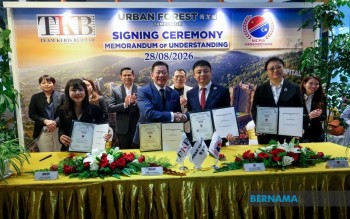
Perak's tourism landscape is poised for transformation with the announcement of a landmark RM1 billion urban forest development in Tambun, a project that represents a significant shift in the state's economic strategy. Team Keris Bhd, working alongside RJJ Hotels and the Malaysian Chinese Restaurant Association, plans to deliver an 84-acre integrated tourism and lifestyle destination within three years, positioning Ipoh to compete on the international stage rather than relying solely on domestic visitors. The initiative marks a deliberate pivot away from incremental tourism development towards a comprehensive ecosystem that weaves together accommodation, dining, retail, and experiential offerings into a cohesive destination brand.
The development carries substantial implications for how Perak approaches regional competitiveness. Perak Tourism, Industry, Investment and Corridor Development Committee chairman Loh Sze Yee articulated the vision during the signing ceremony at TKB headquarters, emphasizing that the urban forest will complement existing attractions such as Lost World of Tambun whilst elevating the entire ecosystem to international standards. This layering strategy recognizes that isolated attractions, no matter how well-developed, struggle to retain visitors for extended stays or command premium pricing. By creating a concentrated hub of diverse experiences, the project addresses a critical gap in Perak's tourism infrastructure: the ability to anchor multi-day itineraries that currently see visitors bypassing the state in favour of Kuala Lumpur, Penang, or direct international flights to other Southeast Asian destinations.
A distinctive element of the project is its deliberate curation of the food and beverage component, which will occupy 40 per cent of operational partnerships through the Malaysian Chinese Restaurant Association whilst reserving 60 per cent for independent Malaysian operators. This ratio represents more than mere diversity metrics; it reflects a strategic decision to position Malaysian culinary traditions as the primary draw for international tourism whilst avoiding over-dependence on any single cuisine or cultural narrative. Team Keris Bhd group executive chairman Datuk Lee Seng Hee emphasized that food serves as a powerful magnet for cross-border travel, and the urban forest will weaponize this insight by creating a concentrated marketplace where diners encounter authentic Malaysian offerings packaged for international consumption.
Muslim-friendly dining options will constitute 30 per cent of the F&B offering, a deliberate nod to market expansion beyond predominantly Christian-majority source markets. The Malaysian Chinese Restaurant Association is developing halal dim sum and other adaptations, acknowledging that Malaysia's halal certification framework provides competitive advantage in markets spanning the Middle East, North Africa, and South Asia. This approach demonstrates sophistication in demand segmentation: rather than attempting to serve all markets equally, the developers have identified that halal-certified products and experiences command premium pricing and loyalty from rapidly expanding middle-class consumers across Islamic-majority regions.
RJJ Hotels brings critical distribution infrastructure to the project through its affiliation with Jin Jiang Hotels, a network spanning more than 200 million members across 50 countries and operating over 40 hotel brands globally. This partnership addresses a fundamental challenge facing Perak tourism: visitor acquisition at scale. RJJ Hotels CEO Yap Lip Seng outlined a packageable tourism model that eliminates friction from the visitor journey, removing the question of how to reach Ipoh from major entry points like Kuala Lumpur or Penang. By bundling accommodation, meals, and experiences into integrated packages marketed through Jin Jiang's global distribution channels, the project transforms Ipoh from a day-trip destination into a multi-night base for extended regional travel.
The logistics of visitor retention receive particular emphasis in the project design. Rather than relying on spontaneous discovery or word-of-mouth, the developers envision coordinated packages that anchor visitors for multiple nights whilst showcasing diverse food experiences within the urban forest itself. This model addresses seasonal volatility and extends average visitor spend far beyond what single-attraction visits generate. International markets including Australia, Britain, and the United States represent primary targets, suggesting the developers have conducted market research indicating sufficient demand from these English-speaking demographics to justify the investment scale.
The supply chain implications merit attention within Malaysia's broader manufacturing context. Malaysian Chinese Restaurant Association president Gao Houyun articulated a vision for Perak as a production hub for Asian food ingredients, encouraging Chinese manufacturers of sauces, spices, and prepared components to establish facilities in the state. This represents economic integration beyond tourism services: by clustering food production with high-volume retail and hospitality consumption, the project creates backward linkages into agribusiness and food manufacturing. Products developed in Perak for the urban forest's international visitor base could subsequently scale into Southeast Asian distribution networks and export markets, leveraging Malaysia's halal certification as a non-tariff advantage against competitors in other Southeast Asian countries.
The skills development narrative constitutes another layer of economic impact. Gao emphasized that the Malaysian Chinese Restaurant Association will provide training and standards upgrading for local food service operators and workers, addressing a persistent challenge in Malaysia's hospitality sector: the skills gap between aspirational international service standards and current workforce capabilities. By concentrating training investment around a single high-visibility project, the developers create demonstration effects that ripple through the broader Perak hospitality industry, establishing benchmarks that smaller operators subsequently adopt.
The project timing aligns with regional tourism recovery patterns following pandemic disruptions, though it also reflects longer-term demographic and economic shifts. International visitor demand for authentic Asian experiences continues expanding amongst affluent Western demographics, particularly post-pandemic cohorts prioritizing experiential travel over conventional leisure. Malaysia's geographic position as a Southeast Asian hub positions it to capture a share of this demand, yet Perak has historically captured a disproportionately small percentage of international visitors relative to its attractions portfolio. The RM1 billion investment represents a bet that concentrated, professionally-managed infrastructure can materially shift this distribution.
Competing with other Southeast Asian destinations requires demonstrating sophistication that extends beyond simple value propositions. Thailand's Chiang Mai and Vietnam's Hanoi have established themselves as culinary tourism destinations by combining authentic food traditions with international service standards and networked accommodations. The Ipoh urban forest project applies this playbook to the Malaysian context, recognizing that Southeast Asian regional tourism increasingly operates through sophisticated distribution channels and professional marketing rather than organic backpacker networks. By anchoring this project in hospitality and dining partnerships with proven international reach, the developers position Perak to compete directly with established regional alternatives.
For Malaysia's broader tourism strategy, the project signals state-level innovation in destination branding and infrastructure investment. Tourism Ministry initiatives have emphasized domestic and regional market development, yet international arrivals remain concentrated in Kuala Lumpur and Penang. Perak's willingness to invest at scale in an integrated tourism ecosystem, coupled with strategic partnerships accessing global distribution networks, provides a template for other states exploring tourism diversification. The success or failure of this project will consequently carry implications beyond Ipoh, establishing precedents for how Malaysian regional governments approach tourism competitiveness and economic transformation.

