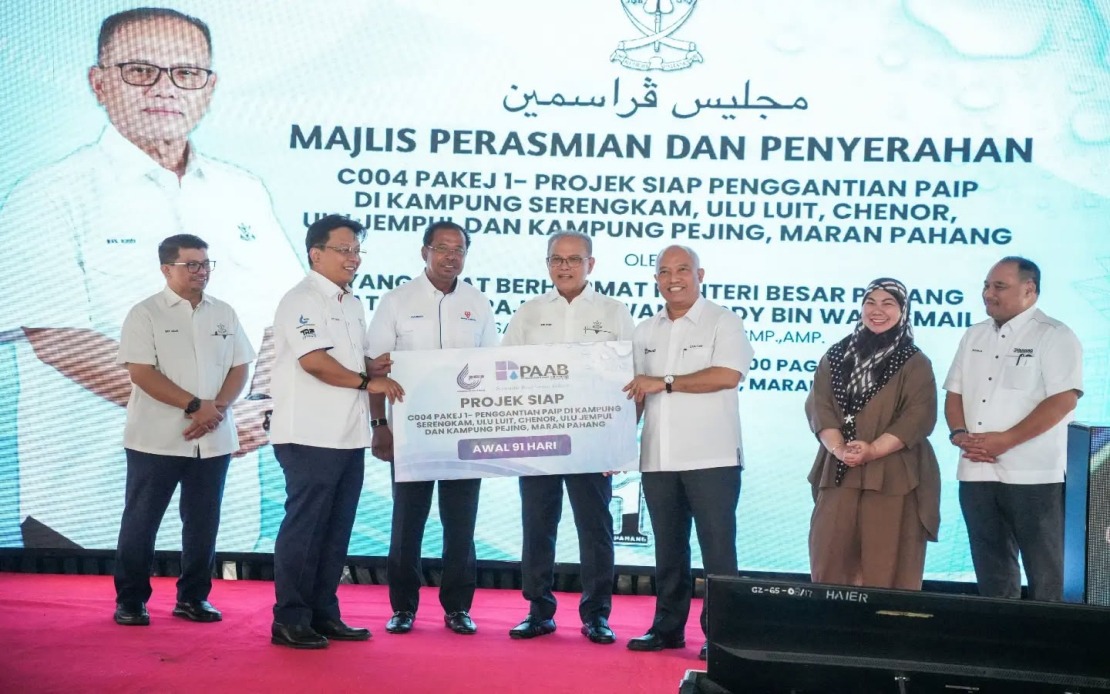
Pengurusan Aset Air Berhad (PAAB) has successfully concluded a RM11.19 million infrastructure initiative in Maran, Pahang, designed to rectify persistent clean water supply challenges that have plagued the district for nearly twenty years. The extensive pipe replacement scheme, which saw 29.6 kilometres of ageing water distribution lines renewed across multiple residential areas including Kampung Serengkam, Ulu Luit, Pejing, Ulu Jempul and Chenor, was delivered three months ahead of the original completion timeline. The completion of this project marks a watershed moment for the district's water security and reflects intensifying federal investment in Pahang's water infrastructure resilience.
The initiative directly benefits approximately 10,000 residents scattered across Maran's various communities, representing a significant improvement to their daily living conditions and economic prospects. The replacement of deteriorating pipes addresses one of the most persistent infrastructural challenges affecting the district: chronic water supply interruptions that have disrupted households, businesses and essential services with alarming regularity. These disruptions have proven particularly severe during periods of peak demand, such as the scorching dry season months and major festive celebrations when household and commercial water consumption surges substantially.
Beyond resolving the immediate problem of frequent pipeline ruptures, the project delivers measurable gains across multiple dimensions of water system performance. Non-revenue water losses—the sector's euphemism for unaccounted-for water loss through leakage and theft—should diminish significantly as modern pipes replace the crumbling infrastructure. Water pressure stability has also improved markedly, ensuring consistent supply at appropriate force throughout the distribution network, a challenge that previously forced residents to rely on storage tanks and alternative arrangements during peak usage periods.
Pahang Menteri Besar Datuk Seri Wan Rosdy Wan Ismail officially transferred ownership of the completed project during a ceremony held at the Chenor Water Treatment Plant, underscoring the political significance of this infrastructure milestone. The handover ceremony's attendance by Deputy Energy Transition and Water Transformation Minister Datuk Seri Abdul Rahman Mohamad and Deputy Economy Minister Datuk Mohd Shahar Abdullah signals sustained federal commitment to resolving water security issues in the state. The presence of PAAB chief executive officer Zulkiflee Omar and Pengurusan Air Pahang Berhad (PAIP) chief executive officer Datuk Saiful Zaini Mohd Bokhari highlighted the collaborative institutional framework underpinning these infrastructure developments.
The Maran project represents merely the initial phase of a far more ambitious three-year partnership between PAAB and PAIP aimed at comprehensively modernising water infrastructure across multiple Pahang districts. This coordinated approach reflects strategic thinking about long-term water security, moving beyond reactive crisis management toward proactive system-wide transformation. The collaboration signals recognition that piecemeal interventions prove insufficient; instead, systematic planning and coordinated investment across geographically dispersed areas offers superior outcomes.
Substantial complementary initiatives are already underway or in advanced planning stages. The Jengka Utama Water Treatment Plant faces electrical system upgrades designed to stabilise supply across the Felda Jengka settlement, where water disruptions have historically complicated agricultural operations and rural livelihoods. Meanwhile, a RM35.7 million undertaking involves replacing 76.2 kilometres of deteriorating pipes in Jerantut and Lipis, spanning areas near Pulau Tawar and Kuala Tahan, extending modern infrastructure to previously underserved communities. In Felda Keratong within Rompin district, a RM13 million pipe replacement scheme targeting 11 kilometres of supply lines aims to enhance water distribution efficiency across a substantial rural area.
These interconnected projects reveal PAAB's strategic focus on transforming Pahang's water infrastructure landscape systematically. As of July 2024, PAAB had committed RM1.17 billion toward water supply infrastructure across Pahang, with RM69.79 million already spent on completed projects, RM66.94 million allocated to ongoing construction efforts, and RM981.04 million earmarked for projects still in planning and design phases. This substantial financial commitment demonstrates the scale of infrastructure deficit that exists across the state and the magnitude of effort required to address it comprehensively.
For Malaysian readers, particularly those in less urbanised areas, the Maran project underscores a broader shift in how the federal government approaches water security beyond the Klang Valley and major metropolitan zones. Historically, rural and semi-rural communities have received disproportionately limited infrastructure investment, creating persistent service quality gaps. This initiative suggests evolving policy priorities recognising that water security represents a foundational component of rural economic development and quality of life. When residents spend countless hours managing water shortages instead of pursuing productive activities, entire communities suffer economically and socially.
PAAB, established in 2006 under the Water Services Industry Act 2006, serves as the primary vehicle for implementing the National Water Services Industry Restructuring Plan. As a wholly owned entity under the Minister of Finance Incorporated and regulated by the Ministry of Energy Transition and Water Transformation (PETRA), PAAB operates within a governance framework designed to ensure long-term infrastructure sustainability and service quality standards. PAIP, following its 2020 signature of the Pahang State Water Supply Services Restructuring Agreement, brings state-level operational expertise to these infrastructure initiatives.
The completion of the Maran project carries implications extending beyond the district itself. It demonstrates that systematic investment in water infrastructure can resolve long-standing service deficiencies affecting large populations. As Malaysia pursues broader water sector transformation goals—improving resilience against climate variability, reducing non-revenue losses, and ensuring universal access to reliable clean water—projects like Maran provide proof of concept for replicable models. The three-month ahead-of-schedule completion also suggests that coordinated implementation involving both federal and state entities, supported by experienced contractors and project management, can achieve efficiency gains.
Looking forward, the sustainability of these infrastructure improvements depends on ongoing maintenance, demand management, and water conservation practices among residents. The initial capital investment, substantial though it is, merely establishes the physical foundation; protecting that investment requires vigilant system management and community engagement around water conservation. As Malaysia confronts rising water demand from population growth, economic expansion, and climate change impacts, investments in infrastructure must be paired with demand-side interventions encouraging more efficient consumption patterns.
The Maran initiative ultimately reflects a maturing approach to water security that recognises infrastructure as essential to economic development and quality of life. Rural communities that previously suffered endemic water supply disruptions can now redirect resources and time toward productive pursuits, whether agricultural intensification, small business development, or human capital investment. When basic utilities function reliably, communities can focus on advancement rather than survival, unlocking economic potential that has remained constrained by infrastructure limitations. As Pahang and other Malaysian states pursue comparable infrastructure transformation, the Maran model offers valuable lessons in coordinated planning, adequate funding, and execution excellence.

