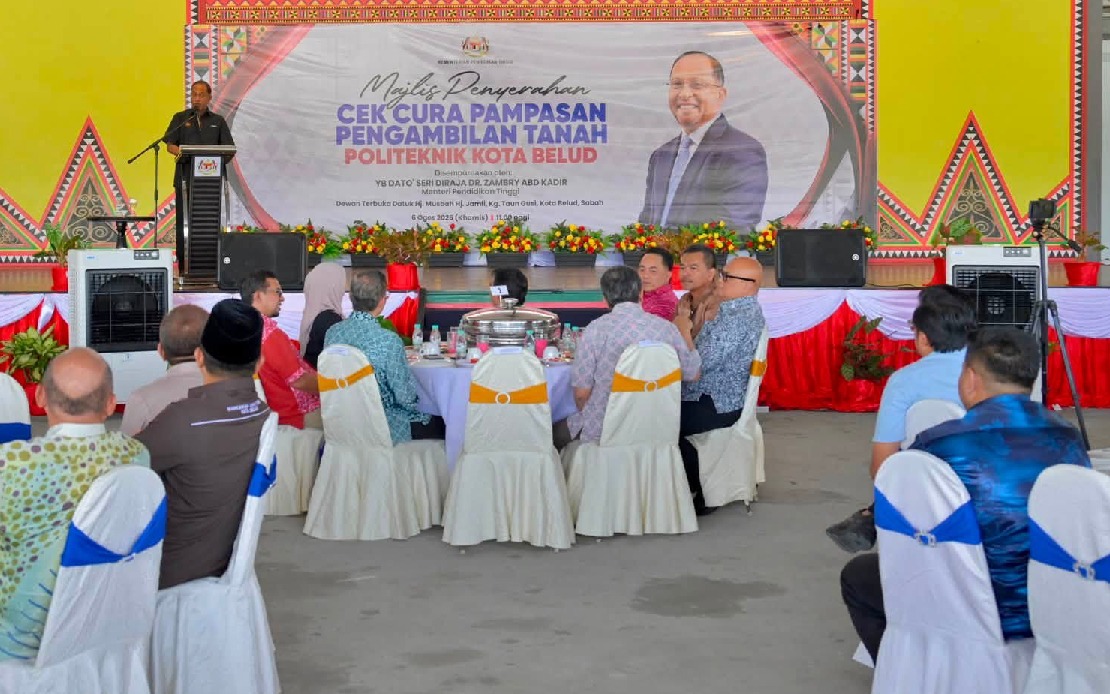
The long-awaited Politeknik Kota Belud moved closer to reality this week when Higher Education Minister Datuk Seri Zambry Abd Kadir oversaw compensation payments to landowners affected by the RM250 million development project. The ceremonial handover of compensation marked the formal transition from the land acquisition phase into active construction planning, signalling that the institution is now set to reshape Sabah's vocational education landscape by the end of this decade.
Zambry indicated that the polytechnic is expected to open its doors to its first cohort of approximately 500 students, with enrolment capacity subsequently rising to between 1,000 and 1,500 learners as the institution matures. This scaling approach reflects realistic projections for the institution's growth and suggests a phased expansion strategy that will allow for infrastructure development and staffing to keep pace with increasing student numbers. The planned capacity positions Politeknik Kota Belud as a significant regional vocational hub, capable of absorbing substantial numbers of school leavers seeking skills training across Sabah and neighbouring areas.
The polytechnic's curriculum philosophy is unambiguously aligned with Sabah's economic future rather than legacy industries. Rather than defaulting to traditional technical trade training, the institution will concentrate on high-technology programmes spanning green energy transition, artificial intelligence applications, computer science fundamentals, and technology-enhanced agriculture. This strategic focus acknowledges the state's need to diversify its economic base and prepare workers for positions in emerging sectors that are reshaping employment patterns across Malaysia and the wider region.
Zambry revealed that the project's conceptual origins trace back to 2017, when Kota Belud's then-Member of Parliament Datuk Seri Abdul Rahman Dahlan submitted the initial proposal. This extended gestation period underscores the complexity of establishing major educational infrastructure, encompassing feasibility studies, land acquisition negotiations, funding approval processes, and detailed planning phases. The transition from proposal to active implementation represents a critical juncture where political commitment must translate into sustained resource allocation and effective project management.
The anticipated completion date of 2030 places the polytechnic's opening roughly six years from now, a timeline that appears ambitious given typical construction schedules for tertiary education facilities. The minister's statement that the project will now progress through design and detailed planning phases suggests that architectural blueprints and engineering specifications remain outstanding. These planning stages, while necessary for technical rigour, frequently extend beyond initial projections, potentially compressing the construction window that remains.
The polytechnic's emphasis on green energy and sustainable technology reflects broader Malaysian policy direction toward environmental responsibility and clean energy transition. Sabah, with its natural resource endowments and geographic positioning in the ASEAN region, stands to benefit substantially from a skilled workforce trained in renewable energy systems and sustainable resource management. The curriculum design indicates that planners have assessed Sabah's medium-term economic opportunities rather than simply replicating technical education models from other Malaysian states.
The artificial intelligence and computer science focus addresses a documented shortage of digital skills across Southeast Asia's emerging economies. Malaysian employers across multiple sectors consistently report difficulty recruiting personnel with intermediate to advanced competency in software development, data analysis, and automation technologies. By establishing an AI-focused polytechnic in Sabah, the ministry is attempting to distribute digital skills training beyond the Klang Valley and other peninsular concentration zones, potentially reducing geographic inequalities in technological capability.
Smart agriculture programming acknowledges Sabah's agricultural heritage whilst positioning the sector for productivity gains through precision farming techniques, sensor networks, and data-driven crop management. This convergence of traditional agriculture with digital technologies reflects how vocational education must bridge heritage livelihoods and modernisation pressures. Farmers and agribusiness entrepreneurs equipped with such training can maintain rural economic viability whilst adopting efficiency improvements that enhance competitiveness in regional agricultural markets.
From a regional Southeast Asian perspective, Politeknik Kota Belud represents Malaysia's commitment to skills development infrastructure investment in states beyond the economic core. Singapore's dominance in advanced manufacturing and digital services partly reflects superior vocational education systems that identify and nurture technical talent at relatively early educational stages. By investing substantially in polytechnic infrastructure across Sabah and other peripheral regions, Malaysia signals serious intent to harness human capital development as a foundation for more balanced economic growth.
The compensation payments ceremony, whilst administratively significant for clearing land acquisition obstacles, also carries symbolic weight for Kota Belud residents who have awaited tangible evidence of the polytechnic's progression. Public confidence in government infrastructure projects depends partly on visible milestones and transparent evidence of momentum. The formal compensation process, conducted with ministerial participation, demonstrates institutional commitment and may facilitate smoother community relations as construction commences.
Looking ahead, the polytechnic's success will depend substantially on factors extending beyond 2030 completion. Recruitment of qualified academic staff specialising in green energy, AI, and contemporary agricultural technology may prove challenging, particularly if compensation packages prove insufficient to attract expertise from more established institutions. Equipment procurement and laboratory facilities must align with industry standards to ensure graduate credentials retain market value. Furthermore, ongoing collaboration with employers in target sectors will be essential to calibrate curriculum content with actual workforce requirements.
The timing of the polytechnic's establishment within Malaysia's broader educational and economic planning cycles is noteworthy. Zambry referenced the Third Rolling Plan under the 13th Malaysia Plan as the framework within which Politeknik Kota Belud's development will be financed and managed. This institutional anchoring within formal national planning mechanisms suggests the project enjoys bureaucratic support and budgetary commitment that should insulate it from political fluctuations. For Malaysian and Southeast Asian observers monitoring vocational education investment trends, this Sabah polytechnic exemplifies how developing nations are repositioning skills training toward future-oriented sectors rather than simply maintaining traditional technical education models.

