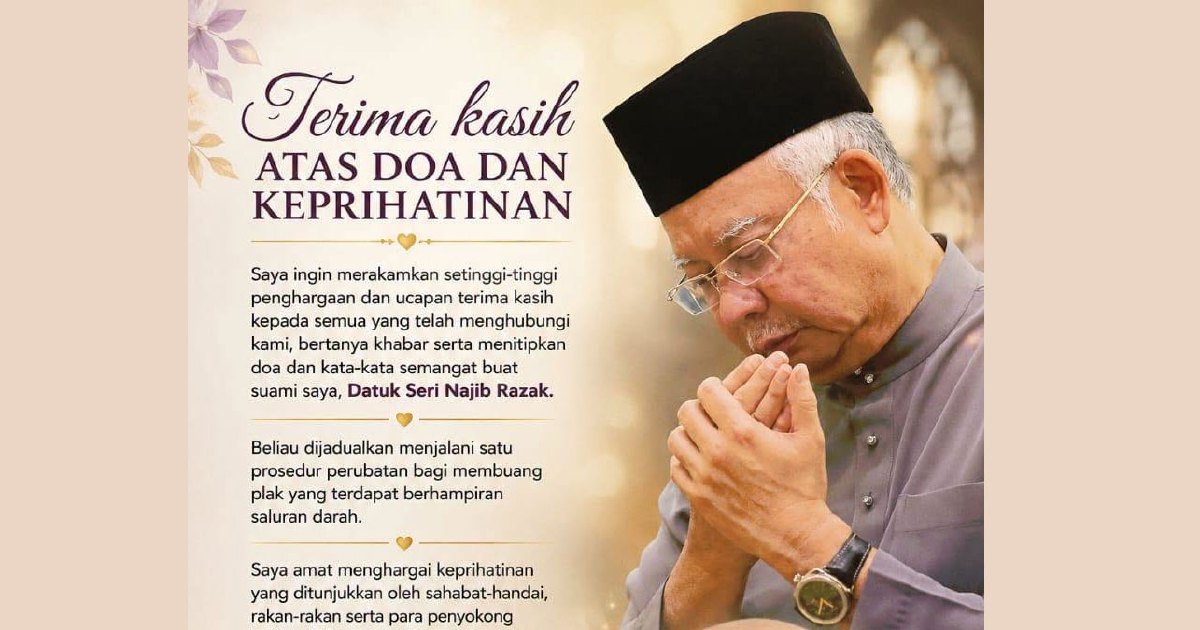
The wife of Malaysia's former prime minister has made a public appeal for prayers and well-wishes as her husband prepares to undergo a significant medical intervention. Datin Seri Rosmah Mansor issued the request on behalf of Datuk Seri Najib Razak, who is scheduled to receive treatment designed to remove plaque accumulation affecting a major blood vessel. The procedure represents a routine but important intervention in cardiac care, involving the clearance of arterial buildup that can impede blood flow and pose health risks if left unaddressed.
Rosmah's appeal reflects the gravity with which the family is treating the upcoming medical intervention, and underscores the continued public interest in the health and wellbeing of one of Malaysia's most prominent political figures. The former prime minister, who held office from 2009 to 2015, has remained a significant fixture in the nation's political landscape despite the considerable legal challenges he has faced in recent years. His health status thus carries implications extending beyond his immediate family circle to encompass broader national discourse.
The decision to make the medical procedure public knowledge represents a deliberate engagement with the Malaysian electorate, signalling transparency regarding Najib's condition even as he navigates an intense period of legal proceedings and political scrutiny. Such announcements often serve a dual purpose: they address legitimate public curiosity about the health of prominent figures while simultaneously humanising individuals within the political sphere by acknowledging their vulnerability to common ailments.
Atherosclerotic plaque buildup—the primary target of Najib's forthcoming treatment—remains a leading cause of cardiovascular complications across Malaysia and Southeast Asia. The prevalence of this condition has risen in tandem with lifestyle changes, dietary habits, and an ageing population across the region. Medical professionals typically address such blockages through interventional procedures that restore proper circulation without requiring invasive open surgery, making the therapeutic approach both medically sound and comparatively low-risk when performed by experienced teams.
Rosmah's gratitude towards her husband's supporters during this period acknowledges the network of well-wishers who have remained engaged with the couple through an extended period marked by legal turbulence and public debate. The expression of appreciation, coupled with the prayer request, appeals to the spiritual and emotional dimensions of Malaysian society, where faith-based responses to health challenges hold cultural significance. This framing permits supporters across different religious backgrounds to participate in expressions of goodwill regardless of their personal political views.
The timing of the procedure announcement carries weight within Malaysia's current political environment. Najib's health status intersects with ongoing legal proceedings and questions about his future political role, creating a complex backdrop against which the medical news must be understood. His capacity to participate in public life, attend court proceedings, and maintain engagement with his political base depends significantly on his physical wellbeing, making this intervention consequential for multiple stakeholders.
For observers within Malaysia and across Southeast Asia, the episode illustrates how health matters involving prominent political figures inevitably become subjects of public concern and discourse. Unlike private citizens, former heads of government operate within a framework where their personal circumstances frequently generate national conversation. The nature of Najib's condition—common enough that millions of Malaysians navigate similar health challenges annually—simultaneously renders it relatable to the broader population whilst elevating its prominence through his status.
The medical procedure itself falls within the established spectrum of cardiovascular interventions routinely performed at major Malaysian hospitals and international medical centres. Advancement in interventional cardiology over recent decades has transformed the treatment landscape for arterial occlusion, permitting effective resolution with minimal trauma and recovery periods measured in days rather than weeks. Modern facilities within Malaysia possess the technological capabilities and specialist expertise to deliver such treatments safely and effectively.
Rosmah's solicitation of prayers represents a culturally appropriate mechanism for seeking collective goodwill within the Malaysian context, where spirituality intersects prominently with matters of health and personal adversity. The appeal transcends political divisions by positioning the request within the universal framework of human concern for medical wellbeing. This approach enables Najib's supporters to express solidarity whilst creating space for the broader public to participate in an act of collective compassion independent of their political orientations.
Looking forward, the outcome of Najib's procedure will likely feature prominently in Malaysian media coverage and public discussion, with his recovery trajectory potentially influencing broader perceptions of his capacity to manage his various commitments and challenges. Successful resolution of the cardiac issue would enable him to continue his engagements without the distraction of unresolved health concerns. The procedure thus represents not merely a medical event but a checkpoint in the ongoing narrative of a controversial political figure navigating the complexities of post-prime ministerial life within a highly polarised national context.

