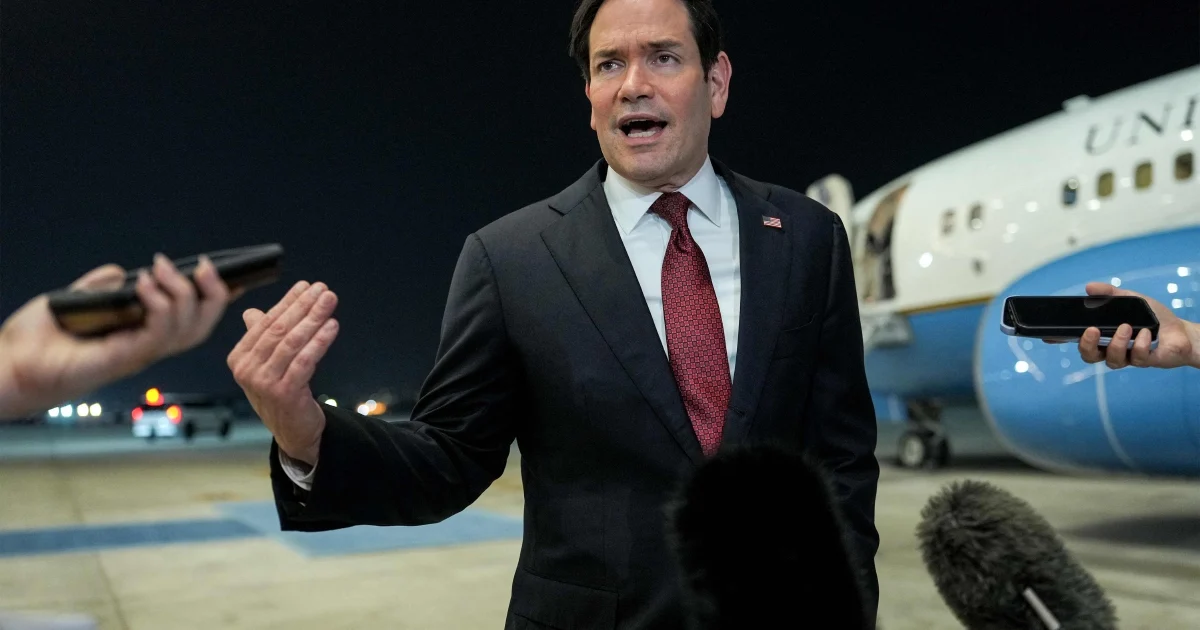
The United States has drawn a clear line in emerging negotiations over Middle East stability, with Secretary of State Marco Rubio flatly refusing to consider any Iranian levy system on vessels transiting the Strait of Hormuz. His statement on Tuesday underscores Washington's unwillingness to cede control over one of the world's most economically critical waterways, through which roughly one-third of global maritime oil traffic flows daily.
Rubio's position reflects longstanding American doctrine that international straits must remain open to unrestricted navigation under existing maritime law. The Strait of Hormuz, squeezed between Iran's coastline and Oman's peninsula, represents perhaps the single most important chokepoint in global energy markets. Any Iranian ability to levy fees—or worse, impose restrictions—would fundamentally reshape geopolitical and economic dynamics across Asia, Europe, and beyond. For Malaysia and other Southeast Asian nations dependent on stable energy supplies and predictable shipping costs, Iranian control over Hormuz traffic carries enormous implications.
The rejection of toll proposals marks only one of several substantive disputes now complicating what were expected to be relatively straightforward negotiations to stabilize the Middle East and end the ongoing regional conflict. Alongside the Hormuz question, negotiators are grappling with deeply contentious issues around Iran's nuclear programme and its arsenal of ballistic missiles. These three pillars—maritime access, atomic capabilities, and weapons systems—represent the core concerns that have defined US-Iran tensions for decades, and their simultaneous emergence in talks signals that early progress will be neither swift nor uncontested.
The nuclear inspection dimension remains particularly fraught. International monitoring of Iran's atomic facilities has been a cornerstone of previous agreements, yet verification mechanisms and the scope of permitted inspections continue to spark disagreement. Iran has historically resisted what it characterizes as intrusive external oversight of its nuclear installations, while the United States and its allies insist on robust, transparent verification to ensure compliance with any new accord. This fundamental tension between national sovereignty and international accountability has derailed past agreements and threatens to complicate current efforts.
Iran's ballistic missile capabilities add another layer of complexity. The country has invested heavily in developing and producing missiles of varying ranges, which Tehran views as a legitimate deterrent but which Washington and regional allies regard as destabilizing. Any comprehensive settlement would likely require limits on Iranian missile development and testing, yet such restrictions sit uncomfortably with Iran's strategic calculus and its sense of national defence requirements.
For Southeast Asian observers, the unraveling of these negotiations carries practical weight. Malaysia and other regional trading nations depend on uninterrupted energy flows and predictable maritime conditions. Disruption to Hormuz shipping—whether through conflict, new tolling schemes, or heightened tensions—directly inflates energy costs, disrupts supply chains, and introduces economic uncertainty. The region's manufacturing and refining sectors are particularly vulnerable to any shock affecting oil availability or price stability.
The convergence of these disputes also reveals how fragile the current diplomatic window may be. Initial negotiations often feature agreement on procedural matters and broad principles before narrowing to specific details. Yet Rubio's early and emphatic rejection of toll proposals suggests that the United States is taking a harder line than might be expected at this preliminary stage. This posture could reflect confidence in American negotiating strength, or it could signal that Washington views Iranian demands as non-starters from the outset.
Iran's apparent willingness to raise the toll question demonstrates Tehran's desire to extract maximum concessions from negotiations. Control over Hormuz traffic would provide Tehran with both economic leverage and geopolitical clout, potentially enabling it to pressure neighbours and extract payments from trading partners. For a nation under severe economic sanctions, such mechanisms represent attractive sources of revenue and influence. However, the American rejection indicates that this particular demand will not be accommodated, at least not without enormous shifts in the broader negotiating context.
The appearance of these disputes so early in talks may actually signal realistic expectations on both sides. Rather than papering over disagreements with vague language, negotiators are confronting substantive issues directly. This approach, while creating friction, potentially allows for more durable agreements if compromises can ultimately be found. Alternatively, the early emergence of seemingly unbridgeable gaps could portend a return to confrontation rather than resolution.
For Malaysia and the broader region, the critical variable is whether these negotiations ultimately produce a durable framework preventing renewed conflict in the Middle East, or whether they collapse and trigger another cycle of escalation. Either outcome carries implications stretching far beyond the Middle East itself, affecting energy security, shipping safety, and economic stability throughout Southeast Asia and globally.

