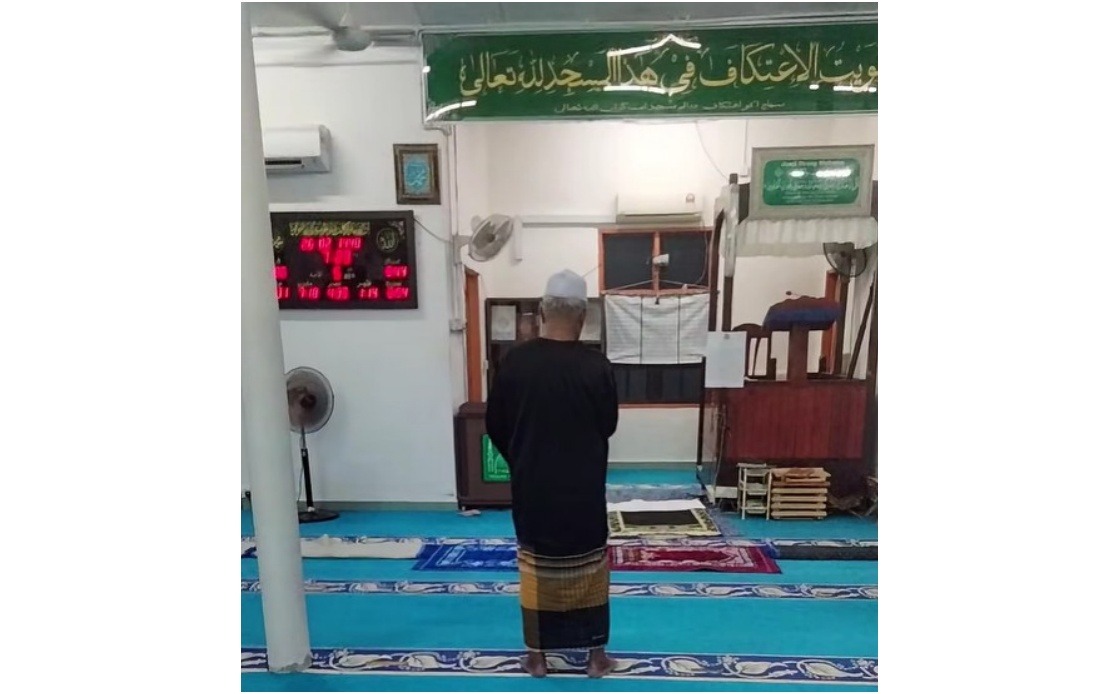
A short video circulating on social media has brought unexpected attention to Masjid Tanjung Resang in Mersing, a coastal district in Johor, when it depicted what appeared to be a solitary worshipper performing prayers at the mosque. The 15-second clip, shared across Facebook and WhatsApp in recent days, prompted questions about the spiritual vitality and administrative capability of the place of worship, particularly after observers noted that the lone figure seemed to be simultaneously serving as the congregation's imam and bilal—the roles of prayer leader and call-to-prayer announcer.
Mersing's Member of Parliament, Muhammad Islahuddin Abas, who himself resides in the area, moved quickly to clarify the situation and provide context that the viral moment did not represent the mosque's typical state of affairs or commitment to religious programming. In comments made to journalists at the mosque premises, he acknowledged that the locality indeed grapples with a persistent demographic challenge: although the village contains numerous residential structures, the actual number of residents has dwindled over time as people have relocated for employment opportunities elsewhere or chosen to settle in other regions. This outward migration stands as a significant structural issue affecting not only worship participation but also the broader sustainability of community institutions in the locality.
Despite these population pressures, Muhammad Islahuddin emphasized that the mosque's leadership continues to operate a full calendar of religious and educational activities. Weekly programmes including religious lectures, theological talks, and Yasin group recitations proceed without interruption, demonstrating organizational consistency even when the congregation may sometimes appear sparse. The MP's characterization underscores a distinction between low attendance figures—which reflect unavoidable demographic reality—and institutional dysfunction or neglect, a crucial nuance often lost in social media discourse.
The circumstances surrounding the video itself proved notable to Muhammad Islahuddin, as he initially learned of the controversy not through local channels but via a screenshot forwarded by an acquaintance in Kuala Lumpur. This discovery pattern illustrates how rapidly content can traverse Malaysia's social media landscape, reaching audiences thousands of kilometers away from the original location. His initial surprise at receiving the message from a distant contact highlights how viral narratives can emerge and gain traction before local authorities or stakeholders have opportunity to provide factual counter-context.
Yet the MP chose to frame the publicity in terms of potential benefit rather than mere reputational damage. He observed that the unexpected attention, while triggered by a misleading visual representation, has inadvertently served a promotional function by raising awareness of Masjid Tanjung Resang among people beyond the immediate district who might otherwise never have encountered it. This silver lining perspective reflects pragmatic thinking about information ecology: once content enters circulation, efforts to control narrative become less productive than efforts to redirect attention toward constructive outcomes.
Geographic isolation compounds the mosque's visibility challenge. Muhammad Islahuddin noted that the facility occupies a position removed from main thoroughfares, situated in a location that renders it relatively inconspicuous to passersby and even to residents of neighboring districts who may traverse Mersing without encountering the mosque's physical presence. This seclusion means that despite the mosque's existence and programming, knowledge of its availability and functions remains limited even within the administrative area it serves. Such invisibility is not uncommon among rural religious institutions across Malaysia, where infrastructure distribution often skews toward more densely populated zones.
The mosque has developed a particular role within its immediate context that extends beyond conventional congregational worship. Muhammad Islahuddin characterized it as hosting diverse visitor populations, including hikers preparing for or returning from ascents of Gunung Arong, the prominent mountain feature in the locality. The facility has positioned itself as a way-station of sorts, offering practical amenities and hospitality to outdoor enthusiasts, including non-Muslim visitors, thereby fulfilling a community service function alongside its primary religious purpose. This multi-use approach reflects adaptive management in resource-constrained settings.
Abdul Syamil Abdul Fadzil, the mosque's chairman, provided additional clarification regarding the viral video's actual content and context. He disclosed that state-level Islamic authorities from the Johor Islamic Religious Affairs Department (JAINJ) had initiated contact with mosque leadership following the video's circulation, indicating that the matter had attracted governmental attention. However, this official engagement, rather than revealing problems, confirmed departmental awareness of the mosque's true operational circumstances and challenges. Abdul Syamil explained that the individual visible in the 15-second recording was performing a voluntary prayer, a personal devotional act distinct from congregational prayer, and therefore did not accurately represent typical attendance patterns or the mosque's functioning.
The chairman's statement emphasized that regular religious activities continue at the facility despite media representations suggesting otherwise. This consistency of programming stands as the relevant measure of institutional health, he suggested, rather than snapshot moments captured in brief video clips that may distort context. His defensive posture, while understandable given the reputational implications, also reflects the vulnerability of small institutions to misrepresentation through selective documentation and rapid sharing without explanatory information.
The incident illustrates broader tensions in Malaysia's information environment regarding rural development and demographic change. Rural communities throughout the country face similar pressures of out-migration and population decline, affecting the sustainability of local institutions from mosques to primary schools to community centers. When such challenges become visible through unexpected viral content, they can trigger broader discussions about how Malaysia's economic development and urbanization have reshaped settlement patterns and created geographic disparities in demographic vitality.
From a practical standpoint, the controversy highlights how rural religious institutions might benefit from proactive communication strategies that preempt misunderstanding. Regular updates about programming, documentation of activities, and targeted outreach to individuals who may have migrated but retain community connections could build understanding and perhaps even support for rural mosque operations. The unplanned publicity surrounding Masjid Tanjung Resang, while initially unwelcome, has created an opportunity for more intentional narrative development.
The situation also underscores how demographic realities shape institutional life in rural Malaysia differently than in urban centers, where population density ensures consistent congregational participation. Rural religious leaders must navigate expectations developed in urban contexts while managing institutions suited to smaller, more dispersed populations. Masjid Tanjung Resang's experience reflects these broader structural realities affecting rural mosque management throughout the country, making this local incident relevant to policymakers and religious administrators across multiple states.

