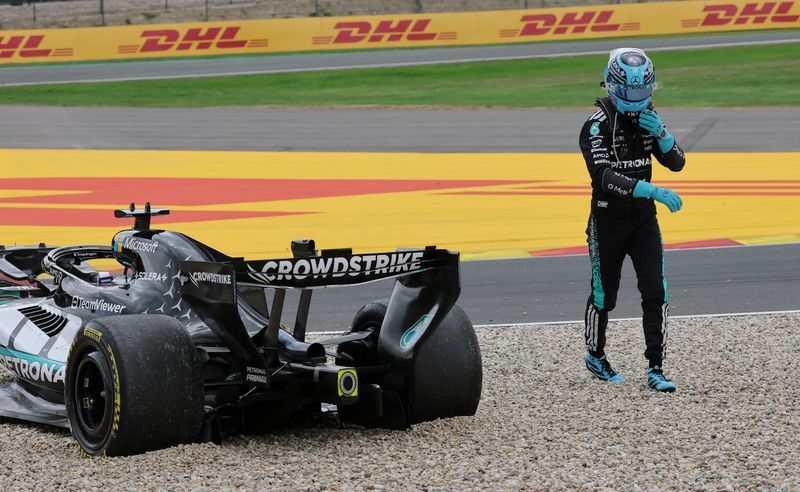
George Russell's troubles at the Belgian Grand Prix have left him confronting the harsh reality of a deteriorating season. The Mercedes driver's Sunday disappointment at Spa-Francorchamps was compounded not merely by the opening-lap incident with Ferrari's Lewis Hamilton, but by a cascade of mechanical failures that undermined his competitive standing from the very first corner. Russell's resignation—expressed as numbness to repeated setbacks—reveals the mounting frustration of a driver whose title ambitions are slipping away with each race weekend that goes wrong.
The collision itself was dramatic but relatively straightforward: Russell, having started third on the grid, lost crucial ground along the opening straight before attempting an audacious pass on Hamilton heading into the high-speed Eau Rouge section. The pair made contact, sending the Mercedes driver spinning into the gravel trap whilst Hamilton, despite steward scrutiny, continued racing and ultimately received a five-second penalty for causing the collision. What made this particular incident noteworthy was Russell's own analysis: he acknowledged that whilst the incident with Hamilton constituted a racing accident, the real culprit was his car's mysterious electrical failure.
The technical narrative that emerged from Russell's post-race debrief paints a picture of a driver wrestling with systems failures rather than competing fairly on track. According to Russell's account, his battery management system failed to recharge properly at Turn One, leaving him depleted of the electrical power needed for the hybrid system's deployment. This deficit—35 percent down on power exiting the first corner—cascaded into further problems, with the turbocharger failing to recover boost pressure as the car climbed toward Eau Rouge. By the time Russell reached that legendary Belgian section, he had zero percent battery charge remaining, placing him in genuine physical danger from both the track conditions and the faster cars surrounding him.
This technical breakdown represents more than a single weekend's misfortune for the British driver. Russell has now failed to score points in three consecutive races, a devastating stretch for someone locked in a title fight. His Mercedes teammate Kimi Antonelli, meanwhile, sits 25 points clear at the head of the championship standings after winning six times already this season, having sampled two retirements of his own. The gulf between the teammates—ostensibly driving identical machinery—suggests systemic issues or perhaps a concerning disparity in operational execution within the Mercedes camp.
Russell's remarks about being "numb to the disappointment" carry particular weight given the frequency of his recent troubles. The veteran driver's capacity to absorb repeated setbacks without erupting speaks to his psychological resilience, yet it also underscores the frustration of someone experiencing what feels like compounding bad luck. His phrase "when it happens so often you just get used to it" suggests resignation more than acceptance, hinting at deeper concerns about whether Mercedes can resolve whatever combination of mechanical and strategic issues have plagued his recent performances.
The qualifying Saturday warning Russell had issued about straight-line speed issues apparently went unresolved overnight. This suggests either that Mercedes engineers underestimated the severity of the problem or that the solution space proved limited before Sunday's race. For a team that has traditionally prided itself on technical excellence and precision, such oversights are particularly troubling. The gap between identification and rectification in Formula One—where every marginal gain matters—can determine championship outcomes.
Context matters significantly for Malaysian and Southeast Asian motorsport enthusiasts. Formula One's technical complexity and the potential for equipment failures represent the sport's least glamorous but most consequential aspect. Russell's experience serves as a reminder that whilst driver skill remains paramount, the machinery fundamentally determines competitive viability. Teams investing in preparation and reliability often extract rewards that appear to stem from driver performance alone, yet are genuinely rooted in engineering execution and operational discipline.
Hamilton's involvement as the collision partner adds narrative intrigue, though Russell's assessment that his former teammate bore greater responsibility whilst remaining blameless in intent reflects the nuanced reality of split-second racing decisions. The five-second penalty ultimately mattered little for Hamilton, who continued his afternoon whilst Russell walked away from the wreckage. This imbalance—where one driver faces consequences for an incident whilst continuing to race, whilst another's day ends completely—represents the lottery aspect of motor racing incidents.
Looking forward, Russell faces a critical juncture in his title campaign. With nine rounds completed of the 22-race calendar, Antonelli's 25-point cushion is substantial but not insurmountable. However, the mechanical problems Russell encountered demand urgent resolution. Mercedes cannot afford to lose Russell as an operational component of their championship challenge whilst simultaneously losing races on the basis of equipment failures rather than performance deficits. The team's engineering department faces mounting pressure to identify whether Sunday's battery and turbo issues stemmed from a one-off malfunction or represent a design vulnerability requiring comprehensive redesign.
Russell's composure in defeat, whilst admirable, perhaps masks the deeper anxiety a driver must feel when confronted with uncontrollable technical variables. His willingness to absolve Hamilton of reckless intent whilst reserving anger for his team's equipment represents a mature perspective, yet it also illustrates the complex challenge Mercedes faces. The team must restore Russell's confidence not through motivational rhetoric but through demonstrated mechanical reliability and strategic excellence in the races that remain.

