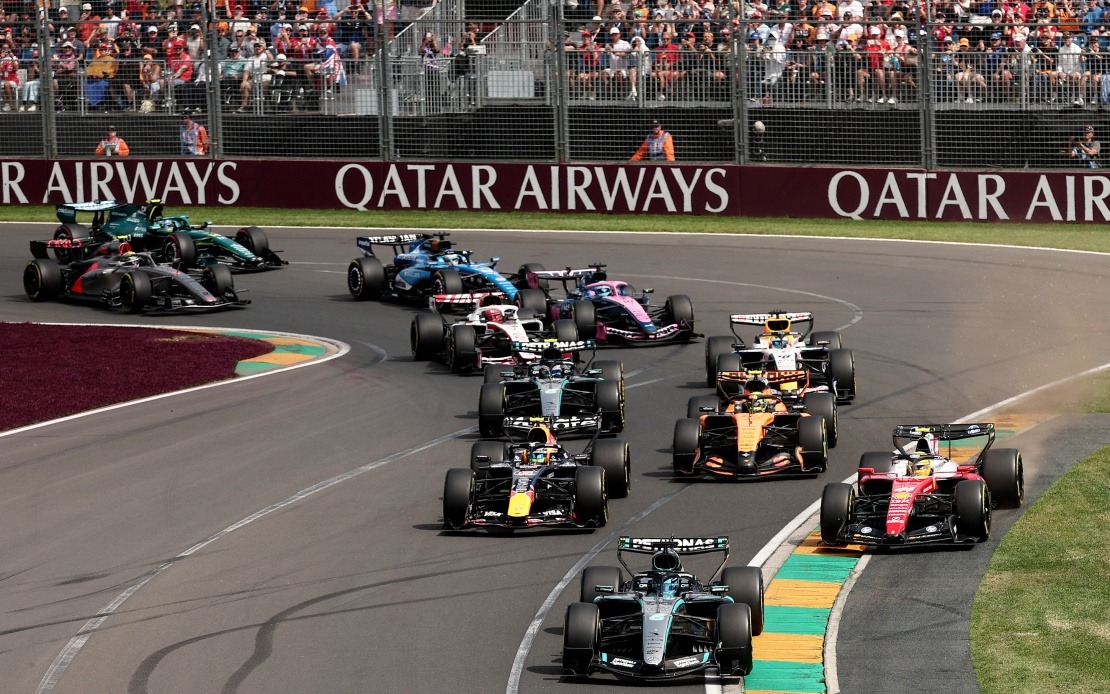
George Russell's championship aspirations suffered a significant blow at Spa-Francorchamps when a technical failure and subsequent collision forced him out of the Belgian Grand Prix, prompting an angry on-radio outburst directed at his Mercedes team. The British driver now trails his teenage teammate Kimi Antonelli by 50 points in the standings after the Italian secured his sixth victory from the season's opening ten races, a gap that has effectively strangled Russell's realistic path to the world title.
The sequence of events that undid Russell's weekend began early in the race when a first-lap engine deployment problem left him vulnerable to the chasing pack, an issue that had already plagued his qualifying session where he finished half a second behind Antonelli. That vulnerability proved costly when contact with Lewis Hamilton—his own Mercedes teammate—ended his afternoon entirely, transforming what had been a frustrating but salvageable situation into race retirement. In an unbroadcast radio transmission that emerged after the final flag, Russell's composure fractured completely, demanding answers from the garage about the state of his battery charge down the Mulsanne-adjacent straights.
The technical problem that undermined Russell's performance illustrated the complexity and fragility of modern Formula 1 power units operating under the new regulations. Mercedes initially suspected the issue stemmed from Russell's driving style, a theory that diagnostic analysis quickly demolished, leaving engineers baffled and Russell increasingly despondent. The problem specifically manifested as insufficient energy availability for deployment into Turn 18, effectively costing him somewhere between half and slightly more than half a second compared to Antonelli's competitive pace—a gap that explains much of the qualifying deficit but offers little consolation to a driver watching his championship dream evaporate.
Russell's emotional state had clearly deteriorated through a season marked by a catalogue of mechanical misfortunes. His radio commentary reflected raw frustration beyond typical race-day tensions, with his declaration of being "numb to disappointment" suggesting that these failures had worn down his psychological resilience. The driver expressed hope that Mercedes could resolve the issues before the Hungarian Grand Prix, the final round before the summer break, but the tone conveyed diminished optimism rather than genuine expectation of revival.
Mercedes team principal Toto Wolff responded to the criticism with a mixture of understanding and institutional defensiveness. Wolff acknowledged that drivers experience intense emotions during technical failures—a statement validating Russell's frustration while subtly suggesting his reaction remained within acceptable parameters for an elite athlete facing extraordinary circumstances. Wolff emphasized the privilege of driving for Mercedes and attempted to reframe the narrative toward team solidarity and shared problem-solving.
Wolff's technical explanation revealed how contemporary F1 power unit systems operate as integrated wholes where driver inputs, energy harvesting strategies, and deployment protocols interact in ways that resist simplistic diagnosis. He characterized the new regulations as naturally producing reliability challenges and positioned the identification of Russell's specific issue at Spa as a fortunate occurrence, since the Hungarian circuit's different energy profile would have obscured the problem until it potentially recurred in unpredictable circumstances. This acknowledgment of luck—that the malfunction happened at a track where it could be identified—underscored how random mechanical failures have become decisive factors in championship contention.
The contrast between Antonelli's dominant form and Russell's struggles presents an uncomfortable narrative for Mercedes and for Russell personally. The nineteen-year-old has transformed the team dynamic, producing six victories from ten races while his experienced teammate battles not merely against the opposition but against his own machinery. From a Southeast Asian perspective, where Mercedes maintains significant commercial operations and audience interest, this technical disparity raises questions about whether the team's resource allocation or engineering focus might inadvertently favor one driver's setup and reliability over the other.
Russell's championship mathematics have become bleak with mathematical precision. Trailing by 50 points with limited rounds remaining, even a string of victories cannot overcome the deficit unless Antonelli experiences several non-finishes or dramatic underperformance—scenarios unlikely given the teenager's demonstrated competence and the apparent superiority of his car-driver combination. The retirement at Spa effectively closed off realistic pathways to the title, transforming the remainder of the season into recovery exercises for morale and reputation rather than genuine championship pursuit.
Wolff's assertion that the team remains "100 per cent behind" Russell appeared designed to defuse potential tensions about whether Mercedes might shift focus toward the clearly superior Antonelli. Such team statements, when issued after high-profile criticism, often mask subtly altered priorities and resource allocation. The statement also attempted to normalize Russell's emotional outburst as characteristic behavior during difficult spells—a framing suggesting that frustration and expletive-laden radio messages represent normal sporting passion rather than indications of deeper concerns about the driver-team relationship.
The Belgian Grand Prix episode encapsulates broader questions about how unpredictable technical failures distribute competitive advantages in Formula 1. Russell faced through no fault of his own an equipment malfunction that opened the door to collision with his teammate, a sequence of events illustrating how mechanical unreliability can alter championship trajectories. For Malaysian observers familiar with regional motorsporting development, the contrast between Russell's predicament and Antonelli's rise demonstrates why young drivers with maximum computational and mechanical support systems can rapidly overtake established competitors when reliability distributions favor them.
Looking ahead to Hungary and the summer break, Russell faces the psychological challenge of rebuilding confidence after a season where machinery rather than driving skill has repeatedly been the limiting factor. Wolff's coaching language about "recreating optimism and positivity" suggests that Mercedes recognizes the mental and emotional dimensions of Russell's situation require as much attention as the technical fixes. The driver's admission of numbness represents a dangerous psychological state for any competitor, indicating that cumulative disappointments have begun exceeding his emotional capacity to process them as isolated incidents.

