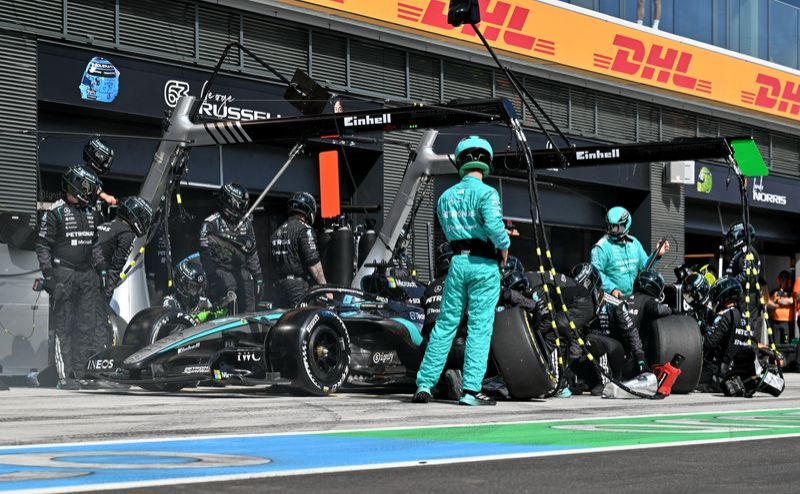
George Russell's patience has worn thin after another mechanical failure crippled his championship ambitions at Sunday's Hungarian Grand Prix, with the Mercedes driver now openly acknowledging he has transcended simple disappointment into a state of resignation. The pre-season favourite and current title contender sat devastated in the aftermath of the Budapest race, having started sixth on the grid only to catastrophically lose positions on the opening lap when his car's anti-stall system engaged without warning, pitching him toward the rear of the field. Though Russell salvaged a seventh-place finish from the wreckage, the damage to his championship hopes continued its relentless accumulation, with his Italian teammate Kimi Antonelli finishing third and cementing a commanding 59-point advantage after 11 of 23 rounds.
The recurring nature of Russell's mechanical tribulations has begun weighing heavily on the 26-year-old's mental resilience. "I am past the point of disappointment now," he confessed to assembled media, his tone reflecting exhaustion rather than the fire typically associated with competitive athletes confronting adversity. Russell articulated a philosophy of necessity rather than optimism, explaining that persistent frustration would render him miserable throughout every waking hour. The driver identified a troubling pattern wherein his engine began revving erratically approximately four seconds before the race start, suggesting a fundamental disconnect between throttle input and mechanical response on what Mercedes had installed as a brand-new power unit. Such systemic failures across multiple races have transcended random misfortune and entered territory that troubles both driver and team leadership alike.
What distinguishes Russell's predicament from typical on-track setbacks is the apparent concentration of mechanical gremlins affecting his vehicle relative to his peers. While acknowledging that technical problems occasionally impact other teams, Russell's frustration stems from the disproportionate frequency with which his car malfunctions compared to competitors operating similar equipment. He emphasised this disparity while carefully avoiding public recriminations, noting instead that the difficulties represent broader team failures rather than isolated incidents affecting only his machinery. This diplomatic framing reflects professional maturity, yet masks the underlying reality that Russell has endured a season fundamentally different from his pre-championship-favourite status.
Mercedes team principal Toto Wolff responded to Russell's latest setback with uncharacteristic directness, accepting full institutional responsibility and acknowledging insufficient performance in addressing the accumulating problems. Wolff's statement that "it isn't good enough" carried weight precisely because his organisation has achieved legendary status through precision engineering and operational excellence. The public admission of failure, unusual for Mercedes leadership, underscores genuine concern within the team environment regarding their inability to deliver reliable machinery to their senior driver. The team continues implementing solutions, yet the interval between problem identification and practical resolution has extended too long, with each race weekend offering fresh opportunities for mechanical betrayal.
The mathematical reality of Russell's championship position has become increasingly bleak as technical failures pile atop competitive disadvantage. With Antonelli establishing a substantial points margin and demonstrating speed sufficient to secure podium finishes regularly, Russell requires sustained excellence to recover lost ground. However, such excellence becomes nearly impossible when fundamental mechanical reliability cannot be guaranteed. The contrast between his six-win teammate and Russell's two victories this season further illustrates the championship's trajectory, with the Italian teenager capitalising on opportunities Russell's faulty equipment has systematically denied him. Three races completed without points add additional context to a season characterised by unrealised potential rather than genuine incompetence.
Russell's previous weekend at Belgium amplified his frustration, having incurred a first-lap spin after contact with Ferrari's Lewis Hamilton, the seven-time world champion subsequently receiving penalty sanction for the incident. The combination of external collision and mechanical failure across consecutive weekends has created psychological fatigue compounding the purely sporting disappointment. Russell's distinction between controllable and uncontrollable factors demonstrates mature race craft philosophy, yet also highlights his powerlessness before systems malfunctioning beyond his influence. This lack of agency, more than any single failure, appears to have extracted emotional toll disproportionate to points lost.
Formula One's summer break arriving after the Hungarian Grand Prix offers temporary respite, though Russell acknowledged unprecedented need for psychological separation from competition and the associated machinery frustrations. Typically resilient to fatigue, Russell's admission that he "definitely feel[s] like" requiring downtime indicates stress accumulation beyond normal seasonal cycles. The break provides Mercedes extended time to diagnose recurring problems and implement comprehensive remedies before mid-season racing resumes in late August. However, confidence in mechanical resolution remains uncertain given the pattern of repeated failures despite previous repair attempts.
Russell's philosophical pivot toward extracting positives from flawed circumstances reveals psychological coping mechanisms developed through adversity. He highlighted competitive pace matching or exceeding rivals, suggesting fundamental driver capability remains intact despite mechanical curtailment. This perspective allows continuation through discouraging circumstances while maintaining professional standards and public composure. Yet such stoicism masks deeper anxieties about remaining championship viability should technical problems persist through the remainder of the season. With nearly half the calendar remaining, Mercedes must achieve genuine resolution rather than temporary fixes to preserve their senior driver's diminishing championship prospects and his psychological well-being throughout what threatens to become a deeply frustrating campaign.
The convergence of mechanical failure, championship disadvantage, and psychological toll has created circumstances where Russell's previously demonstrated resilience faces genuine testing. Mercedes' recognition of inadequate performance and commitment to resolution provides some assurance, yet repeated failures have eroded confidence in institutional problem-solving. Russell enters the summer break requiring both mechanical reliability and mental restoration, understanding that the second half of the season will demand extraordinary performance from both himself and his team merely to remain competitive. The championship may already have moved beyond his realistic reach, yet his competitive pride demands continued effort to prove that pre-season predictions held merit despite mid-season circumstances suggesting otherwise.

