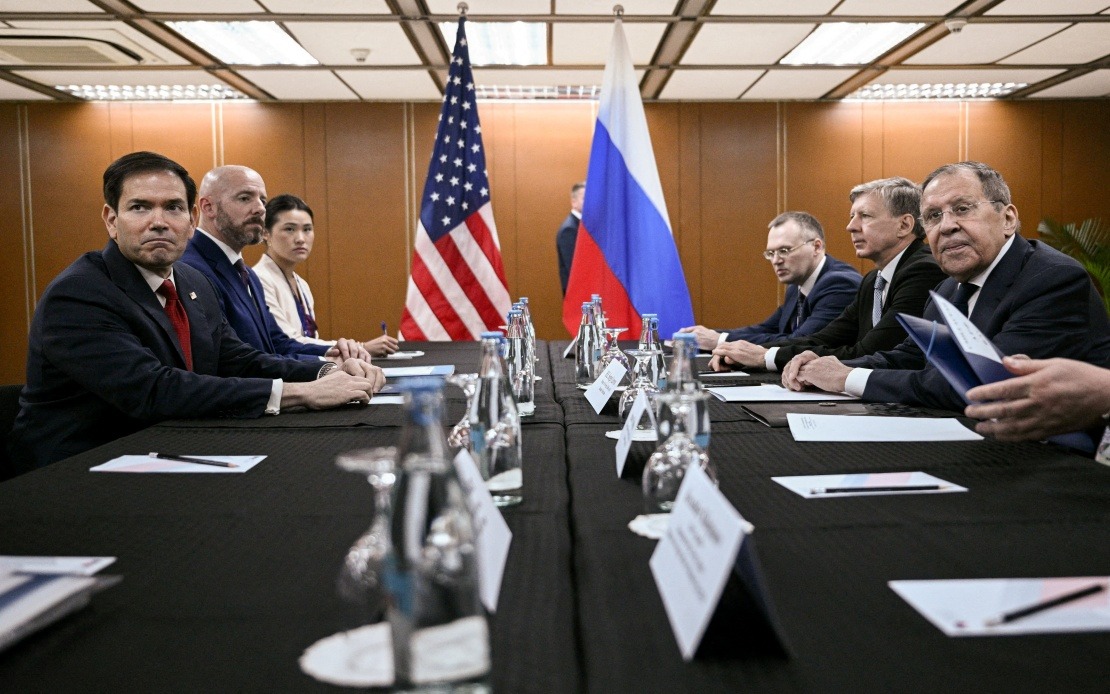
In a rare moment of diplomatic engagement between Moscow and Washington, Russian Foreign Minister Sergey Lavrov and United States Secretary of State Marco Rubio have committed to preserving communication pathways between their respective foreign ministries. The agreement, reached during their meeting in Manila on Thursday, signals an effort to prevent a complete breakdown in bilateral relations despite the substantial geopolitical tensions that have defined the Russia-US relationship in recent years.
The announcement from Russia's Foreign Ministry underscores a pragmatic recognition that maintaining channels of dialogue, even amid strategic competition, remains in both nations' interests. The commitment extends specifically to continued engagement within the framework of international organisations where both countries maintain representation. This distinction is significant for the international system, as it suggests that despite profound disagreements on numerous fronts, Moscow and Washington are unwilling to allow diplomatic relations to deteriorate entirely through multilateral forums where their participation remains essential to global governance.
Beyond the commitment to maintain ministry-level contacts, the two foreign ministers addressed a more operational concern that has become a persistent irritant in bilateral relations: the normalisation of working conditions for their respective diplomatic missions. This issue touches on the practical ability of embassies and consulates to function effectively, including staffing levels, visa processing, and the everyday operations necessary for diplomatic engagement. Both sides have previously levied complaints about restrictions and impediments placed on their diplomatic personnel, making this discussion a concrete step toward reducing friction in day-to-day diplomatic work.
A particularly noteworthy element of the meeting involved space cooperation, with Lavrov and Rubio welcoming the resumption of full-scale contacts between Roscosmos, Russia's state space agency, and NASA, the American civilian space authority. This development carries substantial implications beyond the immediate bilateral relationship. The International Space Station, jointly operated by Russian and American astronauts since 1998, depends fundamentally on this cooperation to function. The resumption of full contacts between these space agencies indicates a willingness to compartmentalise certain forms of collaboration even as geopolitical disputes persist elsewhere, demonstrating that practical cooperation in fields of mutual benefit can transcend political differences.
For Southeast Asian observers, particularly Malaysian policymakers and analysts, this development carries several implications. The region has increasingly found itself positioned between great power competition, and the demonstration that even severely strained relationships can maintain functional diplomatic channels offers a template for managing regional relationships without allowing them to fracture completely. Malaysia and other ASEAN nations have sought to balance engagement with both Russia and Western powers, making the preservation of dialogue mechanisms a principle with direct relevance to regional stability and economic interests.
The Manila setting itself merits consideration, as the Philippines hosts significant regional interests and has been a focal point of US strategic attention in Southeast Asia. The choice to hold this ministerial meeting in the Philippine capital may reflect the broader geopolitical reorientation occurring across the region, where diplomatic engagement continues even as great powers manoeuvre for influence and strategic advantage. This underscores how international organisations and regional forums provide essential venues for maintaining contact and negotiation.
The agreement to develop interparliamentary exchanges and cultural ties, as noted in the Russian Foreign Ministry statement, represents an attempt to broaden the foundation of bilateral relations beyond government-to-government diplomacy. Cultural and parliamentary connections can create constituencies within each country with interests in maintaining positive relations, thereby building resilience into the diplomatic relationship. These softer forms of engagement often prove more durable than official relations alone, particularly during periods of political tension or when administrations change.
The timing of this meeting occurs within a context where both Russia and the United States have been recalibrating their foreign policies under evolving circumstances. For Southeast Asia, including Malaysia, the continuation of US-Russia dialogue through international organisations suggests that the region will not become a theatre where these powers completely abandon communication mechanisms. This matters for multilateral institutions where both participate, such as the East Asia Summit and various UN bodies where consensus or cooperation remains sometimes possible.
However, the agreement's limitations merit acknowledgement. Maintaining contacts through international organisations differs substantially from resolving the underlying disputes that have created distance between Moscow and Washington. The commitment announced in Manila represents a floor, not a foundation for broader rapprochement. Both sides have significant reasons to maintain these channels, but structural tensions in their relationship suggest that practical cooperation will remain compartmentalised and limited to specific sectors where mutual benefit is clear.
For Malaysia and regional countries seeking to navigate great power competition while maintaining relationships with multiple powers, the Russian-American agreement offers an important lesson: diplomatic formality and institutional structures can persist even through periods of substantial disagreement. By maintaining contacts through international organisations rather than exclusively through bilateral channels, both powers have created mechanisms that allow engagement without implying normalisation of relations. This distinction will likely characterise the Russia-US relationship for the foreseeable future and provides a useful model for how regional states might approach their own complex diplomatic balancing acts in Southeast Asia's multipolar environment.

