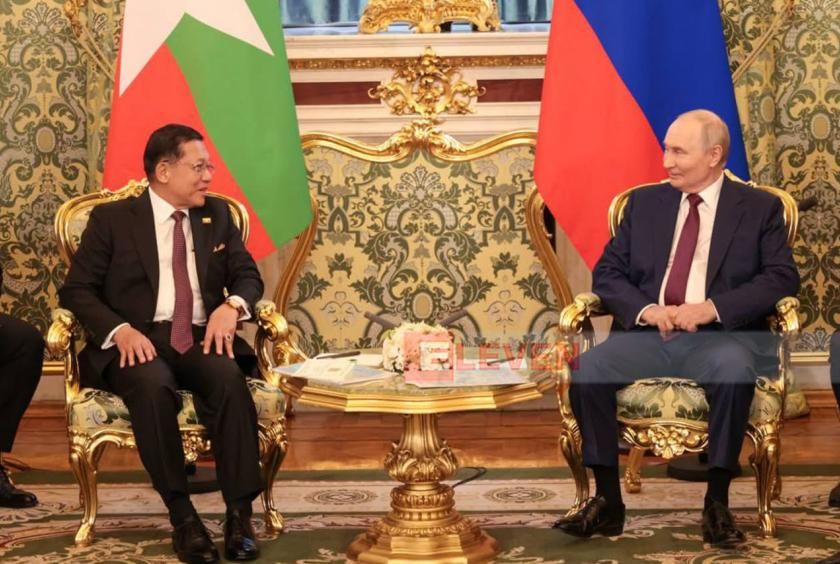
Russia is positioning itself as a key strategic partner in Myanmar's energy infrastructure development, with President Vladimir Putin committing to expanded cooperation in offshore oil and gas exploration during high-level talks with Myanmar President U Min Aung Hlaing in August. The announcement underscores deepening ties between Moscow and Naypyidaw at a time when Myanmar faces international isolation following the 2021 military coup, making Russian investment and technical expertise increasingly valuable to the junta-led government.
Putin framed the energy sector as a cornerstone of bilateral relations, emphasising that Russia stands ready to support Myanmar's natural resource extraction across multiple domains. Beyond offshore petroleum operations, the two countries are pursuing complementary projects including coal-fired power generation facilities and refinery infrastructure within Myanmar's borders. The Russian leader specifically highlighted the potential for exporting liquefied natural gas to Myanmar, positioning the Southeast Asian nation both as a consumer market and as a potential transshipment hub for Russian energy exports destined for other regional economies.
The energy partnership sits within a much broader framework of economic and strategic engagement that extends across multiple sectors. Twelve memoranda of understanding were formally signed during President U Min Aung Hlaing's visit to Russia, reflecting the scope of cooperation discussions. These agreements touch upon industrial manufacturing, with steel and fertiliser production facilities under construction or in advanced planning stages, alongside port development initiatives designed to enhance Myanmar's maritime infrastructure and regional trade connectivity.
Historical context shapes contemporary Russian-Myanmar relations significantly. Putin invoked the Soviet Union's substantial contributions to Myanmar's development during the Cold War era, particularly across the 1950s and 1960s when Moscow provided extensive technical assistance and built critical institutions including hospitals and educational facilities. Many of these structures remain operational and continue serving Myanmar's population, lending historical legitimacy to Russia's pitch as a reliable long-term development partner compared to Western nations that have implemented sanctions following the 2021 military transition.
Nuclear power development represents another ambitious dimension of the partnership. Russia and Myanmar signed an agreement in 2025 to construct a nuclear power plant, which Putin characterised as strategically significant for both nations. This project carries particular implications for Myanmar's energy security and long-term industrial development strategy, though it also raises questions about regulatory frameworks, safety standards, and operational capacity within Myanmar's institutional environment.
The military and security dimensions of bilateral cooperation merit particular attention for Southeast Asian observers. Russia and Myanmar conduct regular military exercises in Myanmar's territorial waters, and Russian naval vessels frequently call at Myanmar ports. This military-technical cooperation extends existing patterns of defence engagement and signals Russia's intention to maintain significant influence over Myanmar's security infrastructure and strategic orientation, particularly as the country navigates regional geopolitical tensions and international pressure.
Cultural and educational exchange programmes form a softer layer of Russian influence that should not be underestimated. Currently, 400 Myanmar nationals study at Russian universities, while 17,000 Myanmar citizens have previously graduated from Russian institutions. These educational ties create networks of Russian-trained professionals embedded throughout Myanmar's government, military, and technical sectors. Additionally, Russia has secured approval to construct an Orthodox Christian church in Yangon, while Myanmar cultural centres operate in multiple Russian cities, indicating investments in long-term people-to-people connectivity.
Language promotion reinforces these cultural strategies. Russian instruction has expanded to universities in Yangon and Mandalay, as well as Myanmar's military academy, creating institutional pathways for sustained Russian engagement across generations. A visa-free travel arrangement facilitates movement of scientists, students, athletes, and tourists between the countries, while Myanmar's government has approved opening a consulate in Vladivostok, further formalising the bilateral relationship infrastructure.
For Malaysian and Southeast Asian policymakers, Russia's deepening Myanmar engagement carries several analytical dimensions. First, it demonstrates how sanctions-affected countries seek alternative partnerships to compensate for Western restrictions, creating opportunities for non-aligned powers to expand influence. Second, Russian investment in Myanmar's energy infrastructure and port development could reshape regional supply chains and maritime commerce patterns. Third, Myanmar's orientation toward Moscow may affect broader ASEAN dynamics, particularly regarding consensus-building on regional security issues where Russia holds significant leverage through its Myanmar partnerships.
The offshore oil and gas dimension particularly warrants regional attention. Myanmar's maritime boundaries remain disputed in several areas, and expanded hydrocarbon exploration could intensify existing tensions with neighbouring countries over resource rights and territorial claims. Russian technical expertise and investment flowing into these projects may influence how Myanmar asserts its maritime claims and manages potential disputes with Thailand, Bangladesh, and other regional actors.
Putin's emphasis on fair, mutually beneficial cooperation reflects standard diplomatic language, yet the practical asymmetries merit scrutiny. Russia gains strategic positioning in a region where Western influence has diminished, access to energy resources, and a reliable partner for maritime presence in the Indian Ocean region. Myanmar, conversely, obtains desperately needed capital investment, technical expertise, and international legitimacy from association with a major power. Whether these benefits translate into sustainable development or deepen Myanmar's dependency on Russian patronage remains an open question that will significantly shape the country's trajectory.
The partnership also reflects broader geopolitical fragmentation, with Myanmar increasingly oriented toward Russia and China while distancing from Western institutions. This realignment has consequences for ASEAN coherence and Southeast Asia's ability to maintain strategic autonomy amid competing great power interests. As Russia formalises its Myanmar presence through infrastructure projects, military cooperation, and institutional investments, the region's balance of power dynamics continue shifting in ways that merit careful observation from other Southeast Asian capitals.

