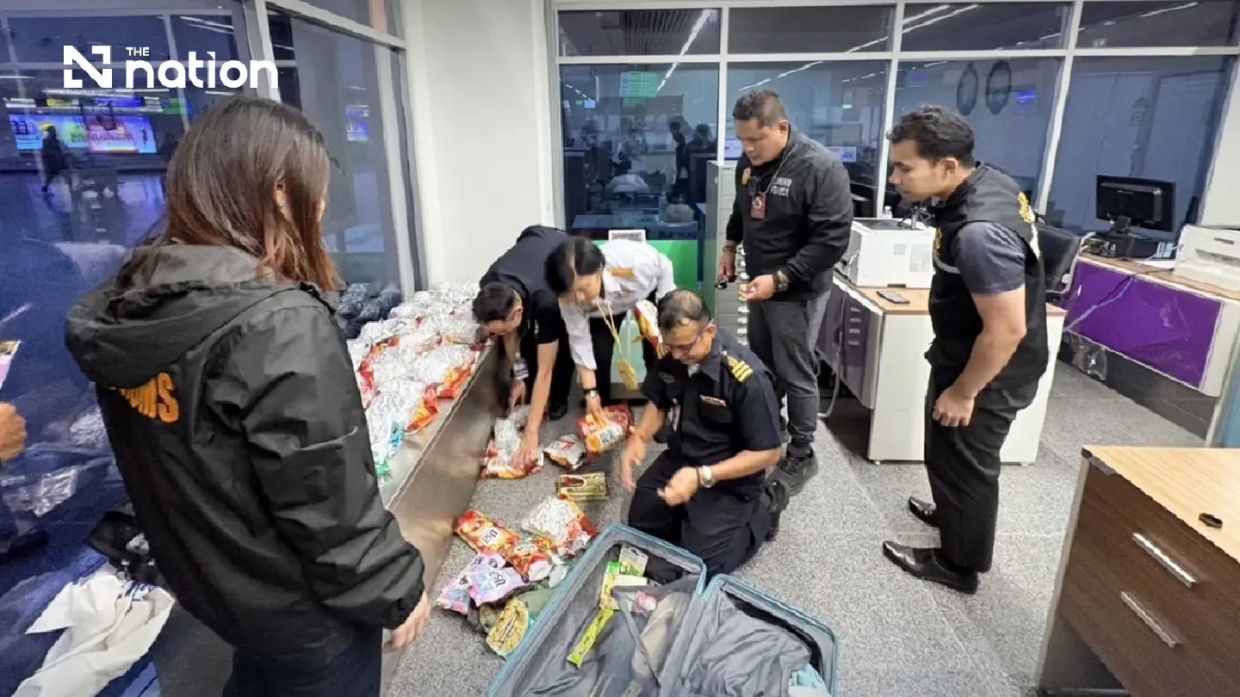
A 30-year-old Russian national has been detained at Phuket International Airport following a major drug seizure that highlights ongoing challenges with narcotics smuggling through Thailand's major transport hubs. Sergei Chalabari was apprehended in the international departure terminal on Wednesday, July 8, when customs inspectors uncovered cannabis products concealed within his checked luggage, marking another significant bust in the kingdom's fight against drug trafficking.
The discovery occurred during routine screening procedures at the departure section of the airport's international terminal, located in Mai Khao subdistrict, Thalang district. Customs officer Rawin Kanokakorn led an inspection team that examined two blue BP WORLD branded suitcases weighing approximately eight kilogrammes combined. The systematic search of Chalabari's baggage yielded a substantial haul that underscores the persistent threat of drug smuggling through Thailand's aviation infrastructure.
The confiscated items comprised two distinct forms of cannabis products, reflecting the sophistication of modern trafficking operations. Officers recovered 35 separate vacuum-sealed packages of cannabis flowers totalling 11.4 kilogrammes, alongside 12 sealed packs of cannabis resin weighing 6.2 kilogrammes in aggregate. All materials were allegedly hidden within the interior compartments of the suitcases, with authorities seizing both the contraband and the luggage itself as evidence for the investigation.
During preliminary questioning at the airport, Chalabari acknowledged that both the suitcases and their illicit contents were his property, immediately establishing his involvement in the attempted smuggling operation. This admission streamlined the investigation process and provided authorities with a clear evidentiary foundation for prosecution. The suspect now faces charges related to attempting to transport controlled substances across international borders without proper customs declaration or authorisation.
The coordinated response to the seizure demonstrates the operational depth of Thailand's drug enforcement apparatus across multiple agencies. Sakhu Police Station superintendent Pol Col Salan Sankhisasanakun and deputy superintendent for investigation Pol Lt Col Rattanawut Nukaew oversaw police aspects of the operation, while the customs component was directed by Nucha Jeeradit, chief of the Phuket Airport Customs House, along with customs officials Thanomjit Burirak and Charoenporn Jaengwansuk. Such multi-agency cooperation reflects Thailand's serious approach to preventing narcotics from leaving the kingdom through commercial aviation channels.
The incident carries implications for regional security and tourism patterns, as Phuket remains a major international gateway serving millions of visitors annually. The airport's critical role in both tourism and legitimate commerce means that drug seizures at its terminals directly affect the kingdom's reputation and the confidence of international travellers. This particular case demonstrates that screening mechanisms are functioning effectively to intercept contraband before departure, providing some reassurance regarding airport security protocols.
Chalabari's detention and transfer to Sakhu Police Station for further legal proceedings initiated a formal criminal investigation process that will likely take several months to conclude. Pol Capt Chaphinya Surithamkul, serving as deputy investigation inspector, received custody of the suspect from customs authorities, establishing the chain of responsibility necessary for prosecution in Thai courts. The seriousness of drug trafficking charges means he could face substantial penalties under Thai narcotics laws, which impose lengthy prison sentences and significant fines for such offences.
This seizure fits into a broader pattern of cannabis smuggling attempts detected at Thai airports, particularly among foreign nationals attempting to transport drugs to third countries rather than for domestic distribution. The vacuum-sealed packaging methodology employed to conceal the cannabis suggests deliberate efforts to avoid detection by standard search procedures and drug-detecting dogs. Such techniques indicate organised smuggling networks increasingly sophisticated in their approaches.
For Malaysia and other regional nations, Thai drug enforcement successes at international departure points provide indirect benefits through disruption of regional trafficking networks that often use multiple Southeast Asian countries as transit points. The interconnected nature of regional drug trafficking means that disruptions in Thailand's enforcement environment can influence supply flows and operational logistics for criminal organisations spanning the wider region.
The case underscores why aviation security remains a critical frontline in combating narcotics smuggling across Southeast Asia. As international travel volumes continue to increase post-pandemic, maintaining vigilant customs and security procedures becomes ever more important for law enforcement agencies. Thailand's investment in training and equipping customs officers at major airports appears to be yielding results in detecting sophisticated smuggling attempts, though the continued frequency of such seizures indicates the persistent challenge posed by international drug trafficking networks.

