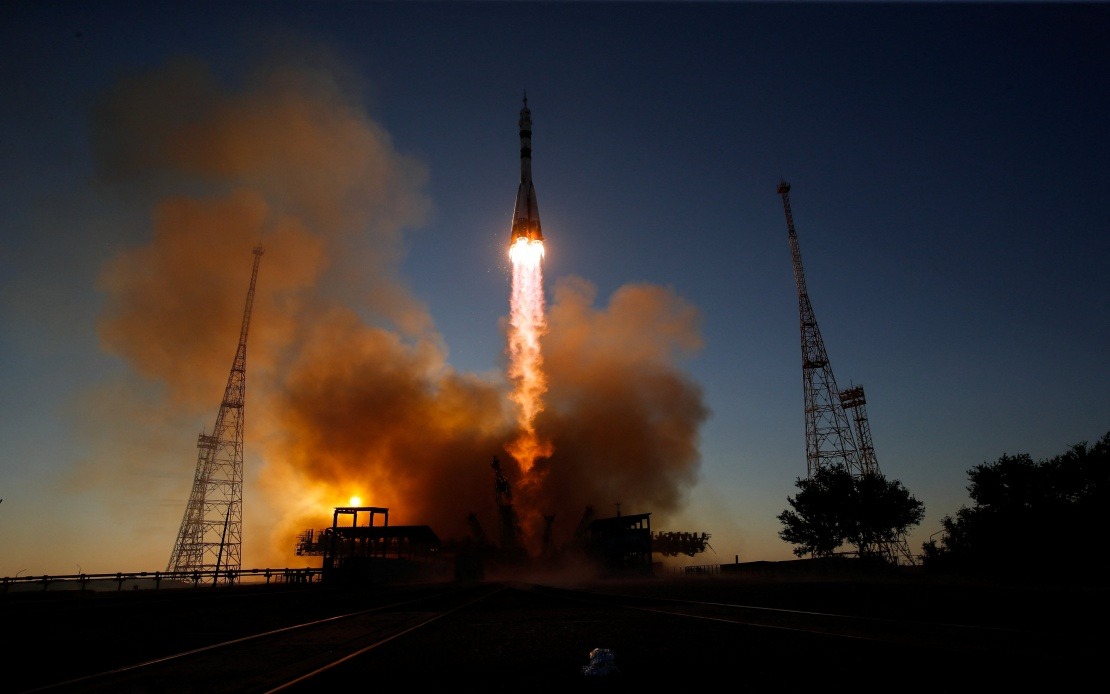
Three space explorers began their journey home on July 26 as the Soyuz MS-28 spacecraft undocked from the International Space Station, marking the conclusion of a lengthy orbital mission that has exemplified sustained international cooperation in space exploration. The vessel carried Russian cosmonauts Sergey Kud-Sverchkov and Sergey Mikayev alongside United States astronaut Christopher Williams, with Roscosmos confirming the separation through its live broadcast feed.
The undocking represented a carefully orchestrated manoeuvre in the ongoing operations aboard humanity's permanent orbital laboratory. Following the detachment, the spacecraft would maintain separation from the station before initiating the complex sequence of procedures necessary for safe atmospheric re-entry. Mission planners at Roscosmos had configured the timeline to ensure adequate distance between the two vessels before executing critical braking operations.
Once sufficient separation had been achieved, the Soyuz MS-28 would ignite its engines for a deorbit burn, a crucial manoeuvre that would lower the spacecraft's velocity and trajectory to intersect with Earth's atmosphere at a calculated angle. This controlled descent represents the culmination of months of planning and contingency preparation by both Russian and American space agencies.
The spacecraft's structural design incorporates a modular configuration that enables controlled separation during re-entry. As the vessel encounters progressively thicker atmospheric layers, aerodynamic heating and structural stresses would cause the orbital module, instrument module, and descent capsule to separate sequentially. Only the descent capsule, equipped with advanced thermal protection systems, would survive the extreme temperatures generated during this violent passage through the thermosphere.
Kazakhstan's remote steppe region near the city of Zhezkazgan had been selected as the primary landing zone, a location chosen for its vast open terrain and established recovery infrastructure. Mission control anticipated touchdown at approximately 12:50 pm Moscow time, equivalent to 09:50 GMT, with recovery teams already positioned to locate and extract the crew following their return.
The three crew members had maintained continuous presence aboard the International Space Station since November 27 of the previous year, accumulating nearly eight months in microgravity. This extended duration allowed them to participate in numerous scientific experiments, conduct maintenance activities, and oversee the arrival and departure of resupply vehicles that sustained the orbiting laboratory.
Their mission exemplifies the enduring partnership between Russia and the United States within the ISS program, a collaboration that has persisted despite geopolitical tensions on Earth. The Soyuz spacecraft has remained the primary vehicle for transporting personnel to and from the station, a role it has fulfilled reliably for decades. Each crew rotation involves meticulous coordination between mission control centres in Moscow, Houston, and other international partners to ensure safety and operational success.
For Malaysian observers interested in space exploration, this mission highlights the sophisticated international frameworks that enable human spaceflight operations. The ISS itself comprises contributions from multiple nations, including experiments and infrastructure from countries throughout Asia and beyond. The crew rotation demonstrated how space science transcends terrestrial divisions, with citizens from different nations working together in an environment where international cooperation remains essential for survival and scientific achievement.
The descent capsule's design incorporates lessons learned from decades of spaceflight experience, with redundant systems ensuring crew safety throughout the return journey. The controlled deorbit burn, the precise angle of re-entry, and the timing of module separation all depend on sophisticated navigation systems and real-time mission control guidance. Recovery teams would monitor the descent through visual and electronic tracking systems, ready to respond immediately upon landing.
This mission's completion also paves the way for the next crew rotation to launch toward the ISS, maintaining the continuous human presence that has been sustained aboard the orbital station since November 2000. The rotation schedule requires careful timing to ensure overlapping occupancy, allowing outgoing crews to hand over responsibilities and provide briefings to incoming teams before departing.
The recovery of Kud-Sverchkov, Mikayev, and Williams marks another successful chapter in the ongoing international space program. Their eight-month tenure in orbit contributed valuable scientific data, conducted essential maintenance activities, and demonstrated the continued viability of long-duration human spaceflight operations. As they descended toward Kazakhstan, mission teams in multiple nations monitored their progress, ready to ensure the safe conclusion of their extraordinary journey beyond Earth's atmosphere.

