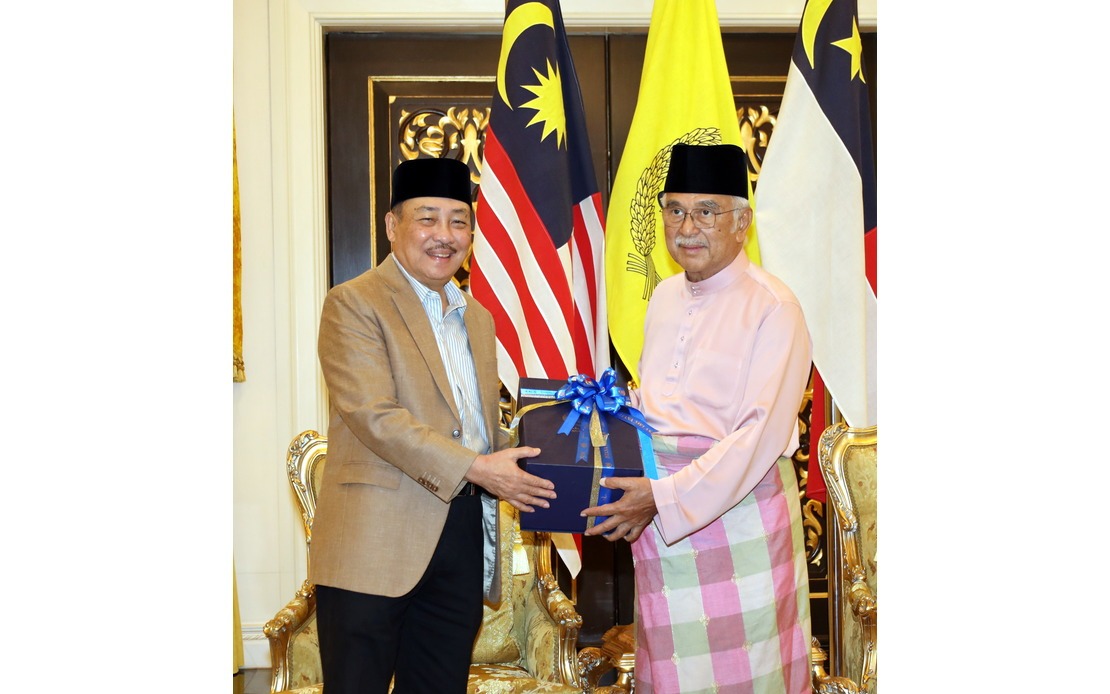
Sabah Chief Minister Datuk Seri Hajiji Noor undertook a formal courtesy visit to Melaka on Wednesday, meeting with Yang Dipertua Negeri Tun Dr Mohd Ali Mohd Rustam at Istana Melaka in Bukit Beruang. The engagement marked another step in deepening institutional connections between Malaysia's two geographically distinct but economically significant states, underscoring the importance of inter-state dialogue in the country's federal system.
Arriving at approximately 3.35 pm with a delegation comprising key ministers and legislators, Hajiji was formally received by Tun Mohd Ali. The composition of the visiting party reflected Sabah's commitment to a substantive exchange, with Rural Development Minister Datuk Rubin Balang, Agriculture, Fisheries and Food Industry Minister Datuk Jamawi Jaafar, and Nominated Member of the Sabah State Legislative Assembly Datuk Mohd Razali Mohd Razi accompanying the chief minister. This multi-sectoral representation suggests the discussions extended beyond ceremonial pleasantries to encompass practical cooperation across several policy domains.
While the official statement released from the Sabah Chief Minister's Office remained circumspect regarding specific agenda items, it confirmed that the two leaders examined "various matters of mutual interest" affecting both territories. The deliberate vagueness typical of such diplomatic communications obscures the particular challenges and opportunities that may have dominated the conversation. For Malaysian observers, such inter-state visits often signal alignment on broader national issues or coordination on shared economic priorities, though the specific content typically emerges through subsequent policy announcements or joint ventures.
The institutional framework for these discussions reflects Malaysia's constitutional structure, whereby state governments operate with considerable autonomy in defined areas including agriculture, local government, and certain aspects of economic development. Melaka, as a peninsular state with established manufacturing and tourism sectors, contrasts sharply with Sabah's resource-rich economy centred on palm oil, timber, and petroleum. Consequently, dialogue between their respective administrations frequently addresses complementary economic interests and shared challenges in areas like workforce development, investment promotion, and infrastructure connectivity.
From a regional perspective, strengthening Sabah-Melaka relations carries implications for East Malaysia's integration into the broader Malaysian federation. Sabah, alongside Sarawak, has historically maintained distinct political dynamics from peninsular states, and efforts by Sabah leadership to cultivate relationships with various peninsular administrations serve to reinforce inter-regional networks. Such diplomatic engagement helps counterbalance the gravitational pull of Kuala Lumpur-centric policymaking and ensures that East Malaysian concerns receive consideration at multiple political levels.
The afternoon tea that concluded the formal meeting represented a traditional element of Malaysian state ceremony, providing an informal setting where sustained dialogue could occur outside the structured format of formal negotiations. These convivial settings often prove instrumental in establishing personal rapport between political leaders, facilitating future cooperation on complex issues that might otherwise prove contentious. The hosting of refreshments by Tun Mohd Ali underscored Melaka's hospitality and the reciprocal nature of the relationship being cultivated.
For Malaysian stakeholders monitoring inter-state developments, such visits warrant attention as indicators of shifting political alignments or emerging collaborative frameworks. The choice of Melaka as a destination for Hajiji's courtesy call, rather than other peninsular states, may reflect specific commercial or administrative convergences or represent deliberate efforts to broaden Sabah's bilateral engagement across multiple state administrations. The timing and frequency of such interactions provide evidence of which states prioritize cross-border institutional relationships.
The inclusion of agriculture and fisheries within the delegation speaks to potential cooperation in these sectors, where Sabah's extensive production capacity and Melaka's market access and processing capabilities might create synergistic opportunities. Similarly, the presence of the rural development minister suggests discussions may have extended to infrastructure projects, connectivity initiatives, or rural economic advancement programmes that could benefit from inter-state collaboration and knowledge exchange.
As Malaysia navigates evolving economic pressures and the imperatives of regional integration, inter-state diplomatic engagement becomes increasingly significant. Chief Minister Hajiji's outreach to Melaka exemplifies how state governments are positioning themselves as active participants in Malaysia's federal dialogue rather than passive recipients of national policy directives. These initiatives, while often appearing purely ceremonial to external observers, constitute the foundational network through which regional governance is actually conducted.
The visit also reflects contemporary Malaysian political practice, wherein state leaders routinely undertake extensive networking visits to counterpart administrations to build coalitions of support for particular policy positions at the national level. Given Sabah's particular concerns regarding petroleum revenue-sharing, infrastructure development, and regional autonomy, such bilateral engagement allows the state's leadership to advocate its interests while demonstrating respect for peninsular political sensibilities. The carefully orchestrated nature of such visits, from delegation composition to venue selection, conveys important messages about state priorities and political positioning.

