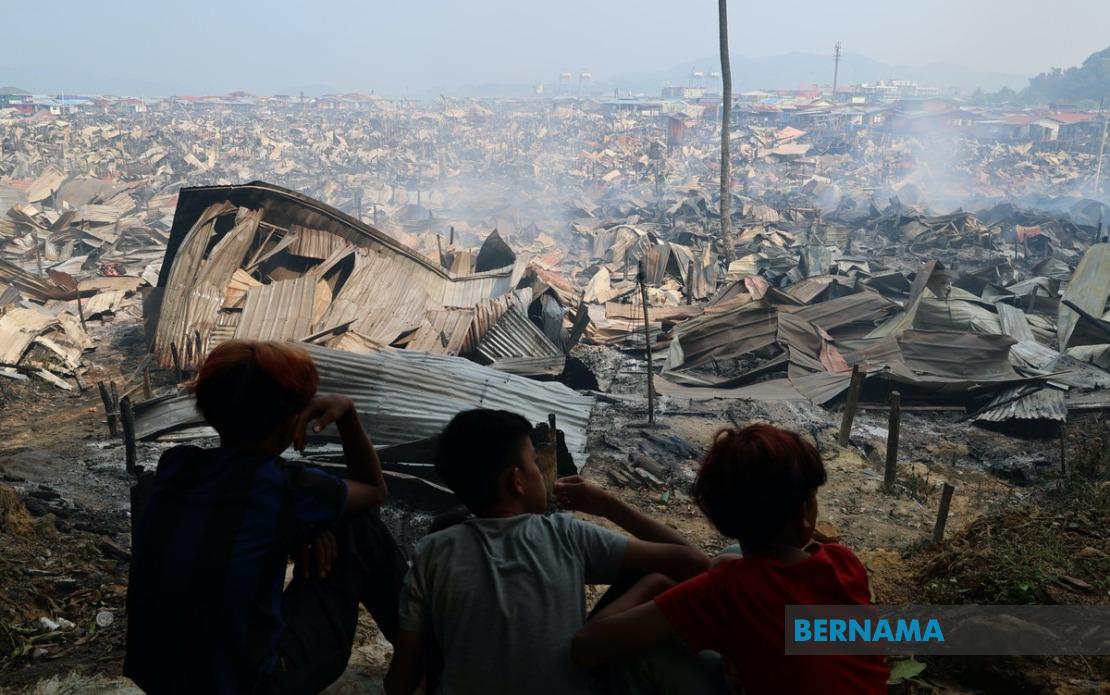
The Sabah government has announced a RM3,000 financial assistance package for each Malaysian head of household whose home was destroyed in the devastating fire that swept through Kampung Lok Buta in Numbak, Kota Kinabalu. The blaze, which erupted around 1.40 am on August 30, consumed more than 200 residential structures and left a community reeling from the scale of destruction. The swift announcement reflects the state administration's commitment to immediate relief even as the broader recovery process begins.
Chief Minister Datuk Seri Hajiji Noor outlined the composition of the aid package during a visit to affected families at the Likas Multipurpose Hall temporary relief centre, emphasizing the collaborative approach involving multiple government bodies and charitable institutions. The RM3,000 comprises three equal contributions of RM1,000 each, sourced from the Sabah state government, the federal government, and Yayasan Kebajikan Sabah. This tripartite funding arrangement demonstrates coordination across administrative levels to mobilize resources quickly in response to the humanitarian crisis.
Beyond the immediate cash assistance, the state government has committed to supporting longer-term reconstruction efforts through institutional partnerships. The State Secretary's Office will work alongside Majlis Amanah Rakyat (MARA) to coordinate the rebuilding of destroyed homes, ensuring that the process receives structured administrative oversight. The authorities recognize that fire victims face not only the immediate loss of shelter but also the complex challenge of navigating rebuilding processes while managing displacement and trauma.
The government has indicated flexibility regarding where homes will be reconstructed, signaling that decisions about whether victims return to the original Kampung Lok Buta site or relocate elsewhere will be made collaboratively and with consideration of area suitability. This approach suggests that planners will assess factors such as fire safety improvements, infrastructure resilience, and community preferences before finalizing relocation or reconstruction decisions. Such deliberation, while requiring time, may prevent repeated vulnerabilities that characterized the original settlement.
Recognizing the heterogeneous composition of affected communities, Datuk Seri Hajiji announced that non-Malaysian heads of household impacted by the fire would receive RM1,000 in assistance from the state government. This humanitarian consideration acknowledges the presence of foreign workers and undocumented residents whose presence in Malaysian settlements reflects broader economic patterns across Southeast Asia, where cross-border labor migration creates complex social obligations. The decision to extend support across citizenship lines demonstrates that the state prioritizes addressing immediate human suffering over strict administrative categories.
Immediate welfare support extends beyond financial disbursement to encompassing essential goods and services. The government will furnish affected families with food supplies and household items during the critical period when they remain displaced and unable to provision themselves. Such in-kind assistance proves especially valuable for vulnerable populations including young children, elderly residents, and those with specific medical requirements who cannot easily access markets or afford replacement items during the crisis period.
The tragedy claimed three young lives, casting a profound shadow over the community and highlighting the particular vulnerability of children in informal settlement fires. The victims—four-year-old Nana Abdullah, her six-year-old brother Mohd Asrul, and their eight-year-old cousin Nurfarahdilah Mohd Tajihah—represent a devastating loss that financial compensation cannot restore. The deaths underscore recurring fire safety challenges in densely populated residential areas where wooden structures, inadequate emergency access, and limited fire-fighting infrastructure create dangerous conditions.
For Malaysia and the broader Southeast Asian region, the Kampung Lok Buta fire represents a recurring pattern of vulnerability affecting low-income communities and informal settlements. Similar fires have devastated communities across the region, from the Philippines to Indonesia, revealing systemic gaps in fire prevention, emergency response capabilities, and building safety standards. The incident prompts examination of whether financial assistance, while necessary, should be paired with more fundamental interventions addressing fire risk in informal housing areas.
The coordination demonstrated by Sabah authorities—involving state government, federal resources, and charitable foundations in rapid response—offers a model for disaster response that other Malaysian states and regional governments might study. The speed of the announcement, made within hours of the disaster, reflects institutional capacity to mobilize resources and communicate support messages during crisis periods. However, observers note that sustained commitment throughout the long reconstruction process often proves more challenging than initial emergency response, requiring continued political will and budgetary prioritization.
The fire's impact extends beyond immediate victims to encompassing broader economic and social disruption within the community. Displaced residents face not only housing loss but also disruption to employment, education, and social networks. Children affected by the disaster will require psychosocial support alongside material reconstruction. The government's acknowledgment of these interconnected challenges through multi-faceted assistance suggests awareness that effective disaster recovery requires addressing multiple dimensions of community wellbeing simultaneously.
Looking forward, the Sabah government's response will be measured not only by whether promised aid reaches beneficiaries promptly but also by whether the reconstruction process delivers durable improvements in living standards and safety. The temporary relief centre serves as a necessary immediate measure, but sustained institutional attention will determine whether affected families successfully rebuild their lives or face prolonged hardship and displacement. The emphasis on coordinating reconstruction through established institutions like MARA suggests an intention to move beyond emergency management toward structured recovery, though implementation details remain forthcoming.
As Sabah addresses this acute crisis, the incident underscores persistent vulnerabilities within informal housing sectors across Malaysia and the region. While financial assistance provides immediate relief, longer-term community resilience requires complementary investments in fire prevention infrastructure, building code enforcement, and emergency response capacity within vulnerable settlements. The Kampung Lok Buta tragedy offers opportunity for policymakers to examine whether current disaster response frameworks adequately address root causes of informal settlement vulnerability or whether more fundamental systemic reforms are necessary to protect similar communities from recurrent disasters.

