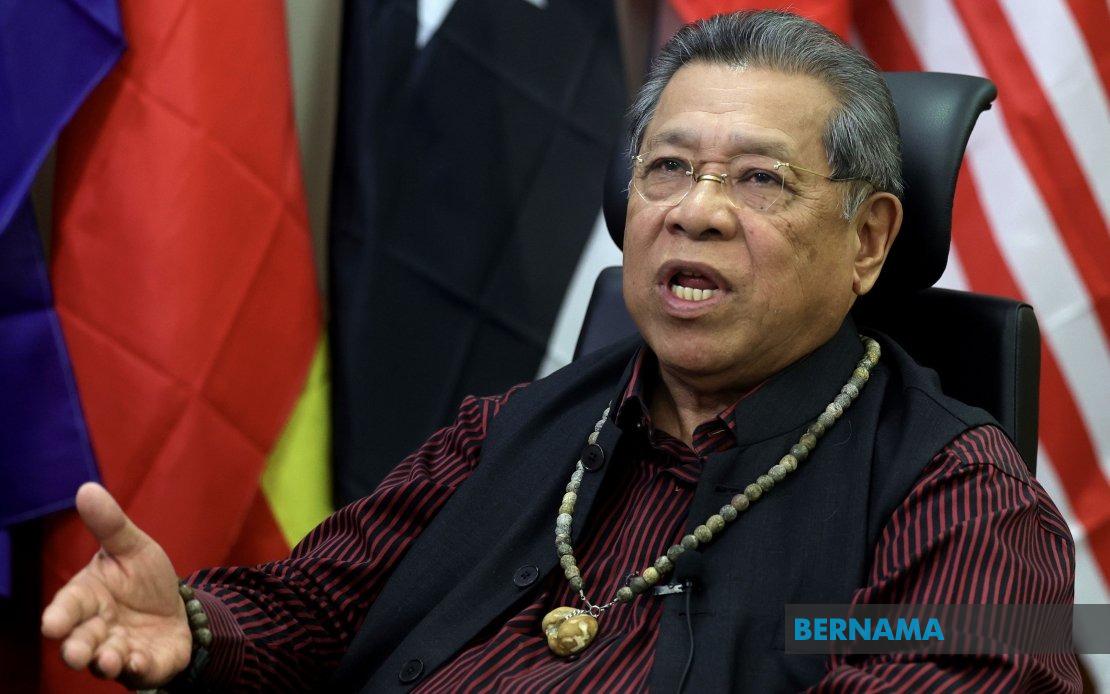
Tan Sri Pandikar Amin Mulia, president of the United Sabah National Organisation, has expressed confidence that the substantial increase in federal funding to Sabah will accelerate development initiatives across the state and strengthen its contribution to national progress. Speaking at the sidelines of the 2026 PKR National Congress held at the Melaka International Trade Centre in Ayer Keroh on August 15, the USNO leader outlined how the heightened investment would translate into tangible improvements for Sabahans.
The funding boost represents a notable shift in resource allocation, with federal support to Sabah rising 35 per cent between 2022 and 2026. In concrete terms, this means the state's allocation has expanded from RM13 billion to RM17.6 billion over the four-year period, a substantial increase that officials argue signals genuine commitment to addressing regional development disparities. This upward trajectory comes amid ongoing discussion about how federal resources are distributed across Malaysia's 13 states and three federal territories.
Pandikar Amin's remarks reflect broader confidence in the current administration's approach to managing Sabah's economic development agenda. The USNO president suggested that accelerating infrastructure projects and public services delivery in Sabah would create multiplier effects throughout the regional economy. By channelling more capital into the state's development pipeline, policymakers hope to unlock investments in areas ranging from basic infrastructure to economic diversification initiatives that could reduce Sabah's historical dependence on primary commodity sectors.
The political significance of this funding increase extends beyond mere budgetary adjustments. Sabah, as one of Malaysia's largest states by land area and the most sparsely populated, has historically faced infrastructure deficits relative to Peninsular counterparts. Roads, ports, airports, educational facilities, and healthcare infrastructure require substantial ongoing investment to meet contemporary standards and support population growth. The increased allocation acknowledges these structural challenges and the need for sustained, elevated spending to narrow longstanding gaps.
Prime Minister Datuk Seri Anwar Ibrahim used the PKR congress as an opportunity to defend his government's fiscal strategy and push back against accusations that certain states have been neglected under the MADANI administration. Rather than applying a uniform funding formula across all states, the government has adopted a differentiated approach that accounts for varying development needs and regional priorities. This methodology, officials contend, represents evidence-based resource allocation that recognises Sabah's particular circumstances and growth potential.
Pandikar Amin's endorsement of the Prime Minister carries weight within Sabahan political circles, where the USNO commands significant influence among rural constituencies. His public statement that Malaysia still requires Anwar Ibrahim's leadership at both domestic and international levels suggests alignment between the USNO and federal government on key policy directions. This convergence, however tentative, could prove crucial for political stability in a state where coalition dynamics have historically been fluid and subject to rapid realignment.
The 35 per cent increase in Sabah's allocation must be contextualised within Malaysia's broader fiscal environment. Government revenues have recovered following the pandemic-induced economic contraction, enabling the MADANI administration greater flexibility in strategic spending. However, competing demands from infrastructure maintenance, human capital development, and debt servicing constrain available resources. Prioritising Sabah's allocation therefore represents a deliberate policy choice that implicitly deprioritises expenditure in other areas or relies on efficiency gains elsewhere in the budget.
For Malaysian investors and businesses, particularly those with interests in Sabah's resource extraction, tourism, and manufacturing sectors, increased federal funding signals improved operational conditions. Better transport networks, reliable power supplies, and upgraded telecommunications infrastructure reduce business costs and enhance competitiveness. The development momentum could attract private sector participation through public-private partnerships, multiplying the impact of direct government expenditure beyond the nominal RM17.6 billion figure.
The announcement also carries implications for Sabah's broader economic integration into regional trade networks within Southeast Asia. Enhanced infrastructure and fiscal stability strengthen the state's appeal as a destination for regional investment and a node within supply chain networks spanning ASEAN economies. Improved port facilities, for instance, could position Sabah as a transshipment hub competing with major regional centres, generating employment and commercial activity that radiates through the local economy.
Looking ahead, the sustainability of this elevated funding commitment remains contingent on macroeconomic conditions and political will. While the four-year trajectory to 2026 is now established, subsequent allocations will depend on government priorities and available fiscal space. Development advocates in Sabah will therefore monitor budget announcements closely to ensure that momentum is maintained beyond the current planning horizon and that promised projects are executed efficiently without the delays that have sometimes plagued similar initiatives.
Pandikar Amin's comments reflect measured optimism rather than transformative confidence, acknowledging that increased funding alone cannot resolve all development challenges facing Sabah. Implementation capacity, project management discipline, and coordination between federal and state authorities will ultimately determine whether the RM4.6 billion increase translates into meaningful improvements in living standards, economic opportunities, and social services for Sabahans across urban and rural areas alike.

