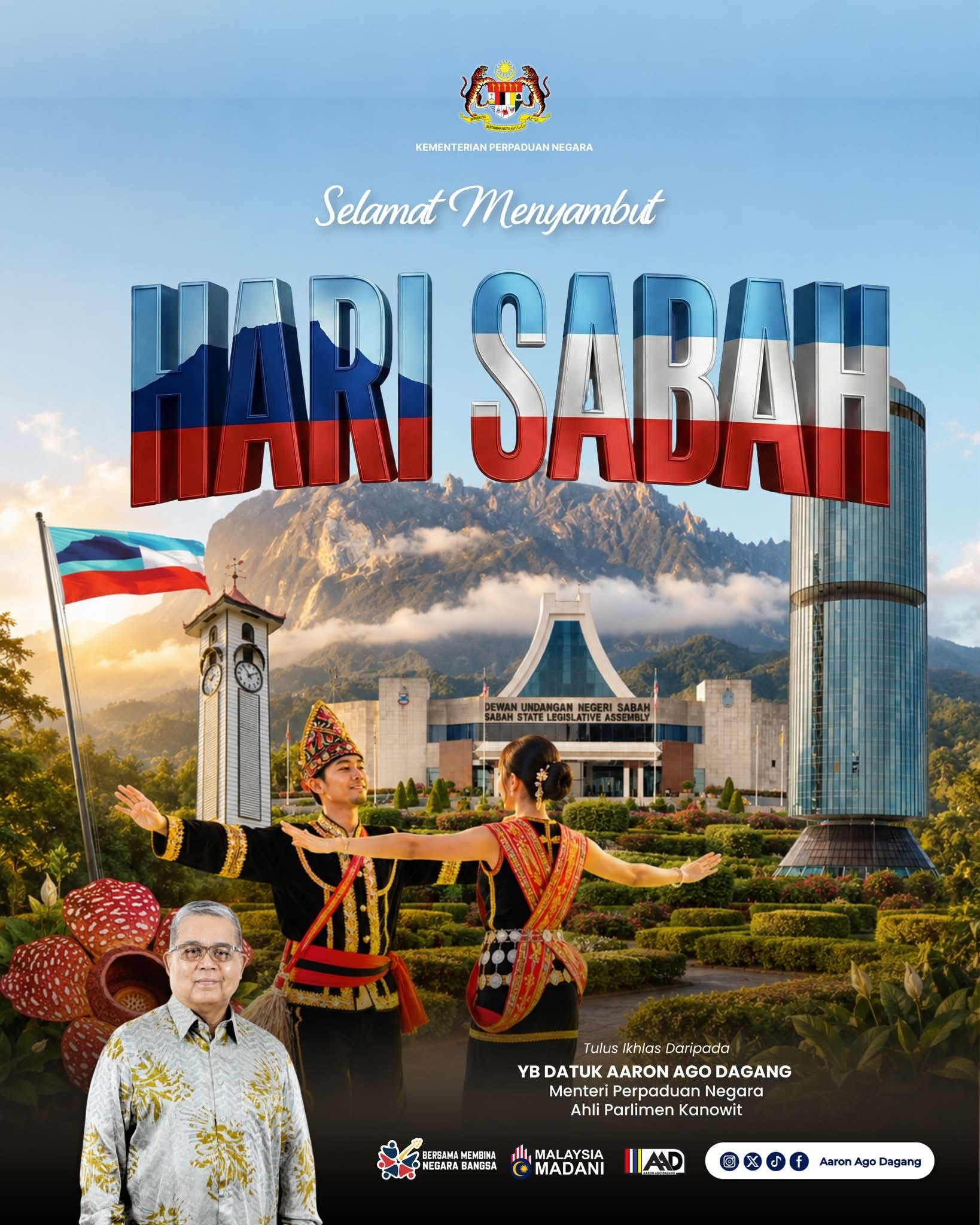
National Unity Minister Datuk Aaron Ago Dagang has emphasized that the remarkable ethnic and cultural diversity found throughout Sabah constitutes one of the state's most valuable assets, serving as a living representation of Malaysia's broader multiracial identity. Speaking during Sabah Day celebrations on August 31, the minister underscored how the harmonious coexistence of multiple communities demonstrates the nation's capacity for unity amid diversity, offering important lessons for the wider Malaysian federation.
The Sabahan landscape is characterized by extraordinary cultural pluralism, with the state serving as home to 35 distinct ethnic groups and 217 sub-groups, each maintaining its own linguistic traditions, customary practices, distinctive clothing, musical heritage and accumulated cultural knowledge. This demographic composition reflects centuries of migration, settlement and cultural exchange across Borneo, resulting in a population that remains among Southeast Asia's most ethnically heterogeneous. The Kadazan, Dusun, Bajau, Murut, Rungus, Bisaya, Lotud and Lundayeh communities, among numerous others, have collectively forged the distinctive identity that characterizes contemporary Sabah.
According to Datuk Aaron Ago Dagang, this cultural plurality should not be interpreted as an impediment to social cohesion. Rather, when communities approach one another with genuine understanding, mutual respect and acceptance, such diversity becomes a wellspring of collective strength. The minister's remarks suggest that the challenge facing modern societies lies not in the existence of difference itself, but in the frameworks through which communities engage with and appreciate that difference. Sabah's historical experience demonstrates that peaceful coexistence across ethnic lines remains achievable when inclusive values are prioritized.
The historical trajectory of Sabah lends particular weight to such observations. August 31 commemorates a pivotal moment in the state's past, marking the terminus of various foreign administrations spanning multiple eras. The date encompasses the transition from the colonial epoch of North Borneo, through the tenure of the British North Borneo Company, the trauma of Japanese occupation during World War II, and subsequent British administration, culminating in the attainment of self-governance in 1963. This accumulated historical experience, compressed into less than a century, exposed the Sabahan population to multiple political systems and administrative frameworks, yet the underlying commitment to cultural preservation and community autonomy persisted throughout.
Sabah's accession to the Malaysian Federation occurred shortly thereafter on September 16, 1963, initiating a new chapter in the state's political narrative. This constitutional arrangement formalized the relationship between Sabah and the peninsular territories, establishing the federation that remains in place today. The formation of Malaysia represented an ambitious consolidation of diverse territories, each with distinct histories and demographic compositions, into a unified nation-state. Sabah's entry into this federation brought its own substantial ethnic and cultural complexity into the national equation, enriching the overall Malaysian mosaic while simultaneously introducing unique constitutional arrangements and protections specific to Sabahan interests.
The minister's invocation of historical memory carries significant implications for contemporary governance. Datuk Aaron Ago Dagang directed attention toward the contributions made by preceding generations of Sabahans who invested their intellectual and physical labour, creative energies and personal sacrifices toward advancing their state. This emphasis on historical continuity suggests that present-day Sabahans inherit not merely a geographic territory and political structure, but a legacy of deliberate nation-building and community stewardship that demands acknowledgment and commemoration.
The responsibility for Sabah's future trajectory now devolves upon the current generation of state inhabitants. According to the National Unity Minister, contemporary Sabahans must demonstrate the intellectual courage and practical determination required to propel their state forward across multiple dimensions simultaneously. Educational advancement, economic diversification, technological adoption and infrastructure development represent the principal vectors through which progress might be achieved. These modernization objectives are neither novel nor exclusively Sabahan concerns; they reflect universal aspirations shared across the Malaysian federation and throughout Southeast Asia more broadly.
Yet the minister's formulation introduces a crucial qualification to this development agenda: the imperative to simultaneously safeguard Sabah's historical inheritance, cultural heritage and distinctive identity. This dual mandate—advancing material progress while preserving intangible cultural assets—presents genuine tensions that require careful negotiation. Rapid modernization frequently erodes traditional practices and customary knowledge systems, particularly in societies experiencing swift economic transformation. The challenge facing Sabah's leadership involves charting a developmental pathway that captures the benefits of contemporary technologies and economic integration while sustaining the cultural practices and community structures that have historically defined Sabahan life.
The state government's 2024 decision to formally establish August 31 as Sabah Day represents an institutional recognition of these historical and cultural imperatives. By designating a specific date for state-wide commemoration and reflection, the government has created an annual occasion for Sabahans to collectively assess their shared identity and trajectory. Such symbolic gestures, while not determinative of actual policy outcomes, serve to anchor cultural memory within official state structures and educational curricula, ensuring that younger generations encounter and internalize narratives concerning their state's distinctive past.
For Malaysian observers beyond Sabah, the minister's remarks carry broader significance regarding the foundations of national unity. Malaysia's fundamental challenge has always been reconciling the coexistence of multiple ethnic and religious communities within a single political framework. If Sabah's experience demonstrates that such coexistence can generate collective strength rather than perpetual conflict, this offers a valuable counternarrative to predictions of inevitable ethnic tension. The state's success in maintaining relative intercommunal harmony, despite the complexity of its demographic composition, provides evidence that multiethnic societies need not inevitably fragment along communal lines.
Moreover, Sabah's position as a component of Malaysian federalism raises important questions regarding the distribution of autonomy within the national structure. The state's entry into Malaysia occurred on specified constitutional terms that granted it particular protections and policy domains, acknowledging the distinctiveness of its circumstances. This federal arrangement has allowed Sabah to pursue development strategies adapted to local circumstances while maintaining participation in the broader Malaysian polity. The sustainability of Malaysia's federation may well depend upon the continued ability of constituent states like Sabah to balance participation in national frameworks with the preservation of substantive autonomy in domains affecting local communities.
The implications for Southeast Asia extend beyond Malaysia itself. The region encompasses numerous multi-ethnic polities grappling with similar tensions between economic modernization, political consolidation and cultural preservation. Sabah's experience offers instructive lessons regarding the mechanisms through which societies can accommodate diversity, maintain institutional stability and pursue material advancement simultaneously. These lessons remain particularly pertinent as Southeast Asian nations confront the accelerating pressures of globalization, technological disruption and demographic change that threaten traditional social structures and cultural practices throughout the region.

