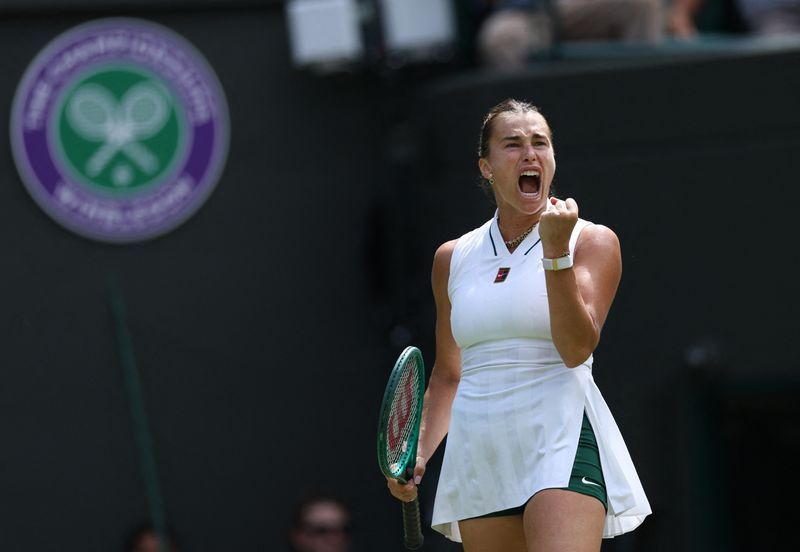
Aryna Sabalenka's continued struggle with Wimbledon's treacherous grass courts once again proved both her greatest vulnerability and her greatest asset on Wednesday, as the Belarusian world number one held her nerve to dispatch American McCartney Kessler 6-1 7-6(9) and progress to the third round of the tournament in London.
Sabalenka's temperament on grass has long been a subject of scrutiny, and her dominant first-set performance appeared to suggest she had finally mastered the surface's unique demands. The top seed stormed through the opening set with minimal resistance, imposing her powerful baseline game on an opponent struggling to find answers. Yet that commanding display would ultimately mask a far more complicated narrative that unfolded across the subsequent hour, one in which Kessler's resilience nearly derailed the Belarusian's bid to capture her first Grand Slam title on a surface other than hard courts.
The pivotal moment arrived when Kessler, who had entered the second round as the only player in the draw to have won her opening match without dropping a single game, surged to a 5-2 lead and appeared poised to force a decisive third set. The American had created genuine opportunities to seal the match, holding set points at 5-3 and subsequently reaching 5-4 in the subsequent tiebreak. Sabalenka's mounting frustration became visibly evident during this stretch, with the world number one repeatedly striking her thigh in anger after each unforced error, her body language reflecting the psychological toll that Wimbledon's grass invariably extracts from aggressive players.
Yet what distinguished Sabalenka's performance was her unwillingness to surrender, even when the match appeared to be slipping away. Rather than unraveling under pressure, she tapped into her reserves of experience and technical superiority, deploying the heavier weaponry that has defined her successful campaigns on faster courts. Each time Kessler threatened to seize control, Sabalenka found the depth and power necessary to neutralize her opponent's advantage, gradually reasserting her authority through sheer weight of shot and competitive hunger.
The culmination came in the tiebreak itself, where Kessler continued to demonstrate the shot-making prowess that had carried her through the early rounds without conceding a set. The American held set points at both 5-3 and again within the tiebreak's decisive moments, but Sabalenka's greater experience in high-stakes scenarios ultimately proved decisive. When the Belarusian finally converted her third match point to conclude proceedings after one hour and 39 minutes, it represented not merely a victory but a statement about her capacity to adapt and overcome adversity.
In her post-match remarks, Sabalenka acknowledged the intensity of Kessler's challenge and displayed the relief that accompanies narrow victories at the sport's most prestigious tournaments. She emphasized that Kessler had played with considerable aggression and precision throughout, forcing her to dig deep reserves of concentration and physical strength to prevail. The American's willingness to attack and her aggressive court positioning had made the second set particularly problematic for Sabalenka, who typically thrives when opponents surrender the baseline initiative.
This victory carries significance beyond the immediate scoreline. Sabalenka's pursuit of her first Grand Slam triumph away from hard courts has become increasingly important to her legacy, and Wimbledon represents the most elusive of her remaining objectives. The surface's unique playing characteristics reward technique and touch in ways that hard courts do not, and many observers have questioned whether Sabalenka's power-based approach could ever prove consistently effective on grass. Her survival of Kessler's determined assault suggests that she may be developing the tactical flexibility and mental resilience required to succeed at the All England Club.
The Belarusian's next opponent will be Latvia's Jelena Ostapenko, a player who also possesses formidable striking power and understands Wimbledon's demands intimately. That fixture promises another examination of Sabalenka's grass-court credentials, though her ability to overcome Kessler's challenge will have provided encouragement that she possesses the necessary adaptability to progress further in this tournament. Her journey toward that elusive non-hard-court Grand Slam title continues, but the manner in which she extracted herself from a precarious position against Kessler demonstrates that desperation and competitive instinct may yet prove as valuable as technical mastery on grass.

