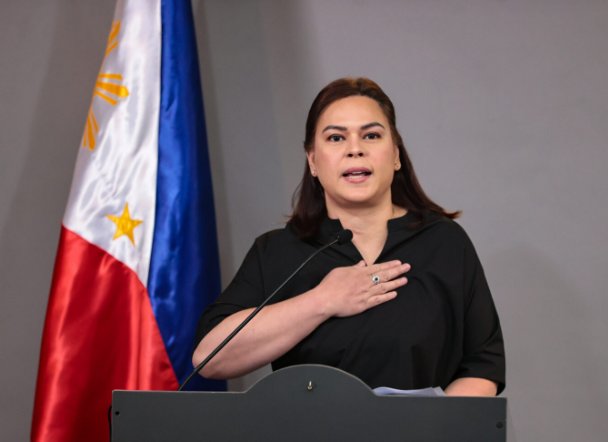
Vice President Sara Duterte intensified her assault on the Marcos administration on Tuesday, leveraging a major rally along Edsa to characterise public discontent as evidence of systemic failure under the current government. The Vice President's pointed remarks came as tens of thousands of Iglesia ni Cristo members assembled on the historic thoroughfare to protest what the religious organization characterised as selective application of justice and manipulation of the legal system, following announcements that Senator Rodante Marcoleta would face a plunder complaint.
Duterte framed the Edsa gathering as a manifestation of what she termed a "growing sentiment" that has animated her public criticism throughout 2024. Rather than viewing the rally as an isolated religious protest, she positioned it as evidence of broader popular disillusionment with Marcos administration policies. By connecting the INC's grievances to wider economic and governance concerns, Duterte constructed a narrative in which diverse groups across Philippine society are uniting in opposition to the current regime's direction and competence.
The Vice President's critique centered on the administration's alleged inability to tackle fundamental challenges confronting ordinary Filipinos. She specifically highlighted the persistence of inflation, widespread job precarity, and the relentless squeeze on household budgets that ordinary workers and families experience daily. This emphasis on material hardship resonates with longstanding criticisms of the Marcos presidency across Southeast Asia and the broader Global South, where governance legitimacy increasingly depends on demonstrable improvement in living standards and economic opportunity. Duterte's framing suggests that abstract policy debates matter far less than the everyday economic stress that defines millions of Filipinos' lives.
Crucially, Duterte accused the administration of responding to criticism with intimidation rather than substantive policy reform. She alleged that questioning alleged corruption within Malacañang, scrutinising the government's performance record, or raising allegations regarding the President himself have become risky exercises, met with official pressure designed to suppress rather than engage with dissent. This allegation—if substantiated—would represent a troubling departure from democratic norms and would echo concerns about democratic backsliding that regional analysts have flagged across parts of Southeast Asia in recent years.
The Vice President escalated her rhetoric by characterising the administration as presiding over an "increasingly oppressive political environment." She contended that a government responding to criticism through intimidation undermines the very democratic institutions it is constitutionally obligated to safeguard. This formulation transforms what might otherwise appear as partisan political conflict into a more fundamental challenge to democratic governance itself. For Malaysian observers, such rhetoric invokes familiar debates about the balance between executive authority and democratic accountability that periodically surface in regional political discourse.
Duterte's characterisation of Marcos as "detached" from the suffering experienced by ordinary citizens represents a pointed personal critique that goes beyond policy disagreements. This framing suggests not merely incompetence or misguided strategy, but a fundamental disconnect between the President and the population he governs. In the context of Philippine politics, where personalism and leadership character remain central to electoral calculations, such attacks on a leader's empathy and connection to common concerns carry substantial weight.
The Vice President's invocation of "honor of the State" and "the future of a people" elevates the dispute beyond immediate partisan competition. She positioned the conflict as fundamentally about national values and collective destiny rather than factional competition for power. This rhetorical move broadens her appeal beyond her traditional supporters and potentially resonates with broader constituencies concerned about the trajectory of Filipino democracy and society, regardless of their usual partisan alignment.
The timing of Duterte's statements carries particular significance given her ongoing impeachment proceedings. The House of Representatives has levelled multiple allegations against her, including purported threats directed toward the President and his wife, unexplained accumulation of wealth, and misappropriation of confidential funds. Her Senate trial is scheduled to commence on July 6, placing her remarks within a context of active political and legal struggle. This intersection of personal legal jeopardy and broader political critique creates complex dynamics that shape how various constituencies interpret her statements.
For regional observers, Duterte's deployment of the Edsa moment illustrates how political actors across Southeast Asia continue to draw on historical symbols and locations to legitimise their positions. Edsa carries profound symbolic weight in Philippine democratic history, evoking both the 1986 People Power Revolution that toppled Ferdinand Marcos Sr. and subsequent popular mobilisations. By situating her critique within this geography, Duterte implicitly invokes historical parallels and democratic memory that carry particular resonance for Filipino audiences familiar with these historical episodes.
The Vice President's characterisation of the issue as transcending partisan politics merits careful scrutiny. Her assertion that concerns about governance quality, economic performance, and democratic freedoms constitute matters of national rather than factional significance may resonate with constituencies experiencing genuine economic hardship. However, her positioning must be understood within the context of her own political vulnerabilities and the strategic considerations shaping her public statements during a period of significant personal and political challenge.
Moving forward, Duterte's escalating rhetorical offensive suggests she intends to transform her impeachment trial from a personal legal proceeding into a broader referendum on the Marcos administration's legitimacy and governance record. Whether this strategy will prove effective depends substantially on whether economic conditions improve, whether the administration can credibly address allegations of selective justice, and how broader segments of the Philippine electorate respond to competing narratives about governance quality and democratic values in the coming months.

