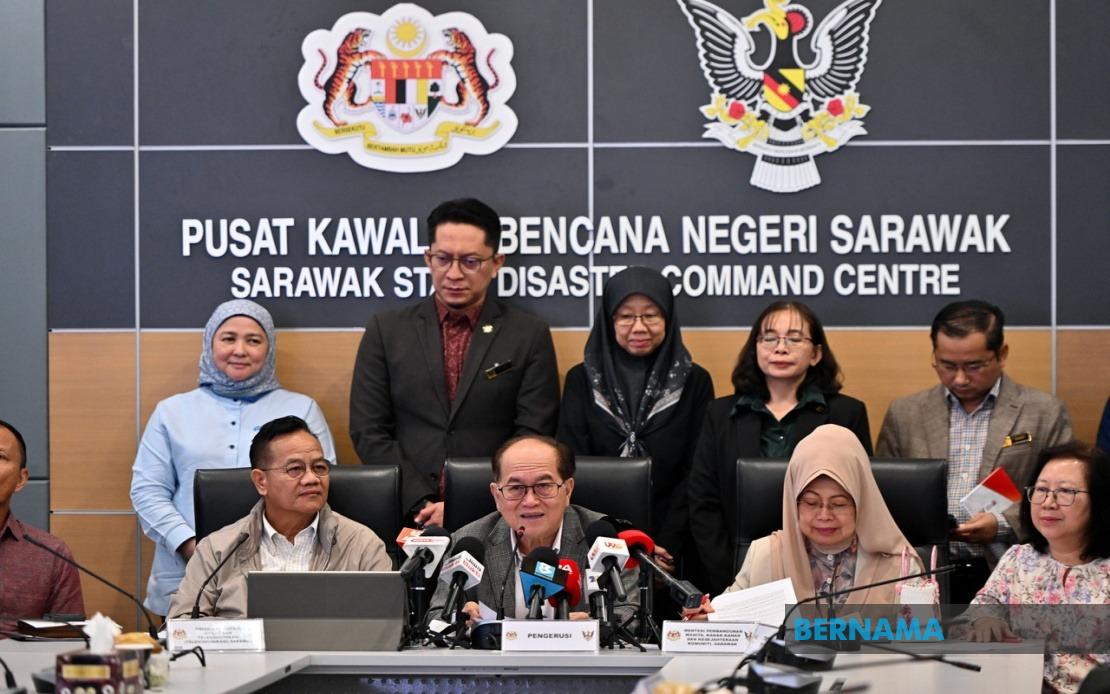
Sarawak's Deputy Premier Datuk Amar Douglas Uggah Embas has established a clear threshold for triggering emergency protocols in response to the deteriorating air quality that has plagued the state. An Air Pollutant Index reading of 500 will activate a formal declaration of emergency across the affected regions, marking the point at which the situation escalates beyond standard management procedures. This benchmark represents a critical decision point for state authorities, signalling the transition from routine environmental monitoring to crisis-level intervention requiring comprehensive shutdown of non-essential activities.
Once the emergency threshold is crossed, the Sarawak State Disaster Management Committee will escalate the matter to the National Disaster Management Agency in Kuala Lumpur for coordination at the federal level. This multi-tiered approach ensures that regional air quality crises receive appropriate attention through Malaysia's established disaster management framework. The transfer of authority to NADMA triggers standardised response protocols and mobilises federal resources that may exceed what state-level agencies can deploy independently. Uggah made these remarks after presiding over a session of the Sarawak State Disaster Management Committee, underscoring the formal nature of the decision and the institutional machinery now focused on managing the haze threat.
The anticipated emergency measures carry far-reaching implications for Sarawak's economy and daily life. Should an emergency declaration take effect, all government offices will cease normal operations, while private sector businesses must also close their doors in affected areas. The only activities permitted to continue are those classified as essential services, a category that typically includes healthcare, utilities, security, and food distribution. Such comprehensive shutdowns reflect the severity of air pollution at that level, where public health risks become so acute that maintaining business continuity would be inappropriate and potentially dangerous. The measure remains unprecedented in recent Sarawak history, making its application a significant constitutional and administrative event.
Uggah characterised the haze crisis as fundamentally a regional challenge demanding engagement through diplomatic and established institutional channels rather than unilateral action. He highlighted that cross-border air pollution originating from neighbouring territories requires coordinated responses involving multiple governments, a recognition that underscores the transnational nature of environmental degradation in Southeast Asia. The deputy premier indicated that JPBN has engaged Natural Resources and Environmental Sustainability Minister Datuk Seri Arthur Joseph Kurup, who serves as deputy chairman of the committee, to facilitate dialogue with Indonesian authorities through ASEAN mechanisms. This emphasis on proper channels and regional cooperation reflects the delicate diplomatic balance required when addressing environmental issues that implicate neighbouring countries.
The state's strategy relies on ASEAN's established frameworks for environmental cooperation and cross-border consultation, reflecting Sarawak's position within both Malaysia's federal structure and the broader Southeast Asian geopolitical landscape. By channelling concerns through ASEAN rather than pursuing bilateral confrontation, Sarawak positions itself as part of a collective regional response to shared atmospheric challenges. The state government's explicit commitment to continuing cooperation with federal authorities ensures that Sarawak's voice reaches Jakarta through Malaysia's national diplomatic apparatus, enhancing the authority and legitimacy of its advocacy. This layered approach acknowledges that Sarawak's direct influence over Indonesian policies is limited, but its position within Malaysia and ASEAN provides institutional pathways for raising concerns and negotiating responses.
Meanwhile, cloud seeding operations represent the state's more proactive measure to address both the immediate haze crisis and underlying water scarcity exacerbating the region's environmental stress. These operations are scheduled to commence on September 3 and continue through September 5, contingent on meteorological conditions proving favourable during that window. Rather than serving solely as a haze mitigation tactic, cloud seeding is framed as a multifaceted environmental intervention that simultaneously combats air pollution while replenishing critical water resources. This dual-purpose framing reflects Sarawak's recognition that the current crisis extends beyond air quality into broader resource security.
The state is contending with a prolonged dry spell that has depleted water reserves across four significant catchment areas: Simunjan, Lingga, Spaoh, and Lijok. These water supply systems are critical infrastructure supporting both urban populations and rural communities throughout Sarawak. The depletion of multiple catchment areas simultaneously suggests that the region faces a compound environmental crisis, where reduced rainfall has simultaneously worsened both air quality conditions and freshwater availability. Cloud seeding represents an attempt to address this compound challenge by artificially inducing precipitation that would improve air quality through moisture absorption and dust suppression while simultaneously restocking depleted reservoirs.
For Malaysian readers and policymakers, Sarawak's experience illustrates how climate variability and transnational air pollution intersect to create multi-dimensional crises affecting public health, economic activity, and water security. The API 500 threshold decision provides a clear metric by which Sarawak's population can understand the severity of air quality deterioration, transforming abstract pollution measurements into concrete policy outcomes. This transparency regarding emergency criteria represents a pragmatic approach to public communication about environmental hazards.
The broader implications extend throughout Southeast Asia, where similar haze episodes have historically affected multiple nations across land borders. Sarawak's coordination through federal and ASEAN channels exemplifies how regional states navigate environmental crises that respect no political boundaries. By emphasising diplomatic engagement and established protocols rather than unilateral escalation, Sarawak contributes to institutional precedents that may shape regional environmental governance for years to come. The state's willingness to deploy cloud seeding while simultaneously pursuing diplomatic solutions demonstrates the multifaceted approach increasingly necessary for addressing transnational environmental challenges in Southeast Asia's interconnected ecosystem.

