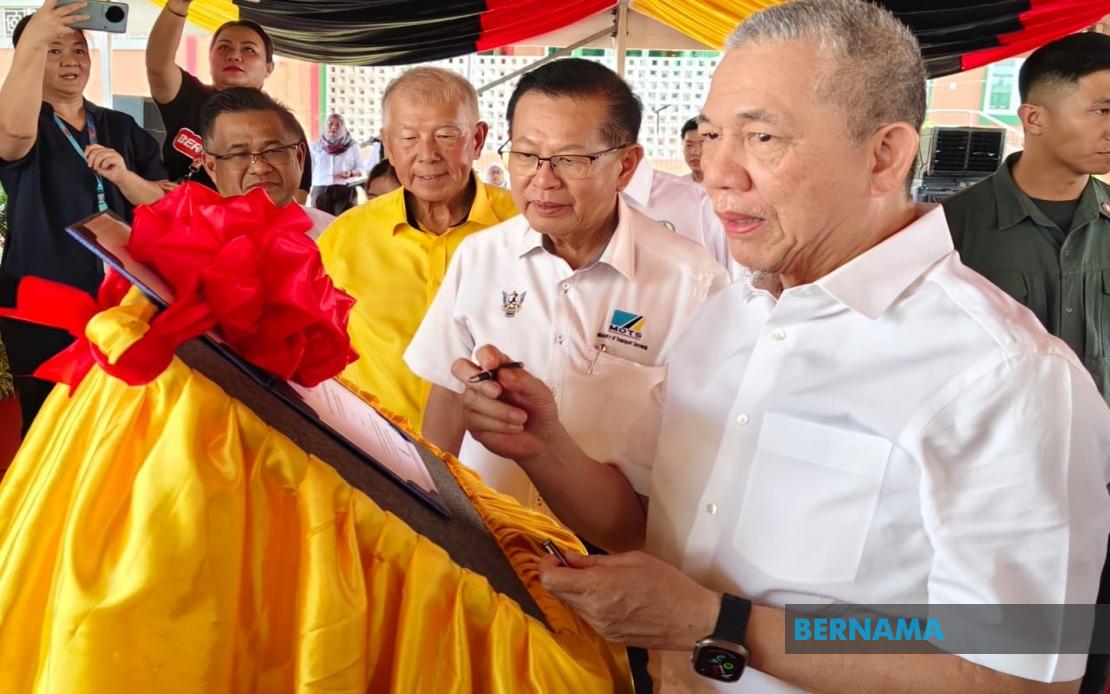
Deputy Prime Minister Datuk Seri Fadillah Yusof has unveiled an extensive initiative to tackle Sarawak's growing environmental challenges, with 52 projects under the Cakna MADANI Programme secured at a combined value of RM9.46 million for implementation this year. The portfolio addresses pressing concerns over coastal and riverbank erosion alongside the recurring threat of inundation that affects communities throughout the state, reflecting mounting pressure on authorities to protect both urban and rural settlements from hydrological hazards.
The initiative demonstrates varied implementation stages across its portfolio. Twelve of the approved projects have already reached completion, signalling momentum in execution. A further thirteen schemes are actively under construction, indicating sustained progress on multiple fronts. The remaining twenty-seven ventures remain in preliminary planning and design phases, suggesting a carefully managed rollout schedule that will extend benefits across the state over an extended timeframe. This staggered approach allows for lessons learned from initial phases to inform subsequent project designs and deployment strategies.
While visiting Miri to inspect one such undertaking, Fadillah highlighted three Cakna MADANI projects earmarked for the district. The Riverbank Stabilisation Project at the Tab Cinaq Cemetery in Miri District exemplifies the programme's tangible focus, with a budget allocation of RM134,682. Scheduled to commence in May and conclude by November, the initiative centres on constructing a fifty-metre retaining wall designed to reinforce the riverbank structure. Beyond mere erosion prevention, the wall serves the dual purpose of safeguarding the cemetery grounds and protecting critical infrastructure situated in adjacent areas, illustrating how targeted interventions can yield multiple community benefits simultaneously.
Fadillah, who concurrently serves as Energy Transition and Water Transformation Minister, contextualised these immediate measures within a broader strategic framework. He disclosed that twenty-nine comprehensive flood mitigation projects have received approval throughout Sarawak, commanding a substantially larger investment envelope of RM3.834 billion. This constellation encompasses the Flood Mitigation Plan, commonly abbreviated as RTB, alongside High Priority Flood Mitigation initiatives coded as TBBT, coastal erosion countermeasures, and river conservation endeavours. The scale of this longer-term commitment underscores governmental recognition that durable solutions to Sarawak's water-related vulnerabilities demand sustained financial and technical commitment beyond immediate remedial action.
The composition of these twenty-nine projects reveals a mixed portfolio strategy. Eighteen are continuation ventures representing extensions of previously initiated schemes, collectively requiring RM3.567 billion to complete. Eleven additional projects classified as new initiatives carry a combined cost of RM267 million, indicating that authorities maintain capacity to launch innovative approaches while consolidating existing commitments. This balance between consolidation and expansion allows the government to leverage institutional knowledge from ongoing work while addressing newly identified problem areas.
Among the continuation initiatives, the RTB Sungai Miri occupies particular prominence, commanding RM31 million in total outlay. Construction mobilised in October 2023, and as of the deputy prime minister's statement, physical progress had advanced to 58.11 per cent completion. The anticipated finish date of November 2026 suggests a three-year construction window, a duration typical for riverine mitigation infrastructure of this scale. Such extended timelines reflect the complexity inherent in major hydraulic engineering projects that must navigate environmental considerations, geological constraints, and seasonal working windows characteristic of equatorial regions.
For Malaysian and Southeast Asian observers, Sarawak's experience carries broader relevance. The state confronts environmental pressures increasingly common across the region—coastal erosion driven by subsidence and sea-level rise, riverine flooding exacerbated by upstream land-use change and intensifying rainfall events, and infrastructure vulnerability in settlements that historically developed without comprehensive drainage planning. Sarawak's dual-track approach, combining immediate stabilisation measures with long-term systemic mitigation, offers a template that neighbouring jurisdictions might study as they formulate their own climate adaptation strategies.
The Cakna MADANI Programme itself represents a policy innovation worthy of examination. By explicitly targeting disadvantaged and vulnerable communities through a dedicated fund, the initiative embeds equity considerations into infrastructure allocation. This contrasts with approaches that distribute resources principally according to administrative or political boundaries, potentially concentrating benefits in already-privileged areas. Southeast Asian governments grappling with uneven development and climate vulnerability may find instructive lessons in how Malaysia structures such programmes to ensure equitable exposure to risk-reduction investments.
Implementation mechanics also merit scrutiny. The distribution across completion, active construction, and pre-implementation stages suggests a calibrated approach to project lifecycle management. Rather than announcing all initiatives simultaneously and risking execution bottlenecks, the staggered introduction allows governments to maintain quality oversight, respond to technical challenges, and adjust subsequent phases based on field experience. For regions facing capacity constraints in project supervision and technical expertise, this methodical sequencing represents a pragmatic middle path between ambitious targets and realistic delivery capacity.
Sarawak's vulnerability to water-related disasters stems from geography as much as development patterns. Situated on Borneo's northern coast with numerous river systems draining toward the sea, the state experiences monsoon-influenced rainfall patterns that generate acute seasonal flood risk. Simultaneously, extensive peatland areas characteristic of coastal Sarawak suffer physical subsidence, exacerbating relative sea-level rise and necessitating continuous investment in protective infrastructure. Communities in such settings face perpetual adaptation demands that static infrastructure alone cannot indefinitely address, requiring integrated approaches spanning engineering, land-use planning, and disaster preparedness.
The financial commitment registered by these initiatives—RM9.46 million for immediate Cakna MADANI interventions and RM3.834 billion for broader mitigation—appears substantial yet warrants contextualisation. Distributed across Sarawak's sprawling geography and diverse settlement patterns, unit costs per protected community member remain modest, suggesting that further resource mobilisation will likely prove necessary as climate change intensifies precipitation extremes and accelerates coastal dynamics. Federal and state budgetary frameworks will face mounting pressure to sustain such spending indefinitely, potentially crowding out other development priorities unless fiscal capacity expands correspondingly.
Stakeholder coordination across administrative levels represents an underappreciated dimension of successful implementation. Flood mitigation requires alignment between federal authorities overseeing major rivers, state governments controlling land use and local infrastructure, and municipal administrations responsible for drainage and community services. Sarawak's project portfolio necessarily involves negotiation among these layers, a coordination challenge that distinguishes water management from many other policy domains. Transparent communication regarding project sequencing, benefit distribution, and maintenance responsibilities can either facilitate or obstruct effective collaboration.
Looking forward, Sarawak's experience suggests that climate vulnerability in tropical developing economies demands sustained, multi-year commitment combining engineering infrastructure with ecosystem conservation and community preparedness. The twenty-nine flood mitigation projects, extending to 2026 and beyond, reflect recognition that durability requires patience and persistence alongside adequate resourcing. For Malaysia and the broader Southeast Asian region confronting intensifying environmental pressures, such long-term thinking merits emulation even as political cycles tempt shorter time horizons and quicker results.

