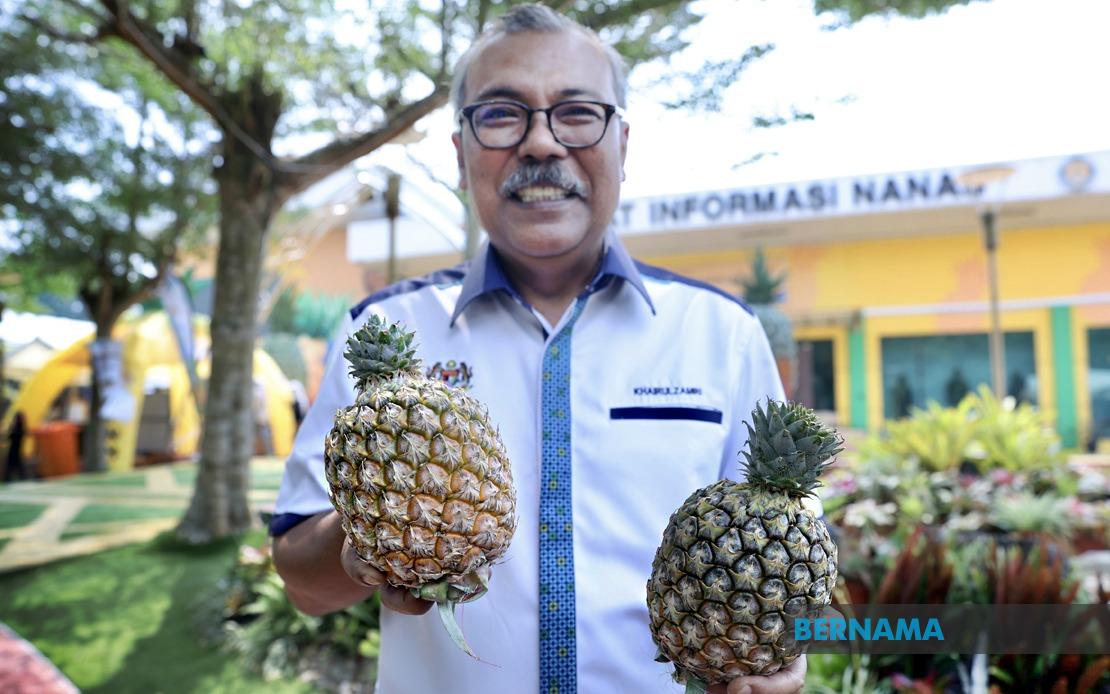
A newly developed pineapple variety from Sarawak is drawing significant attention at the Malaysia Agriculture Expo Park in Serdang, where MAHA 2026 is currently underway. The Sarawak Gold (SG1) pineapple represents a potentially transformative development for domestic cultivation and regional agricultural competitiveness, with the Malaysian Pineapple Industry Board backing its commercialisation across Peninsular Malaysia and beyond.
Seven tonnes of the SG1 variety have been transported to the expo's Laman Nanas section, offering visitors their first widespread encounter with what the industry board describes as a premium offering with distinctive sensory characteristics. According to Malaysian Pineapple Industry Board director-general Mohd Khairuzamri M. Salleh, the variety was first identified and developed in Miri, reflecting Sarawak's growing role in agricultural innovation within Malaysia's wider commodity sector. The shipment underscores confidence in the variety's market viability and represents a strategic effort to build consumer awareness ahead of wider commercial rollout.
The SG1 distinguishes itself through several agronomic and commercial advantages that address longstanding constraints in Malaysian pineapple farming. Its sweetness profile competes directly with the widely planted MD2 variety, a global benchmark, while its visually striking rose-shaped crown offers distinctive branding potential in competitive export markets. Quality and flavour consistency throughout the fruit itself—a feature Salleh emphasised—addresses quality concerns that can undermine market confidence. Yet perhaps most significantly, the variety achieves commercial maturity in approximately nine months, substantially shorter than the fourteen-month timeline required for MD2 cultivation. This accelerated production cycle directly enhances farm economics by increasing the frequency of harvests per land area and improving cash flow for growers operating on tighter margins.
Planting density represents another dimension where SG1 outperforms conventional varieties and opens new productivity pathways for Malaysian farms. The variety tolerates exceptionally high density of between 25,000 and 30,000 plants per acre, a substantial increase over traditional spacing requirements. For growers operating within geographic or land-tenure constraints—a common situation across Peninsular Malaysia and Sarawak—this density advantage translates directly into higher yields without requiring additional land acquisition or long-term lease extensions. This efficiency gain holds particular relevance for smallholder and mid-sized operations that dominate Malaysia's pineapple sector and operate within tight capital constraints.
The industry board has already initiated expansion activities to introduce SG1 cultivation across Peninsular Malaysia, with seedling distribution to growers anticipated to commence within the coming year. This timeline reflects careful planning to build supply chains, establish nursery capacity, and develop farmer familiarity with the variety's specific agronomic requirements before widespread adoption. The structured approach mirrors standard industry practice for new crop introductions and suggests confidence that regional growing conditions will support the variety's performance characteristics established in Sarawak's tropical environment.
International market development activity has already commenced through trial shipments to Singapore, which have reportedly demonstrated commercial viability and confirmed the variety's suitability for regional distribution networks. Singapore's status as a high-value market and regional trading hub makes it a logical testing ground for validating export processes, shelf-life performance, and consumer acceptance among affluent urban consumers. Beyond Singapore, Mohd Khairuzamri indicated that the variety's robust characteristics position it favourably for penetration into more distant but significantly larger markets including China and New Zealand. Success in these territories would represent a substantial competitive achievement, particularly in China where fierce competition from established suppliers and strict quality protocols create formidable barriers to entry.
The broader context for SG1's introduction encompasses a deliberate industry pivot toward value-chain expansion and market diversification. MAHA 2026's Laman Nanas section has adopted the thematic framework "Value Creation for Food Security," reflecting institutional recognition that the pineapple sector's future depends less on volume expansion alone and more on maximising economic returns across multiple product streams. The messaging concept "one planting, three harvests" encapsulates this approach by highlighting the extractable value inherent in every aspect of pineapple cultivation from fruit itself through seeds to processed plant biomass.
Waste streams and secondary products represent underexploited value opportunities within Malaysia's pineapple industry. Plant matter and processing residues can be converted into ruminant feed, supporting the country's growing livestock sector while reducing disposal costs and environmental burden. Fibre extraction enables textile and apparel production, positioning Malaysian pineapples within emerging sustainability-focused fashion markets increasingly demanding alternative materials. Paper and packaging applications open further commercial pathways. These cascading value propositions represent a deliberate strategy to enhance farm-gate returns and differentiate Malaysian pineapple products from commodity-priced competitors within Southeast Asia and globally.
The timing of SG1's introduction coincides with MAHA 2026's expanded scale and reach, which is attracting some two thousand exhibitors and projecting visitor numbers exceeding four million across its August 28 to September 6 operational window. This platform provides unprecedented visibility for a newly commercialised variety, enabling direct consumer sampling and immediate industry networking with growers, traders, exporters, and buyers across the supply chain. The expo environment permits collaborative discussion of adoption pathways, investment requirements, and market positioning that would prove logistically difficult to coordinate through alternative channels.
For Malaysian growers confronting intensifying regional competition from Thailand, Vietnam, and Philippines suppliers, the SG1 variety offers a tangible competitive instrument. Faster harvest cycles, higher planting density, and distinctive quality characteristics provide leverage for premium pricing and market differentiation strategies that can partially offset labour cost disadvantages relative to lower-wage regional competitors. The variety's export track record, even in trial form, signals to both domestic and international buyers that Malaysia remains an innovator within tropical agriculture rather than a marginal or declining producer. This perception shift holds strategic importance as Malaysia seeks to position itself within higher-value agricultural niches rather than competing primarily on cost within commodity-based production frameworks that increasingly favour lower-cost jurisdictions.

