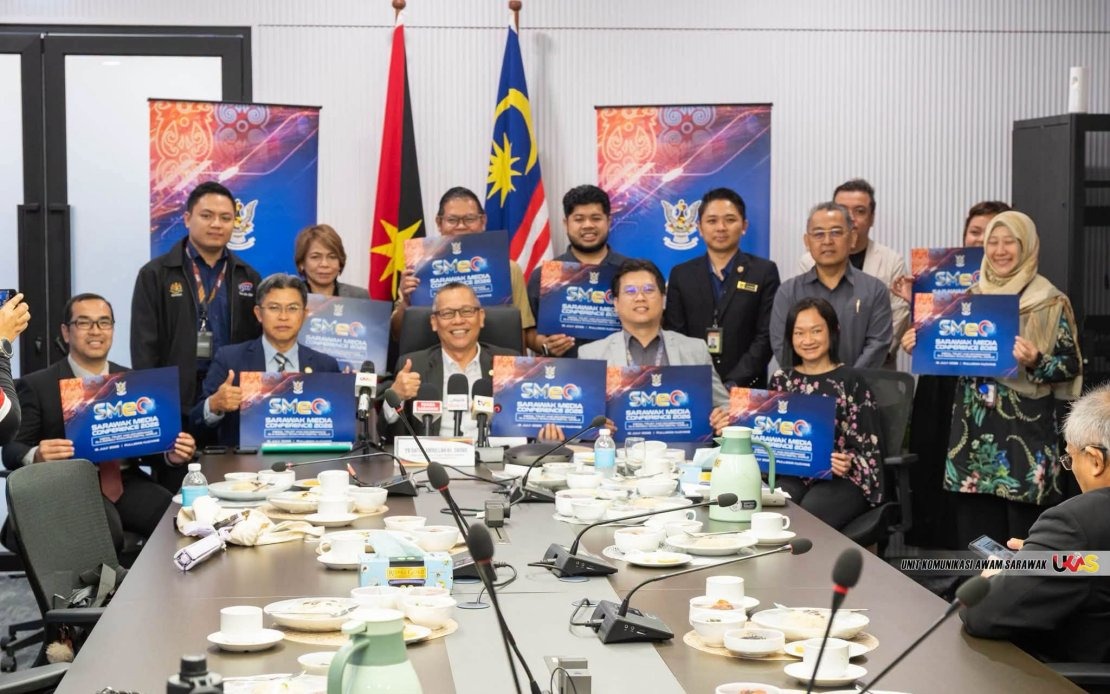
The Sarawak Government is preparing to host a significant gathering of media and communications stakeholders as the Sarawak Media Conference (SMeC) 2026 prepares to convene its participants. Scheduled for Thursday in Kuching, the conference will bring together approximately 800 attendees from diverse backgrounds including practising journalists, university researchers, government officials, corporate representatives and university students. Sarawak Premier Tan Sri Abang Johari Tun Openg will formally open the proceedings, underlining the state administration's commitment to engaging with pressing issues within the media landscape.
The initiative, coordinated by the Sarawak Public Communications Unit (UKAS) under the state government's direction, represents a deliberate effort to create a platform for substantive dialogue around the intersection of media credibility, institutional responsibility and technological disruption. According to Datuk Abdullah Saidol, Deputy Minister in the Sarawak Premier's Department overseeing corporate affairs and communications, the conference operates under the overarching theme of "Media, Trust and Governance in a Rapidly Evolving Digital World." This framing reflects growing regional and global concerns about how news organisations and media institutions can maintain public confidence while adapting to rapid technological change.
The agenda will prioritise two interconnected objectives. First, participants will examine mechanisms for rebuilding and sustaining public trust in media organisations at a time when misinformation and polarised narratives threaten institutional legitimacy. Second, the conference will provide a venue for examining how artificial intelligence, digital platforms and emerging communication technologies reshape journalistic practice, newsroom management and audience engagement. Abdullah indicated that discussions will extend to reinforcing ethical standards within journalism, suggesting that technical innovation alone cannot address the sector's credibility challenges without parallel commitments to professional integrity.
The speaker roster reflects the calibre of expertise the organisers intend to bring to bear on these questions. SOL Digital founder Lunnie Gan and Malaysian Media Council deputy chairman Premesh Chandran represent significant voices within Malaysia and Southeast Asia's media reform movement. Their participation signals that SMeC 2026 is positioned not merely as a Sarawak-specific event but as a gathering with relevance across the broader Malaysian and regional media ecosystem. The inclusion of both industry innovators and institutional guardians suggests a balanced approach that neither romanticises technological disruption nor retreats into defensive nostalgia for pre-digital media models.
Beyond the conference sessions themselves, the event's architecture incorporates ceremonial and recognition elements designed to affirm professional contributions to journalism in Sarawak. The evening programme will integrate the Sarawak-level National Journalists' Day (HAWANA) 2026 celebration, creating a single occasion that honours both the profession and the issues facing the industry. Deputy Prime Minister Datuk Seri Fadillah Yusof's attendance at the dinner component indicates federal-level support for Sarawak's media development initiatives and suggests the conference holds significance within national media policy conversations.
The Sarawak Premier's Special Appreciation Awards constitute a formal recognition mechanism spanning five categories: Editor/Journalist/Stringer, Photographer, Videographer, Radio News Presenter/Broadcaster and Social Media Influencer. This taxonomy reveals evolving understandings of journalism within the state government's perspective. The explicit inclusion of social media influencers alongside traditional broadcast and print journalists acknowledges that contemporary information dissemination and public communication occur across multiple platforms and through diverse content creators. For Malaysian news organisations and journalists accustomed to traditional demarcations between professional journalists and social media participants, this recognition signals shifting institutional boundaries.
For Malaysia's media sector, SMeC 2026 arrives at a consequential moment. The nation's media environment faces sustained pressure from declining newspaper circulation, fragmenting audiences, digital platform dominance, and ongoing questions about editorial independence and ownership concentration. Regional counterparts in Thailand, Indonesia and the Philippines confront similar pressures. By assembling academics, practitioners and policymakers to examine these challenges collaboratively, Sarawak positions itself as contributing substantively to regional media governance conversations rather than treating media issues as peripheral to development priorities.
The conference's emphasis on trust and governance also reflects Malaysia's specific political context. Public confidence in media institutions varies considerably across different demographic and ideological segments. Questions about whether news outlets adequately represent diverse communities, whether journalistic investigations receive legal protection, and whether media ownership structures create conflicts of interest remain contested. A conference addressing these governance dimensions directly rather than avoiding them suggests an administration willing to engage with structural media sector questions.
The artificial intelligence component deserves particular attention for Malaysian stakeholders. As newsrooms across the country experiment with AI-assisted reporting, automated content generation and algorithmic news selection, the ethical and professional implications remain incompletely understood. SMeC 2026 appears positioned to advance this conversation beyond technological enthusiasm to examine how AI implementation affects journalism's accountability functions, editorial judgment and the relationship between news organisations and audiences. For Malaysian journalists and editors facing AI adoption decisions, exposure to peers' experiences and expert perspectives could prove valuable.
The scope of participation—spanning students, academics, practitioners and policymakers—indicates recognition that media sector transformation requires engagement across educational, professional and governmental domains. Students who attend will form cohorts of future journalists and communications professionals with exposure to contemporary debates about media credibility and digital transformation. Academic participants can translate conference insights into research agendas and curriculum development. Policymakers gain ground-level understanding of practitioner concerns, potentially informing regulatory frameworks governing media operations and digital communications.
Sarawak's initiative to host this substantial conference reflects the state's broader positioning within Malaysia's media landscape. As a relatively large state with distinct political dynamics, economic interests and social composition, Sarawak's media sector merits dedicated attention to challenges that national forums may inadequately address. The conference model also allows exploration of how media governance approaches might vary appropriately across Malaysian states while maintaining professional standards and ethical commitments.
As the conference prepares to convene, the gathering represents more than a networking occasion. It constitutes a structured intervention into conversations about media credibility, technological change and institutional adaptation that Malaysian journalists, news organisations and policymakers cannot avoid. Whether discussions translate into concrete reforms, revised professional practices or policy modifications remains uncertain, but the decision to assemble these stakeholders around shared concerns demonstrates commitment to treating media sector development as a legitimate governance priority worthy of sustained, systematic attention.

