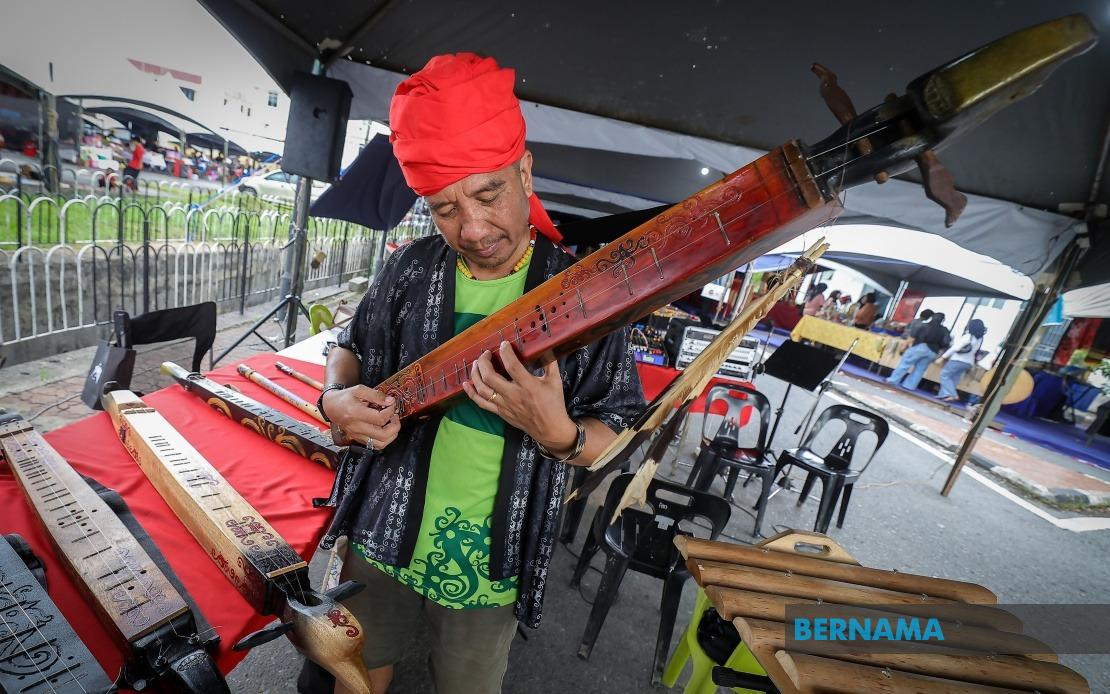
Sarawakian musician Rining Peter Paris has stepped beyond his earlier catalogue of nature-inspired compositions to address a cultural gap he identified within his own community. The 53-year-old artist, through his band Bata' Uduh, released 'Sigar Suba' on July 1, a world music fusion single designed to celebrate the masculine identity and heritage of the Lun Bawang people. This departure from previous works such as 'Busak Baku' and 'Busak Elai'—which predominantly explored feminine aesthetics and natural imagery—reflects a deliberate curatorial choice to ensure male cultural narratives receive equal artistic attention and preservation.
The genesis of 'Sigar Suba' emerged from Rining's observation that the musical landscape of Lun Bawang culture had become imbalanced. He recognised that songs celebrating women and their beaded ornaments dominated community repertoires, while representations of male cultural identity remained conspicuously underrepresented. This realisation prompted him to compose a track entirely in the Lun Bawang language that would serve as both artistic expression and cultural documentation. The title itself carries symbolic weight: 'sigar' refers to the distinctive red head covering worn by Lun Bawang men during significant celebrations, while 'suba' means red, together forming a descriptor of this iconic ceremonial headpiece.
Musically, 'Sigar Suba' operates as a sophisticated integration of heritage and contemporary sound. The single showcases the Tapi', a two-stringed plucked instrument of considerable cultural significance to the Lun Bawang community, alongside the Pek Bu, Ruding, and xylophone. By anchoring these traditional instruments within modern world music and fusion frameworks—particularly incorporating reggae influences—Rining and Bata' Uduh have crafted a sonic bridge between ancestral traditions and contemporary listening preferences. This approach addresses a perennial challenge facing indigenous musical preservation: maintaining cultural authenticity whilst ensuring younger generations find the material genuinely engaging rather than merely obligatory.
The song's lyrical content functions as a detailed ethnographic account rendered in artistic form. Rather than abstract celebration, 'Sigar Suba' specifically names and describes elements of traditional male Lun Bawang ceremonial dress, including the kuyu talun, a bark garment, the pelepet, a traditional machete, and distinctive tusk ornaments that carry cultural significance. This documentary quality—embedding cultural knowledge within musical narrative—serves a preservation function that extends beyond entertainment. Each lyrical reference maintains specific terminology and contextual information that might otherwise be lost as community practices evolve across generations.
Rining's investment in Lun Bawang cultural preservation extends considerably beyond this single release. Over nearly a decade, he has dedicated substantial effort to the Tapi' instrument specifically, functioning not merely as a performer but as an instrument maker. This dual role as both artist and craftsperson distinguishes his contribution to heritage preservation. He has personally constructed and marketed 66 handmade Tapi' instruments, with distribution reaching beyond Malaysia into Australia, the United States, and Canada. This international reach has introduced the instrument to global world music audiences and collectors, providing economic sustenance for the craft whilst elevating its profile internationally.
The commercial viability of Rining's handcrafted instruments demonstrates that indigenous cultural products can find genuine international markets when presented with quality and authenticity. Malaysian experimental musician Belle Sisoski's interest in the Tapi' exemplifies how the instrument attracts attention from serious contemporary musicians regardless of cultural background, suggesting that traditional forms possess intrinsic artistic merit that transcends community boundaries. This broader appeal simultaneously serves the preservation agenda; greater demand creates economic incentive for younger community members to learn instrument-making, thereby transmitting technical knowledge intergenerationally.
Rining's strategic articulation of his intentions reveals thoughtful long-term planning around cultural stewardship. He has explicitly identified 2028 as a target date by which he hopes to transition toward full-time engagement with Tapi' making and musical composition. This temporal specificity suggests deliberate career trajectory planning, moving from balancing creative work with other occupations toward complete professional dedication to heritage arts. Such transitions require not only personal commitment but also economic stability and community recognition, all of which his established reputation and instrument sales appear to be providing.
The availability of 'Sigar Suba' across major streaming platforms represents a critical modernisation of cultural transmission methods. Where previous generations of Lun Bawang cultural materials might have circulated through limited cassette distributions or live performance contexts, Rining's music now occupies the same digital infrastructure as contemporary global pop music. This strategic positioning ensures that Lun Bawang youth searching for cultural connection online encounter their own heritage through familiar technological channels rather than perceiving traditional culture as existing outside contemporary digital spaces.
For the Lun Bawang community specifically, 'Sigar Suba' functions as aspirational projection. Rining's stated hope that younger Lun Bawang men will eventually adopt and perform the song suggests a vision of cultural continuity wherein heritage becomes internalized identity expression rather than external obligation. This subtle distinction matters considerably; when young people choose to perform and share their own cultural materials as authentic self-representation, preservation occurs organically rather than through top-down institutional effort. Rining positions himself as facilitating this organic transition by creating artistically compelling entry points.
Within the broader Southeast Asian context of indigenous cultural preservation, Rining's work illustrates how individual artists can address complex heritage challenges through creative practice. Malaysia's diverse indigenous populations face similar pressures toward cultural homogenization and intergenerational disconnection, yet scattered throughout regions like Sarawak exist practitioners like Rining who employ contemporary artistic tools to keep traditions vital. His integration of reggae fusion with Tapi' performance suggests that cultural preservation need not mean static reproduction of historical forms, but rather dynamic evolution that maintains essential identity markers whilst engaging contemporary aesthetics.
The implicit message embedded within 'Sigar Suba' carries significance beyond the Lun Bawang context. By deliberately centering male cultural identity through artistic production, Rining challenges assumptions about which community narratives merit documentation and celebration. This gender-conscious approach to cultural preservation demonstrates sophisticated understanding of how heritage narratives become constructed and transmitted. His recognition that feminine imagery had achieved disproportionate representation prompted intentional rebalancing, suggesting that sustainable cultural preservation requires critically examining whose stories receive artistic attention.

