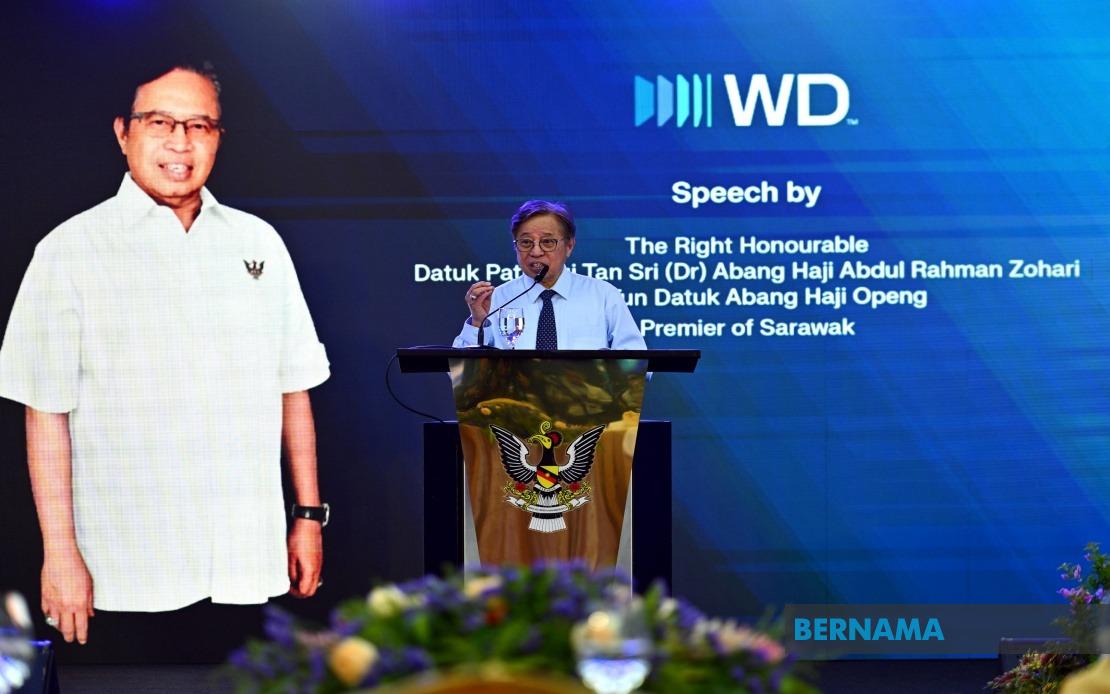
Sarawak's willingness to accept an increase in its constitutionally-mandated special grant hinges entirely on the federal government's ability to afford it, according to Premier Tan Sri Abang Johari Tun Openg. Speaking after attending a Western Digital programme in Kuching on July 2, he made clear that while the state welcomes improved funding arrangements, it recognises the broader fiscal constraints facing Putrajaya. This measured stance reflects a pragmatic approach to the longstanding negotiations over federal-state finances that have periodically dominated relations between Kuala Lumpur and Sarawak since Malaysia's formation.
The Article 112D provision of the Federal Constitution establishes Sarawak's entitlement to a special grant from the federal government, a mechanism that has remained contentious as the state's development needs have evolved. Abang Johari's conditional acceptance signals neither confrontation nor unrealistic demands, instead suggesting a recognition that Malaysia's broader fiscal health must be balanced against regional aspirations. His comments follow earlier statements by Prime Minister Datuk Seri Anwar Ibrahim to Parliament on June 30, in which the premier assured lawmakers that discussions on Sarawak's grant were proceeding in line with the spirit and commitments embodied in the Malaysia Agreement 1963.
The Premier noted that substantive negotiations have not yet occurred, though the matter has been mentioned in general conversation during his recent engagement with Anwar in Bintulu. This distinction between formal discussions and informal acknowledgement underscores the preliminary nature of these talks. Neither Sarawak nor the federal government appears positioned for imminent breakthrough on a concrete increase, yet the willingness to keep the matter under review suggests neither side has shelved the issue. For Malaysian policymakers tracking federal-state relations, this cautious optimism represents a more stable negotiating climate than has characterised certain periods in recent history.
The context of Sarawak's openness becomes clearer when examined alongside the state's broader economic vision. Beyond the immediate question of federal transfers, Abang Johari articulated a compelling narrative about Sarawak's future prosperity rooted in technological advancement rather than traditional resource extraction. The state's three-decade partnership with Western Digital exemplifies this pivot. The technology giant's continued investment in advanced data storage solutions manufactured in Sarawak, particularly glass substrate-based recording technology, represents precisely the kind of high-value industrial activity that generates economic resilience and employment opportunities.
Sarawak's competitive advantages in attracting such investment are multifaceted and substantial. The state possesses abundant renewable energy resources—hydroelectric capacity being particularly significant—and extensive freshwater reserves, both critical inputs for data centre and advanced manufacturing operations. In an era when artificial intelligence infrastructure demands vast computational resources and correspondingly massive electricity consumption, these natural endowments confer genuine strategic value. The Premier's assertion that data will supersede oil as a wealth generator reflects not merely optimism but recognition of genuine structural economic shifts reshaping global industries.
The glass substrate technology that Western Digital develops in Sarawak represents a concrete example of how manufacturing excellence can drive economic diversification. Unlike conventional magnetic storage media, glass substrates enable dramatically higher data density, permitting the expansion of artificial intelligence-powered infrastructure that increasingly underpins global commerce, research, and governance. This technological frontier offers Sarawak an opportunity to evolve from commodity producer to advanced manufacturer, a transition that would fundamentally alter the state's long-term prosperity trajectory and reduce vulnerability to commodity price fluctuations.
For Malaysian observers, Sarawak's positioning within the broader regional technology ecosystem carries implications beyond state boundaries. Southeast Asia's emergence as a significant hub for semiconductor manufacturing, data centre development, and advanced electronics production depends partly on the availability of enabling infrastructure and talent. Sarawak's water and energy advantages position it as a potential cornerstone of regional technological capacity-building, complementing Malaysia's broader industrial strategy. Investments here contribute to Asean's collective resilience and competitiveness in global technology markets.
The measured tone of Abang Johari's comments also reflects political calculation regarding federal-state relations more broadly. In recent years, Sarawak has reasserted its distinctive position within Malaysia's federation, balancing affiliation with the Pakatan Harapan-led federal government against preservation of local political autonomy and economic interests. The state's substantial parliamentary representation, derived from its sizeable population and geographical extent, provides it with genuine leverage in national affairs. By avoiding inflammatory rhetoric whilst maintaining that increased grants remain desirable, the Premier sustains pressure on Putrajaya without poisoning the negotiating atmosphere.
The reference to the Malaysia Agreement 1963 carries particular significance for understanding Sarawak's constitutional position. That foundational agreement established the basis for Sarawak's entry into the Malaysian federation and incorporated protections for state autonomy in matters including internal security, immigration, and religious affairs. Article 112D itself represents one of several constitutional mechanisms reflecting Sarawak's distinctive status. When Prime Minister Anwar invokes MA63 in discussing the special grant, he signals federal acknowledgement of these historical commitments, even as questions persist about their full implementation across multiple policy domains.
Looking forward, the trajectory of negotiations on Sarawak's special grant may depend significantly on the broader federal fiscal environment. Malaysia's debt levels, revenue volatility, and competing budgetary demands will constrain Putrajaya's capacity to increase transfers to states. Economic recovery from pandemic-related disruptions, the trajectory of commodity prices affecting government revenues, and demands for infrastructure investment nationwide will all influence federal finances. Sarawak's pragmatic stance—welcome to improvement if affordable, understanding if not—positions the state reasonably well for negotiations regardless of how these macroeconomic factors unfold.
The state's genuine emphasis on technological development and private sector investment offers a complementary avenue to improved prosperity that need not depend entirely on federal transfers. Western Digital's continued expansion in Sarawak, alongside broader development of the technology sector, potentially generates tax revenues, employment, and economic dynamism that can benefit the state regardless of federal grant levels. This diversification of revenue sources and economic drivers represents the most sustainable path to Sarawak's long-term development, transcending the periodic cycles of federal-state fiscal negotiation that have characterised Malaysian federalism since 1963.

